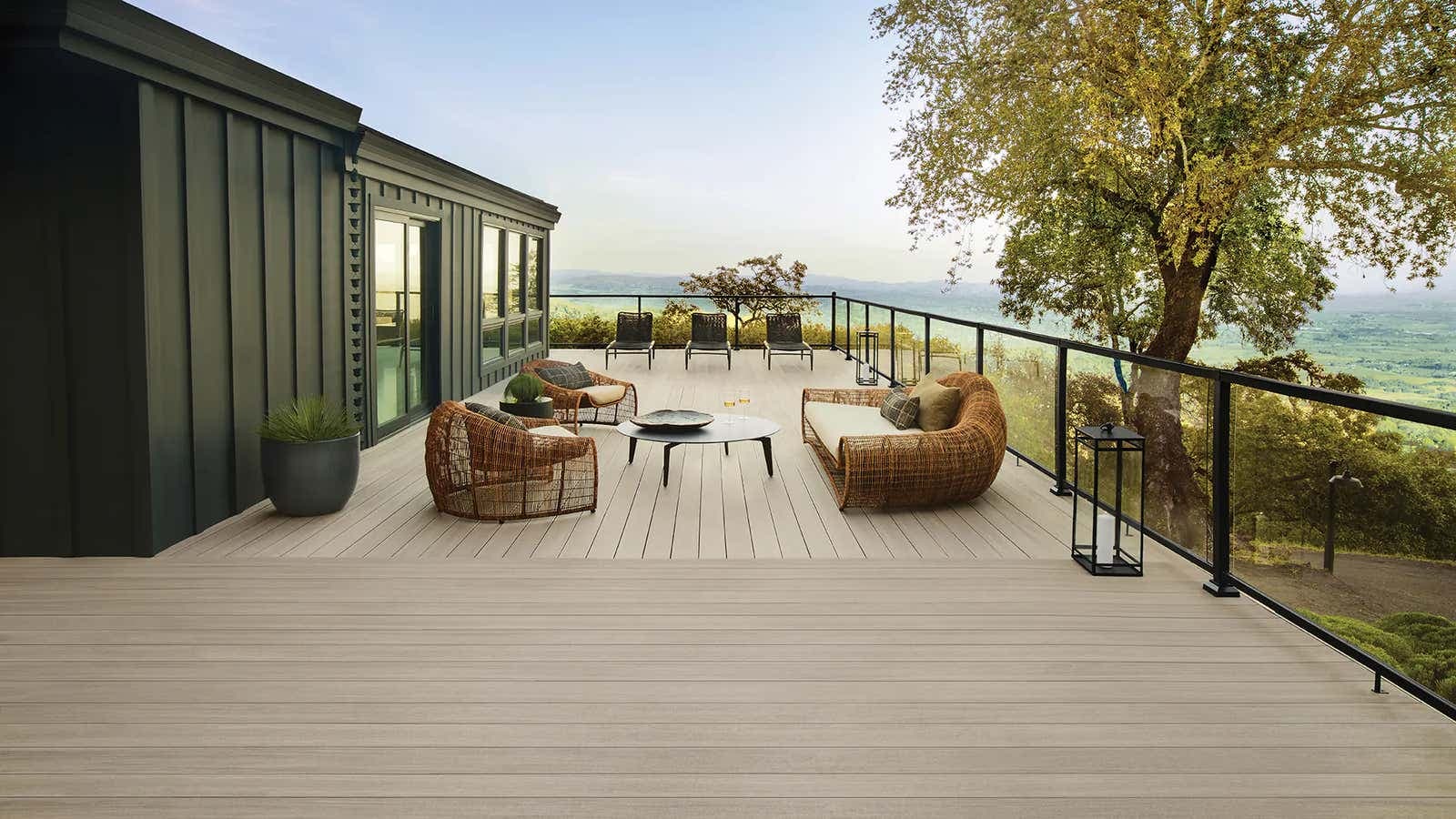
Understanding TimberTech Fascia and Risers
TimberTech offers dedicated fascia boards designed to cover the rim joists of your deck frame. These boards are typically thinner than standard deck boards, making them ideal for vertical applications where structural load-bearing is not required. Fascia provides a clean, finished edge to the deck, hiding the substructure from view. They are available across all TimberTech lines: Azek, Pro, and Edge.
In addition to fascia, TimberTech also offers riser boards. While similar in appearance, risers are specifically intended for stair applications, covering the vertical face of each stair step. Both fascia and risers are designed to complement the aesthetic of the main deck boards, ensuring a consistent look throughout your project.
Matching or Contrasting Colors
One of the primary decisions when selecting fascia is whether to match the color of your main deck boards or choose a contrasting shade. TimberTech offers a consistent color program across its product lines, meaning you can often find fascia in colors that directly correspond to your chosen deck board color. This creates a monochromatic and seamless appearance.
Alternatively, selecting a contrasting fascia color can add visual interest and define the deck's perimeter. For instance, a lighter fascia might highlight the deck's outline against a darker main deck, or vice versa. This design choice can be particularly effective for decks with picture-frame borders, where the fascia can tie into the border color for a unified look. Consider ordering physical samples to see how different color combinations appear in your project's lighting.
Fascia Board Profiles and Dimensions
TimberTech fascia boards typically come in a specific profile distinct from the main deck boards. While standard deck boards are often 1 inch by 5.5 inches, fascia boards are generally thinner, often around 0.75 inches thick, to minimize weight and allow for easier installation on vertical surfaces. They are designed to cover standard rim joist depths. Common lengths for fascia boards often align with deck board lengths, such as 12, 16, and 20 feet, to reduce the need for seams.
It's important to verify the exact dimensions and available lengths for the specific TimberTech line (Azek, Pro, or Edge) you are using, as these can vary. Confirming these details ensures you order the correct quantities and minimize waste.
Fastening TimberTech Fascia
Fascia boards are generally face-fastened to the rim joist. This means screws are driven directly through the face of the fascia board into the underlying structure. For a clean finish, TimberTech recommends using color-matched Cortex Plugs with their specialized screws. This system creates a virtually invisible fastener, as the plugs are made from the same material and color as the fascia board, blending seamlessly into the surface.
When installing fascia, proper spacing and pre-drilling are crucial to allow for material expansion and contraction, especially in varying temperatures. Always follow the manufacturer's specific installation guidelines for fastener type, spacing, and any required pilot holes to ensure stability and maintain the product's aesthetic integrity.
Worked Example: Fascia Calculation for a Small Deck
Let's consider a hypothetical rectangular deck measuring 12 feet by 10 feet, with one side against a house, meaning three sides require fascia. The deck height is 24 inches from the ground to the top of the deck boards.
The perimeter requiring fascia is 12 feet (front) + 10 feet (side) + 10 feet (side) = 32 linear feet.
For the 12-foot front section, we'll need two 12-foot fascia boards. For the two 10-foot side sections, we'll need two 12-foot fascia boards, cut down to 10 feet each, with the remaining 2 feet as offcuts (which may or may not be reusable depending on other needs).
Total fascia boards needed: Four 12-foot boards (two for the front, two for the sides, allowing for cuts). This provides 48 linear feet of fascia, covering the 32 linear feet required and accounting for the vertical stacking and cuts.
Before you order
- Confirm the specific TimberTech line (Azek, Pro, Edge) for your main deck boards.
- Decide whether to match or contrast fascia color with your main deck boards.
- Verify the exact dimensions (thickness, width) and available lengths of fascia boards for your chosen line.
- Measure the total linear feet of deck perimeter requiring fascia.
- Account for vertical height if stacking fascia boards is necessary (e.g., for taller decks).
- Calculate the number of fascia boards needed, factoring in cuts and potential waste.
- Select the appropriate fastening system (e.g., Cortex Plugs) and estimate the quantity of fasteners.
- Review manufacturer installation guides for specific spacing and pre-drilling requirements.
- Consider ordering physical samples of both deck boards and fascia for color verification.
Confirm installation details, approved uses and warranty terms in the current instructions for the exact product and profile. Your installer should verify the substrate, structure and applicable project requirements.
Questions to help you decide
Can I use standard TimberTech deck boards as fascia?
While it is physically possible to use standard deck boards as fascia, it is generally not recommended. Dedicated TimberTech fascia boards are thinner and lighter, designed specifically for vertical applications. Using standard deck boards, which are thicker and heavier, can make installation more challenging and may not provide the intended finished aesthetic. Always refer to TimberTech's installation guidelines for recommended applications.
Do TimberTech fascia boards come in all the same colors as the deck boards?
TimberTech strives to offer a comprehensive color program, and most popular deck board colors have corresponding fascia board options. However, it's always best to confirm availability for your specific chosen color and product line (Azek, Pro, or Edge) with your supplier, as color palettes can evolve. Ordering physical samples is the most reliable way to verify color matching.
How do I calculate how much fascia I need?
First, measure the total linear feet of your deck's perimeter that requires fascia. Then, determine the finished height you need to cover. Divide the total linear feet by the available lengths of fascia boards (e.g., 12, 16, 20 feet) to estimate the number of boards. Always add a small percentage for cuts and potential waste, typically 5-10%, especially for complex deck shapes.
Ready to Plan Your TimberTech Deck?
Request a material quote with your project dimensions, exact TimberTech profile, and ZIP code. We can help confirm current availability and service options for your fascia and decking needs.
Request a material quote →