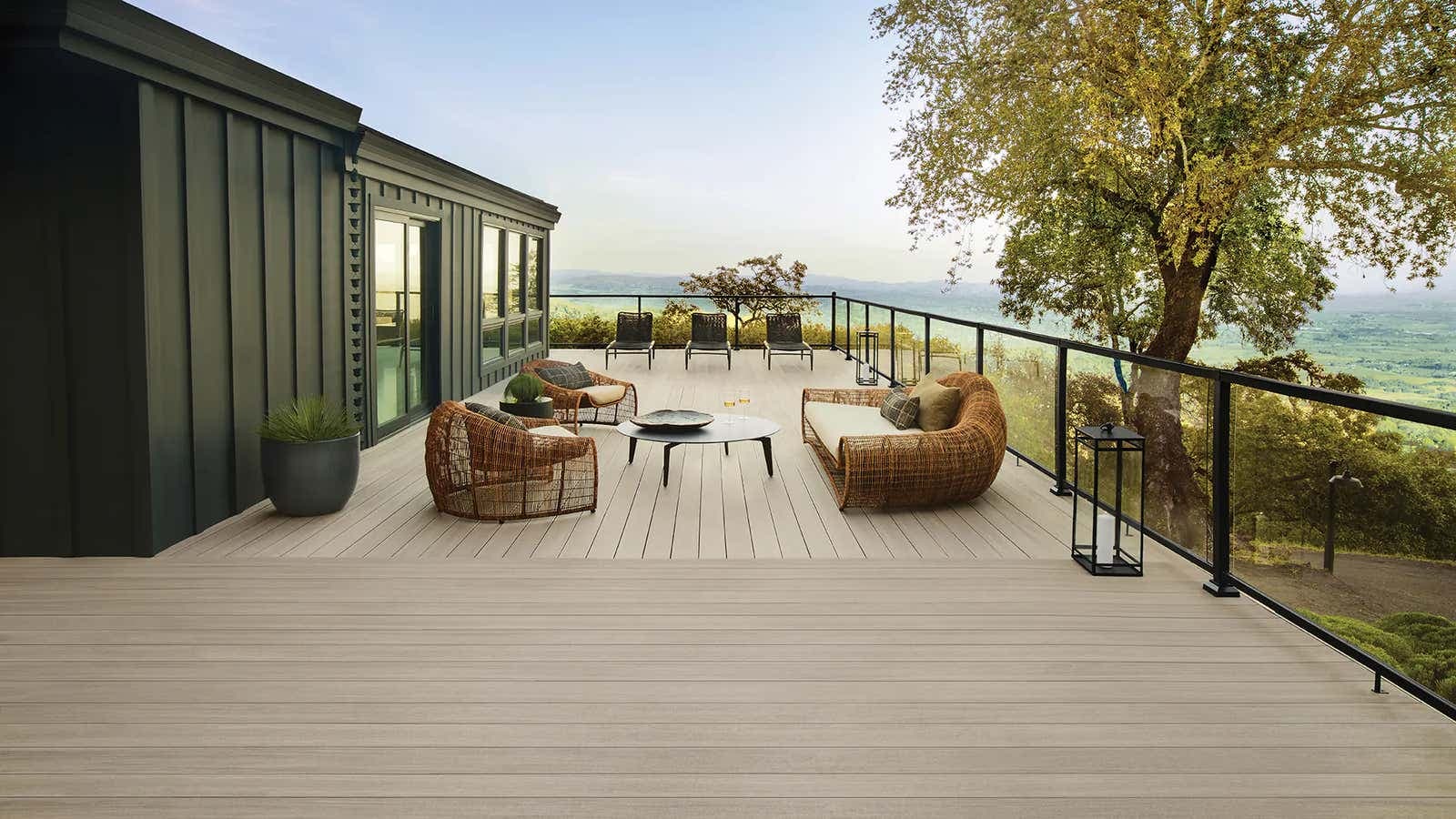
Understanding Coastal Challenges for Decking
Coastal environments are defined by several factors that impact decking materials. Saltwater spray, carried by ocean breezes, can accelerate corrosion of metal fasteners and cause efflorescence on some surfaces. High humidity levels contribute to moisture absorption in wood-based materials, leading to warping, cracking, and fostering mold or mildew growth. Intense UV radiation can fade colors and break down material structures over time. Strong winds can also stress deck boards and fasteners.
Traditional wood decking, even pressure-treated, often requires frequent maintenance in coastal settings to combat these elements. The goal for a coastal deck is to select a material that offers inherent resistance to these stressors, minimizing the need for constant upkeep and ensuring structural integrity.
TimberTech Technologies: PVC vs. Capped Composite
TimberTech offers two primary decking technologies: TimberTech Azek advanced PVC and TimberTech Pro/Edge capped composite. The distinction between these is critical for coastal applications. TimberTech Azek is a full polymer product, containing zero wood fiber. This makes it impervious to moisture absorption.
In contrast, TimberTech Pro and Edge are capped composite boards, meaning they have a protective polymer cap surrounding a wood-fiber and plastic core. While the cap provides significant protection against moisture and stains, the core still contains wood fibers. For the most demanding coastal conditions, where moisture and salt exposure are constant, the full PVC option generally offers a higher level of resistance.
Both technologies are engineered for realistic grain patterns and come in various colors, but their core compositions dictate their performance in extreme moisture-rich environments. The choice between them often balances performance requirements with project budget.
Explore TimberTech Azek advanced PVC decking for maximum moisture resistance: /brands/timbertech
Consider TimberTech Pro and Edge capped composite for a durable wood-look option: /decking/composite
Salt Exposure and Material Performance
For coastal homes, salt exposure is a primary concern. TimberTech Azek PVC decking, being a full polymer product, is inherently resistant to salt corrosion and absorption. This makes it a strong candidate for decks directly adjacent to the ocean, docks, or pool surrounds where saltwater splash is common.
TimberTech Pro and Edge capped composite decking, with their protective polymer caps, offer good resistance to surface salt exposure and staining. The cap shields the wood-fiber core from direct contact with moisture and salt. However, any breaches in the cap, or consistent saturation of cut ends if not properly sealed, could potentially expose the wood fibers. For typical coastal decks not directly over water, these capped composites can perform well, provided installation guidelines for ventilation and end sealing are followed.
The overall impact of salt on the aesthetic appearance of both PVC and capped composite decking is generally minimal, as neither material is porous in the way natural wood is. However, regular rinsing may be beneficial to remove salt residue that could accumulate on the surface.
Fasteners and Hardware in Coastal Environments
Even the most durable decking material can fail if the fasteners and underlying structure are not suited for coastal conditions. Standard steel fasteners can quickly corrode when exposed to salt and moisture, leading to deck board loosening and structural compromise.
TimberTech offers compatible hidden fastening systems and Cortex plugs for face fastening. When planning a coastal deck, confirm that the chosen fastening hardware is explicitly rated for saltwater or marine environments. This is a critical detail that should not be overlooked, as fastener failure can lead to significant repair costs and safety hazards. Similarly, any structural connectors, joist hangers, or other metal components in the deck frame should also be hot-dipped galvanized or stainless steel.
Explore compatible hidden fasteners for TimberTech decking: /decking/composite
Worked Example: Decking a Coastal Balcony
Consider a 10-foot by 12-foot second-story balcony on a coastal home, directly facing the ocean. The client prioritizes minimal maintenance and maximum durability against salt spray. The design requires a picture-frame border.
**Material Choice:** Given the direct ocean exposure, TimberTech Azek advanced PVC decking in "Coastline" (a light gray multi-tonal color) is selected for its zero moisture absorption and resistance to salt. The board profile is 1" x 5.5" grooved, with square edge boards for the picture frame.
**Board Layout and Quantity:**
The main deck area is 9 feet (10' minus 6" for each border board) by 11 feet (12' minus 6" for each border board).
Deck boards are 5.5 inches wide. For the 9-foot width, 9 feet * 12 inches/foot = 108 inches. 108 inches / 5.5 inches/board = 19.6 boards. Round up to 20 boards.
These boards will run the 11-foot length. Using 12-foot boards minimizes cuts and waste. So, 20 pieces of 1" x 5.5" x 12' grooved Azek decking.
For the picture frame, the perimeter is 2 * (10 feet + 12 feet) = 44 linear feet. Allowing for miter cuts and potential waste, approximately 48 linear feet of 1" x 5.5" x 12' square edge Azek decking will be needed. This translates to 4 pieces of 12-foot square edge boards.
**Fasteners:** TimberTech CONCEALoc hidden fasteners for grooved boards will be used for the main field, and Cortex plugs with stainless steel screws will be used for the square edge picture frame boards.
**Understructure:** The existing frame is checked for integrity and all wood components are either pressure-treated lumber rated for ground contact or wrapped with appropriate flashing tapes. All metal hangers and connectors are stainless steel.
This approach ensures that every component, from the visible decking to the hidden fasteners and frame, is chosen to withstand the specific challenges of this coastal location, providing a durable and low-maintenance outdoor living space.
Warranty Considerations for Coastal Use
It's important to review the full warranty documents for specific exclusions and conditions. Most manufacturer warranties do not cover damage caused by improper installation, inadequate ventilation, or the use of non-compatible fasteners.
For coastal applications, ensure that your chosen product's warranty specifically addresses performance in high-moisture and saltwater environments. While many warranties focus on manufacturing defects, understanding the limitations regarding environmental exposure and maintenance is key.
Always keep copies of your product purchase and installation records, as these are often required for warranty claims.
Before you order
- Is the deck directly exposed to saltwater spray or splash?
- What is the desired maintenance level for the deck?
- What is the project budget for decking material and compatible fasteners?
- Are all fasteners and structural hardware rated for marine/saltwater environments?
- Will the deck have adequate ventilation to prevent moisture buildup?
- Have the warranty terms for the chosen TimberTech line been reviewed for coastal applicability?
- Are there any specific local building codes for coastal construction that impact material or installation?
Confirm installation details, approved uses and warranty terms in the current instructions for the exact product and profile. Your installer should verify the substrate, structure and applicable project requirements.
Questions to help you decide
Can I use TimberTech composite decking right on a beach or dock?
For applications directly on a beach, a dock, or any area with constant saltwater immersion or heavy splash, TimberTech Azek advanced PVC decking is generally the more suitable choice due to its full polymer composition and zero moisture absorption. While capped composite offers good resistance, the full PVC option provides superior performance in these extreme moisture-rich environments.
Will salt residue stain TimberTech decking?
TimberTech decking, both Azek PVC and capped composite, is designed to be highly resistant to staining, including from salt residue. However, like any outdoor surface, salt crystals can accumulate. Regular rinsing with fresh water is recommended to remove any buildup and maintain the deck's appearance.
What kind of fasteners should I use for TimberTech decking in a coastal area?
For coastal installations, it is crucial to use fasteners and hardware specifically rated for saltwater or marine environments. Always confirm compatibility with TimberTech's installation guidelines for your specific product line and consult local building codes.
Ready to Plan Your Coastal Deck with TimberTech?
Request a material quote with your project dimensions, exact profile, and ZIP code. We can help confirm current availability and service options for your coastal project.
Request a material quote →