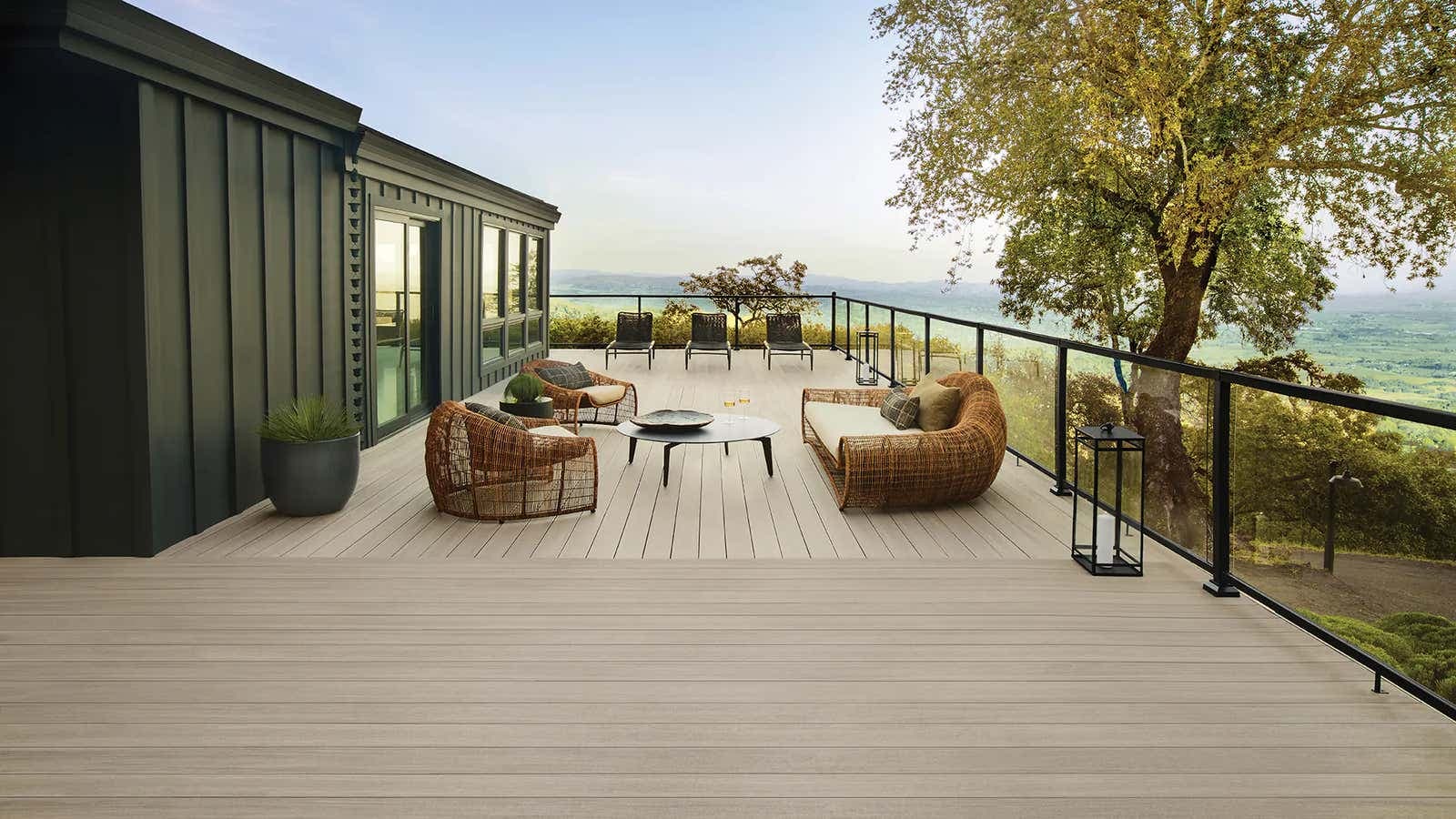
Understanding TimberTech Decking Board Lengths
TimberTech decking boards are typically available in specific lengths: 12 feet, 16 feet, and 20 feet. These standard lengths are designed to accommodate a wide range of deck dimensions, from smaller balconies to expansive outdoor living areas.
Knowing these available lengths is the first step in planning your deck layout. Your goal is to select board lengths that best fit your deck's dimensions, minimizing the need for multiple cuts and seams. For example, a 15-foot-deep deck might be best served by 16-foot boards, allowing for a single board run with minimal waste, rather than combining a 12-foot and a shorter cut from another board.
Types of Decking Board Seams
When a single board length cannot span the entire dimension of your deck, seams become necessary. There are generally two primary approaches to creating seams in TimberTech decking:
This is the most common type of seam for straight decking layouts. Proper support is crucial, meaning the joint must be centered over a joist or a blocking piece. This ensures stability and prevents deflection at the seam.
Picture frame borders provide a clean, finished edge around the perimeter of the deck. While primarily decorative, they also serve as a natural break point for the main field boards, often eliminating the need for butt joints within the primary decking area if the field dimensions align. This approach can simplify board length calculations for the main field.
Planning Your Deck Layout: A Hypothetical Example
Let's consider a hypothetical deck project: a rectangular deck measuring 18 feet wide by 14 feet deep. The homeowner desires a clean look with minimal visible seams.
First, assess the depth: 14 feet. TimberTech offers 12-foot and 16-foot boards. Using 12-foot boards would require a 12-foot piece and a 2-foot piece for each run, creating a seam across the deck. For a typical 5.5-inch wide board, an 18-foot width would require approximately 39 boards (18 feet * 12 inches/foot / 5.5 inches/board = 39.27, rounded up). If each board is 16 feet long, that's 39 x 16 = 624 linear feet.
Alternatively, if a 20-foot length is preferred for a different section or to create a more consistent cut plan across multiple areas, the 14-foot depth would also be covered, with 6 feet of waste per board. The decision between 16-foot and 20-foot boards for a 14-foot depth might depend on other deck dimensions or overall project waste optimization.
For the 18-foot width, if a picture frame border is planned, the field boards would run parallel to the 14-foot depth. The dimensions of the field would be slightly reduced by the width of the border boards. For example, two 5.5-inch border boards (one on each side) would reduce the field width by 11 inches, making the field 17 feet 1 inch wide. The number of boards needed would then be calculated based on this adjusted width.
Optimizing Board Placement for Aesthetics and Efficiency
When planning seams, consider staggering them across the deck rather than aligning them in a straight line. Staggered seams create a more natural and less noticeable appearance, breaking up the visual monotony that a continuous seam line might create.
For a deck with an irregular shape or multiple distinct areas, treat each section as a separate planning unit for board lengths. This allows for more precise material ordering and can reduce offcut waste. Always account for a small amount of extra material (typically 5-10%) for cuts, mistakes, and future repairs. This buffer is especially important for custom cuts or intricate layouts.
Remember that joist spacing also plays a critical role in board support. Ensure your joist layout aligns with your chosen board lengths and seam locations to provide adequate support.
When placing an order, specify the exact lengths you need. Do not assume that a supplier will automatically optimize cuts for you. Providing a detailed cut list based on your layout plan helps ensure you receive the correct materials and can streamline the installation process.
Considering Board Profile: Grooved vs. Square Edge
TimberTech decking is available in both grooved and square-edge profiles. The choice of profile impacts how boards are fastened and can influence your layout decisions.
Grooved boards are designed for hidden fastening systems, where clips slide into the grooves and attach to the joists. This creates a smooth, fastener-free surface. Square-edge boards are typically used for the perimeter, stair treads, or when face-fastening is desired. While the profile doesn't directly dictate length planning, understanding which profile you need for each part of your deck is essential for a complete material order and compatible installation.
Both profiles are available in the standard lengths, ensuring flexibility in design regardless of your fastening preference. Coordinate your profile choice with your fastening system to ensure a smooth installation.
Complementary Products for a Complete Deck
Beyond the main decking boards, consider other TimberTech products to complete your project. Fascia boards, for instance, are essential for finishing the rim joists and deck edges, providing a clean, polished look. These are often available in matching colors and textures.
Additionally, a robust deck frame is foundational. Lumber Plus offers a range of treated lumber options suitable for deck framing, ensuring your TimberTech decking has a stable and long-lasting base. Explore our selection of <a href="/decking">decking options</a>, including <a href="/decking/composite">composite</a> and <a href="/decking/pvc">PVC</a>, to find compatible solutions for your entire project.
For projects requiring specific hardwood aesthetics, consider <a href="/decking/hardwood/ipe">Ipe hardwood decking</a>, which offers a different visual and performance profile, though it would involve different planning considerations for board lengths and installation.
Before you order
- Measure your deck's exact dimensions (length and width).
- Identify TimberTech's standard available board lengths (12 ft, 16 ft, 20 ft).
- Determine if a single board length can span your deck's primary dimensions.
- If seams are needed, plan their location over joists or blocking.
- Consider staggering seams for a more aesthetic appearance.
- Decide on grooved or square-edge boards based on fastening method and application.
- Account for waste and order an additional 5-10% of material.
- Plan for fascia and other trim pieces.
- Review joist spacing requirements for your chosen layout (straight vs. diagonal).
Confirm installation details, approved uses and warranty terms in the current instructions for the exact product and profile. Your installer should verify the substrate, structure and applicable project requirements.
Questions to help you decide
Can I mix different TimberTech board lengths on my deck?
Yes, you can mix different TimberTech board lengths. In fact, it's often necessary to achieve a cost-effective and aesthetically pleasing layout, especially for larger or irregularly shaped decks. The key is to plan where the seams will fall to ensure they are properly supported and appear intentional rather than haphazard. Always prioritize placing seams over joists or additional blocking for structural integrity.
How do I calculate how many boards I need for my deck?
To calculate the number of boards, first determine the total square footage of your deck. Then, divide this by the square footage of a single board (e.g., a 16-foot board at 5.5 inches wide is 16 ft * 0.458 ft = 7.328 sq ft). This gives you the area-equivalent coverage. However, a more accurate method involves calculating the number of runs needed across the width (deck width / board width, including spacing) and multiplying that by the length of the boards you plan to use for each run, accounting for cuts and waste. Always add 5-10% extra for cuts and contingencies.
Are there specific rules for where seams can be placed?
Yes, seams must always be placed over a structural support, typically a joist or blocking. This provides necessary stability and prevents the board ends from sagging or creating trip hazards. Avoid placing seams between joists. Staggering seams across the deck rather than lining them up in a single row will also create a more visually appealing and durable surface.
Ready to Plan Your TimberTech Deck?
Request a material quote with your project dimensions, desired TimberTech profile, and ZIP code. We can help confirm current availability and service options for your decking project.
Request a material quote →