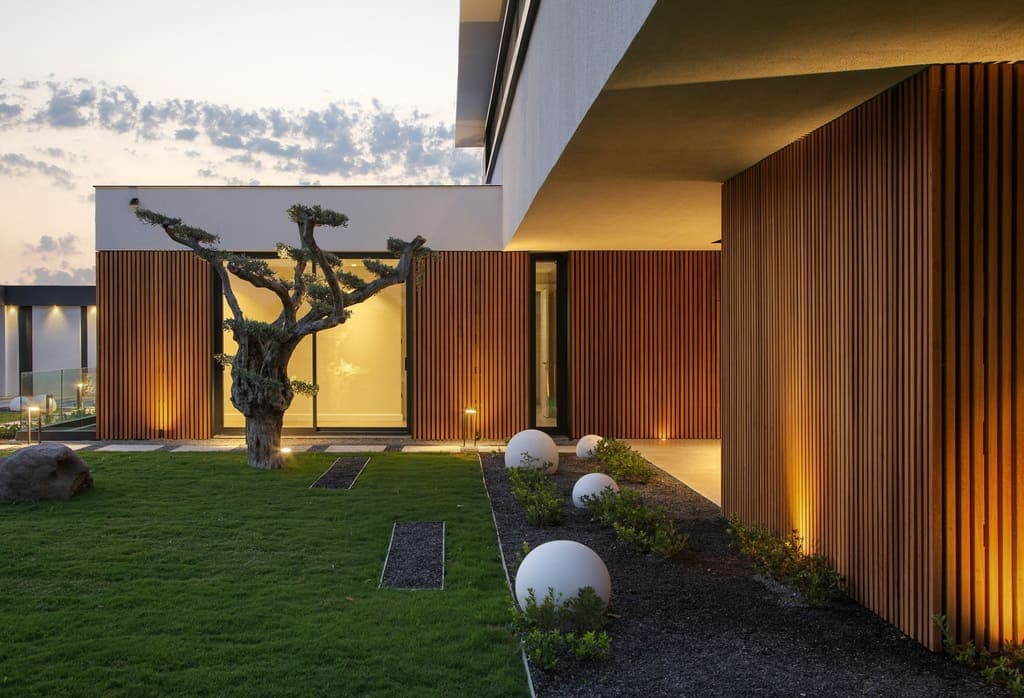
Why Thermally Modified Wood for Covered Patio Walls?
Thermally modified wood undergoes a high-heat treatment process that alters its cellular structure. This modification enhances its stability and resistance to moisture absorption, making it a suitable material for exterior applications. For covered patio walls, where direct exposure to rain and snow might be limited but humidity fluctuations and temperature changes are still factors, these properties are particularly beneficial.
The thermal modification process also imbues the wood with a consistent, rich brown tone that can deepen over time if left unfinished. This natural color variation can complement a variety of architectural styles, from rustic to contemporary. Its improved dimensional stability means less expansion and contraction with changes in humidity, which is a valuable characteristic for wall applications where a consistent appearance is desired.
Selecting the Right Profiles for Wall Applications
For covered patio walls, the choice of profile influences both the visual texture and the installation method. Common profiles suitable for wall applications include tongue-and-groove, shiplap, and square-edge boards. Each offers a distinct aesthetic and functionality.
Tongue-and-groove profiles create a tight, interlocking joint that can provide a smooth, continuous surface or a subtle V-groove, depending on the specific milling. This can be ideal for a more finished, interior-like appearance on a covered patio. Shiplap profiles, on the other hand, create an overlapping joint that produces a distinct shadow line, adding depth and character to the wall. Square-edge boards can be installed with a visible gap, offering a more contemporary, open-joint look, or butted tightly for a solid surface. Consider the desired visual effect and the level of weather protection needed when making your selection.
Finish and Appearance Considerations
Thermally modified wood can be left unfinished to weather naturally to a silver-gray patina, or it can be treated with a protective finish to maintain its original color or achieve a different hue. For covered patio walls, where UV exposure is reduced compared to fully exposed siding, the weathering process may occur more slowly and unevenly if left unfinished.
Applying a penetrating oil or stain can help preserve the wood's color and offer additional protection against moisture and UV degradation. It is important to select a finish that is compatible with thermally modified wood and suitable for outdoor use. Regular maintenance, as recommended by the finish manufacturer, will be necessary to sustain the desired appearance over time.
Consider the overall design of your patio and home when choosing a finish. A natural oil can enhance the wood's inherent warmth, while a semi-transparent stain can introduce color while still allowing the wood grain to show through.
Installation Planning for Covered Patio Walls
Proper installation is crucial for the performance and longevity of thermally modified wood on covered patio walls. While protected, these walls still experience environmental changes, so attention to detail in fastening and ventilation is important. Ensure the substructure is sound, level, and provides adequate support for the chosen wood profile.
For horizontal installations, consider how water might drain. Even under a cover, condensation or wind-driven moisture can occur. Vertical installations generally allow for better water shedding. Fasteners should be corrosion-resistant and appropriate for the wood species and exposure conditions. Concealed fastening systems can provide a clean aesthetic, while face fastening offers a more traditional look and can be very secure. Always follow manufacturer guidelines for spacing and attachment.
Ensure there is adequate ventilation behind the wall cladding, especially if installing over a solid sheathing. This can help prevent moisture buildup and promote air circulation, contributing to the wood's stability and durability. A rainscreen assembly, even in a covered setting, can be beneficial for managing moisture.
Hypothetical Project Example: Covered Patio Wall in Missoula
Consider a covered patio in Missoula, MT, with a back wall measuring 12 feet wide by 8 feet high, intended to be clad with thermally modified wood. The homeowners desire a shiplap profile for its distinctive shadow lines and a natural, weathered look over time.
For this 96 square foot (12 ft x 8 ft) wall, let's assume a thermally modified Pine shiplap profile is chosen, with an effective coverage width of 5.5 inches (0.458 feet) per board, and available in 12-foot lengths. To cover the 12-foot width, you would need approximately 27 boards (12 ft / 0.458 ft per board = 26.2 boards, rounded up to 27). Since the boards are 12 feet long, no vertical cuts would be needed for the 8-foot height, meaning each board yields one 8-foot section and one 4-foot offcut. However, for a uniform appearance, it is often recommended to use full-length boards where possible or plan for staggered joints.
In this scenario, if the 12-foot length is used for the horizontal run, and the 8-foot height is covered by stacking, then 27 boards would cover the width of the wall. To cover the 8-foot height, you would need to calculate how many courses of the 5.5-inch wide boards are needed: 8 feet / (5.5 inches / 12 inches/foot) = 8 / 0.458 = 17.47 courses, rounded up to 18 courses. Therefore, for a 12-foot wide wall, you would need 18 boards, each 12 feet long. This means a total of 18 x 12 = 216 linear feet of material, or 18 individual boards. Always account for a waste factor, typically 10-15%, for cuts and potential imperfections. So, 18 boards * 1.15 waste factor = 20.7 boards, rounded up to 21 boards.
The project would utilize corrosion-resistant fasteners, likely face-fastened for the shiplap profile, with careful attention to spacing. The homeowners plan to allow the wood to naturally gray, but will apply a UV-inhibiting clear sealer after installation to help ensure more even weathering and provide an initial layer of protection against moisture. This project demonstrates how a specific profile and finish choice can be translated into material quantities for a covered patio wall.
Complementary Products and Design Elements
Beyond the thermally modified wood itself, consider other elements that can enhance your covered patio. Matching or complementary soffit materials can create a cohesive look. For example, NORX thermally modified wood soffit panels could be a suitable pairing (see:
Adding accents with other materials, such as stone features or metal railings, can further define the space. Lighting is also a crucial element; integrating wall sconces or recessed lighting in the patio ceiling can highlight the wood's texture and create an inviting ambiance. Consider using durable outdoor furniture that complements the natural aesthetic of the thermally modified wood. For an elevated deck surface that matches the wall, Maximo Accoya decking could be an option (see:
For other siding or cladding options that might also work for covered applications, explore the general siding and cladding category (see:
Before you order
- Confirm the specific thermally modified wood species and profile are approved for vertical wall applications.
- Assess the level of exposure to sun, rain, and snow for the covered patio walls.
- Determine the desired aesthetic: natural weathering or a finished look.
- Select appropriate fasteners (concealed or face-fastened) and ensure they are corrosion-resistant.
- Verify the existing substructure's suitability for cladding installation.
- Plan for ventilation behind the wall cladding to prevent moisture buildup.
- Calculate material quantities, including a waste factor for cuts and adjustments.
- Consider complementary materials and design elements for a cohesive outdoor space.
Confirm installation details, approved uses and warranty terms in the current instructions for the exact product and profile. Your installer should verify the substrate, structure and applicable project requirements.
This is a planning guide for projects in Missoula, MT. Ask our team to confirm availability, delivery to your ZIP code and which branch can support your order.
Questions to help you decide
Can thermally modified wood be painted?
While it is possible to paint thermally modified wood, many users choose to stain or oil it to highlight its natural grain and color, or allow it to weather naturally. If painting, ensure the paint is suitable for exterior wood and follow the manufacturer's recommendations for surface preparation and application.
How does thermally modified wood perform in Missoula's climate?
Thermally modified wood exhibits enhanced stability and reduced moisture absorption, making it well-suited for the fluctuating temperatures and humidity often experienced in Missoula. For covered patio walls, its resistance to decay and insects is beneficial, contributing to its longevity in outdoor, though protected, environments.
What kind of maintenance does thermally modified wood require for covered patio walls?
Maintenance depends on whether the wood is finished or left to weather. If finished with an oil or stain, reapplication will be necessary periodically, as recommended by the finish manufacturer. Unfinished wood will gradually turn gray; occasional cleaning to remove dirt or mildew may be desired. Regularly inspect for any damage or signs of wear regardless of finish.
Ready to Plan Your Covered Patio Walls?
Request a material quote for your project. Provide your project dimensions, desired profile, and ZIP code to confirm current availability and service options. Visit our contact page to get started.
Request a material quote →