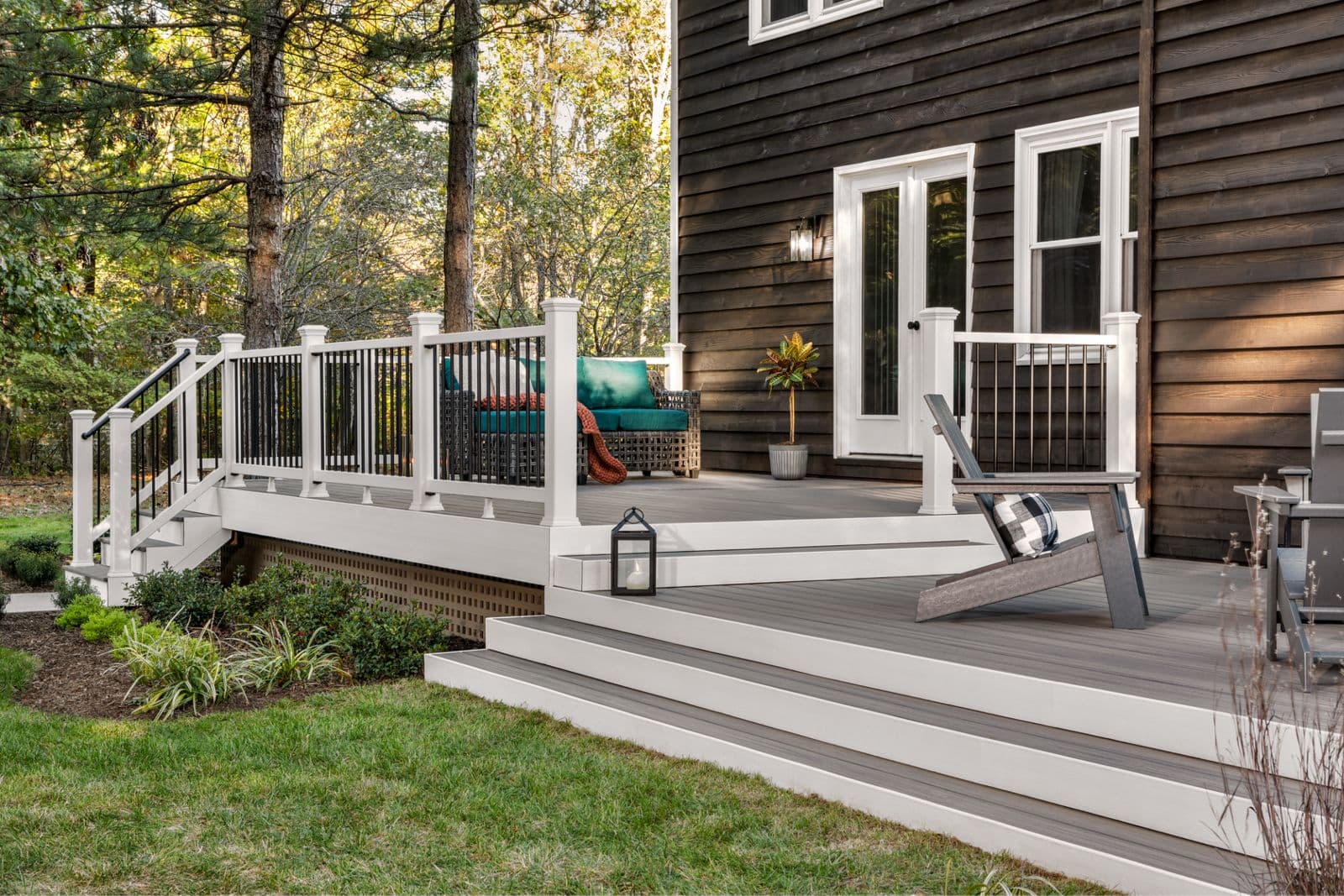
Choosing the Right Trex Collection for Your Gathering Space
Trex offers several decking collections, each with distinct aesthetics and features. For a backyard gathering space, consider not only the visual appeal but also the level of foot traffic and desired finish. The Enhance® collections offer a balance of value and performance, while the Select® and Transcend® lines provide enhanced aesthetics and durability.
The Trex Enhance® Basics line, for example, is lightweight and available in traditional colors like Clam Shell, Beach Dune, and Saddle. Trex Enhance® Naturals offers a more authentic wood-grain appearance with multi-tonal colors such as Foggy Wharf and Rocky Harbor. For a mid-range option, Trex Select® Earth Tones provides hallmark high-performance shell technology with colors like Pebble Grey and Woodland Brown. If a flagship aesthetic and the highest level of performance are priorities, Trex Transcend® Earth Tones (Gravel Path, Rope Swing) or Transcend® Tropical (Havana Gold, Island Mist) may be suitable, offering vibrant colors and luxurious finishes.
When planning for a gathering space, think about how the deck will be used. Will there be frequent entertaining, heavy furniture, or an outdoor kitchen? These factors can influence the choice between collections based on their finish depth and perceived durability. All Trex lines share a core of 95% recycled material and a low-maintenance shell.
Planning Deck Dimensions and Layout
Effective deck planning for a gathering space means considering activity zones. Sketch out areas for dining, lounging, and potentially a grill or fire pit. Trex decking boards are typically 1 inch by 5.5 inches in profile, available in 12, 16, and 20-foot lengths. This consistency allows for flexible layout designs.
A common approach is to create distinct zones using changes in board direction or by incorporating picture-frame borders. For example, a 16x20 foot deck could feature a 12x12 foot central dining area with boards running perpendicular to a 4x20 foot lounging strip. This helps define spaces without physical barriers.
When calculating material needs, remember that module area isn't always direct purchase quantity. For a deck measuring 10 feet wide by 12 feet long (120 square feet), using 16-foot boards running the 10-foot width would require 10-foot cuts from each board. If boards are 5.5 inches wide, you would need approximately 22 boards (12 feet / 5.5 inches per board = 26.18 boards, rounded up to 27 boards to ensure full coverage and account for cuts). This would translate to purchasing 27 boards, each 16 feet long. Always account for waste and potential offcuts that might not be reusable for the primary deck surface but could be used for smaller sections or steps.
Local building codes in Missoula, MT, will dictate structural requirements, including joist spacing and ledger board connections. These are critical for the safety and longevity of your deck. Always consult with a local professional or the relevant building department for specific requirements before starting construction.
Coordinating Fascia and Edge Finishes
Fascia boards provide a finished look to the perimeter of your deck, concealing the substructure. Trex offers matching fascia boards for each of its decking collections, ensuring a cohesive appearance. These are typically available in sizes designed to cover the rim joist or other exposed framing.
The choice between grooved and square-edge boards is important for fastening. Grooved boards are designed for hidden clip fasteners, providing a smooth, fastener-free surface. Square-edge boards are typically used for the perimeter, stair treads, or where face-fastening is preferred.
For a clean, integrated look in a gathering space, hidden fasteners are often preferred as they eliminate visible screws on the deck surface. This creates a safer, splinter-free surface, which is particularly beneficial in areas where people might be barefoot. Discuss fastening options with your installer to ensure compatibility with your chosen Trex boards and desired aesthetic.
Fastening Systems for Trex Decking
Trex decking can be installed using either hidden clip fasteners or face screws. Hidden clips are designed to fit into the grooved edges of the boards, securing them to the joists from below and creating a smooth, uninterrupted deck surface. This method is often favored for its aesthetic appeal and barefoot-friendly finish.
Face-fastening involves screwing directly through the deck board into the joist. While simpler, it results in visible screw heads. If face-fastening is chosen, consider using color-matched screws to minimize their visibility. It's crucial to use fasteners specifically approved for composite decking to prevent issues like mushrooming or cracking.
Regardless of the fastening method, proper board spacing is essential for drainage and to accommodate natural expansion and contraction. Always follow the manufacturer's specific guidelines for spacing, as these can vary by product line and local climate conditions. Adequate ventilation beneath the deck is also important to prevent moisture buildup and ensure the longevity of the deck structure.
Maintenance for Your Trex Decking
One of the primary advantages of Trex composite decking is its low maintenance. Unlike traditional wood decks that require regular staining or sealing, Trex decking is designed to be maintained with a simple soap-and-water wash. This helps keep the deck looking its best and ensures the validity of the warranty.
The protective shell on Trex boards is engineered to resist fading and staining, meaning the color you install should remain consistent over time. Regular cleaning helps remove dirt, pollen, and other debris that can accumulate, especially in an outdoor gathering space.
While Trex is resistant to splinters and rot, it's still important to address spills promptly and perform routine cleaning to maintain its appearance. Avoid using harsh chemicals or abrasive cleaners, as these can damage the deck surface and potentially void the warranty. Always refer to the specific cleaning recommendations provided by Trex for your chosen collection.
Example: Planning a 12x18 Foot Trex Deck for a Missoula Gathering Space
Let's consider a hypothetical 12-foot by 18-foot deck in a Missoula backyard, designed for a dining area and a small lounge. We'll use Trex Select® Earth Tones in 'Pebble Grey' for its balanced performance and contemporary look.
The deck area is 12 ft x 18 ft = 216 square feet. If we run the 16-foot long Trex boards parallel to the 12-foot dimension, we will need to cover 18 feet of length. Each board is 5.5 inches wide. First, convert 18 feet to inches: 18 feet * 12 inches/foot = 216 inches. Then, divide by the board width: 216 inches / 5.5 inches/board = 39.27 boards. We round up to 40 boards to ensure full coverage.
These 4-foot offcuts can be saved for potential use on stairs or other smaller sections, reducing waste. So, we'd purchase 40 boards, each 16 feet long.
For fascia, we'll need enough matching Pebble Grey fascia to cover the perimeter. The perimeter is (12 ft + 18 ft) * 2 = 60 linear feet. If fascia boards are typically 12 feet long, we'd need 60 / 12 = 5 fascia boards. It is always wise to add a small percentage for cuts and potential errors, so purchasing 6 fascia boards would be a safer estimate. For fastening, we would opt for hidden clips for the main deck surface and color-matched face screws for the fascia and any square-edge boards used for stair treads.
This example demonstrates how to approach material takeoff, but always consult with a professional and confirm exact product dimensions and availability before finalizing your order.
Before you order
- Select a Trex collection (Enhance, Select, Transcend) based on aesthetic, performance, and budget.
- Sketch your deck layout, defining activity zones (dining, lounging) and overall dimensions.
- Determine the direction of your decking boards to optimize material usage and minimize seams.
- Calculate the number of decking boards needed, accounting for cuts and potential waste.
- Choose between grooved (hidden fasteners) and square-edge (face fasteners) boards.
- Plan for matching fascia boards to finish the deck perimeter.
- Consider any stairs or railings and select compatible Trex components.
- Verify local building codes and structural requirements for deck construction in Missoula, MT.
- Review manufacturer installation guidelines for board spacing and fastening systems.
- Plan for the necessary maintenance, primarily a soap-and-water wash.
Confirm installation details, approved uses and warranty terms in the current instructions for the exact product and profile. Your installer should verify the substrate, structure and applicable project requirements.
This is a planning guide for projects in Missoula, MT. Ask our team to confirm availability, delivery to your ZIP code and which branch can support your order.
Questions to help you decide
What are the main differences between Trex decking collections?
The main differences lie in their aesthetic complexity, finish depth, and color ranges. Enhance® offers traditional colors and authentic wood grains. Select® provides enhanced aesthetics and performance. Transcend® is the flagship line, offering the highest level of performance, vibrant colors, and luxurious finishes. All share a core of 95% recycled material and a low-maintenance shell.
How do I choose between hidden fasteners and face screws for Trex decking?
Hidden fasteners provide a smooth, clean deck surface without visible screws, which is often preferred for aesthetics and barefoot comfort. They are used with grooved-edge boards. Face screws are installed directly through the board, resulting in visible fasteners, and are typically used with square-edge boards, for perimeters, or when hidden fasteners are not suitable for the application. Always use fasteners approved for composite decking.
What kind of maintenance does Trex decking require in a climate like Missoula, MT?
Trex decking is designed for low maintenance. In Missoula, a simple soap-and-water wash is generally sufficient to keep your deck clean and maintain its appearance, even with seasonal changes. Unlike wood, it does not require staining, sealing, or painting. Regular cleaning helps remove dirt, pollen, and other environmental debris. Always follow Trex's specific cleaning recommendations.
Ready to Plan Your Trex Deck in Missoula?
Request a material quote with your project dimensions, desired Trex profile, and ZIP code. We can confirm current availability and service options for your backyard gathering space.
Request a material quote →