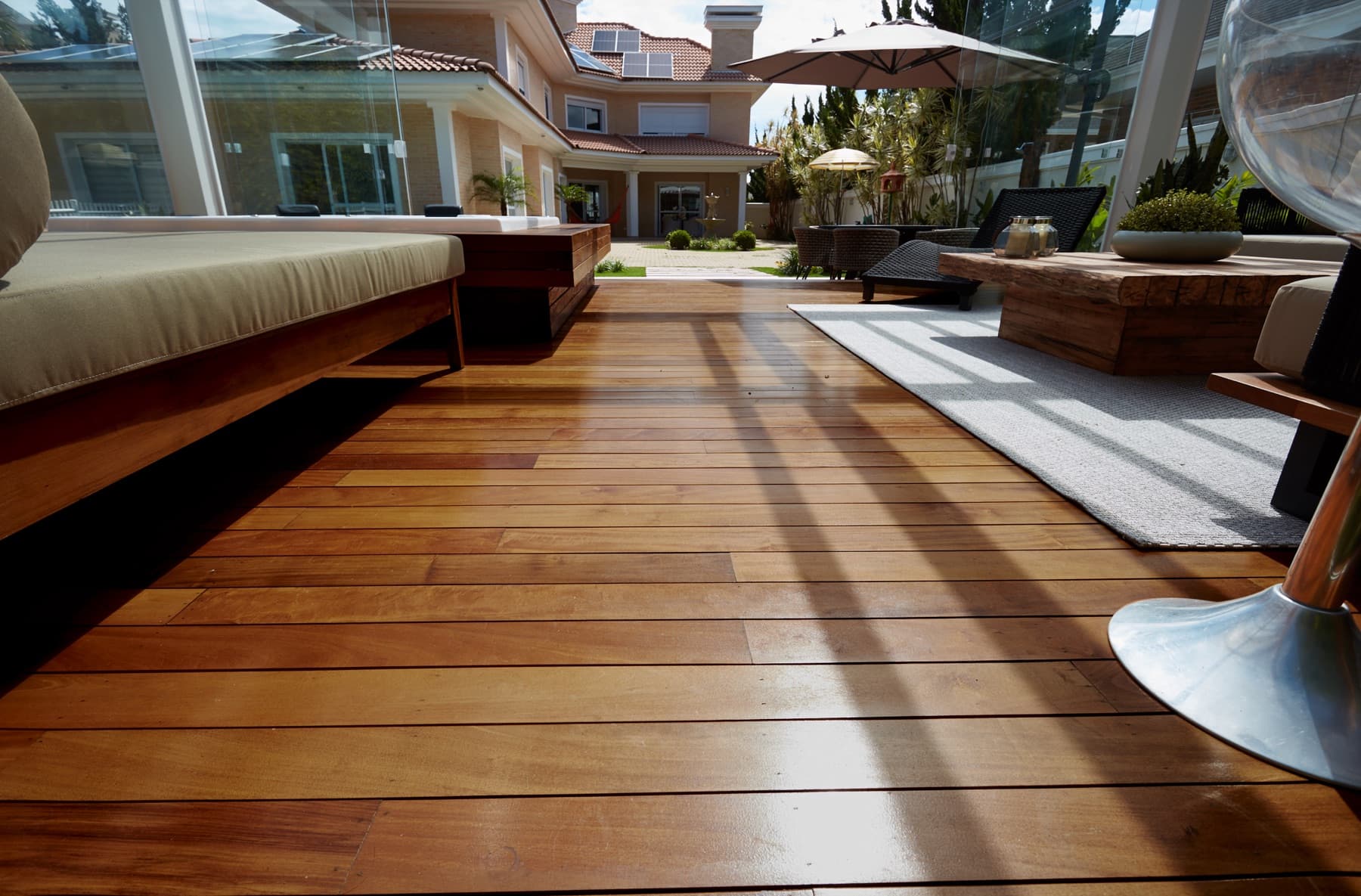
Understanding Sablewood Decking Dimensions
Sablewood decking is supplied in specific board lengths and widths. While custom milling is available for unique project requirements, standard profiles are typically offered in common decking dimensions. Before you begin measuring your project, it's essential to confirm the exact dimensions of the Sablewood boards you intend to purchase, as this directly impacts your quantity calculations.
For example, if Sablewood is available in standard lengths such as 8-foot, 10-foot, 12-foot, and 16-foot, and a nominal width of 5.5 inches, these figures will be central to your planning. Knowing these available lengths allows you to optimize your layout to minimize waste. Always refer to the specific product specifications for the exact profile and dimensions you are considering.
Link: Sablewood Decking: <a href="/products/sablewood">/products/sablewood</a>
Measuring Your Project Area Accurately
Begin by drawing a detailed sketch of your deck or patio area. Include all dimensions: length, width, and any irregular shapes or cutouts (e.g., around posts, planters, or built-in seating). For a rectangular deck, measure the length and width at several points to confirm squareness and account for any slight variations. If your project has multiple sections or unusual angles, break it down into simpler geometric shapes for individual measurement.
Consider the direction of your decking boards. Will they run parallel to the house, perpendicular, or diagonally? This decision significantly affects how board lengths are utilized and how many cuts will be necessary. For instance, boards running perpendicular to the house typically require fewer cuts if they span the full width of the deck, while diagonal layouts inherently generate more waste.
Calculating Board Footage for a Rectangular Deck: A Worked Example
Let's consider a hypothetical rectangular deck project measuring 14 feet wide by 20 feet long. We will assume Sablewood decking boards are available in a nominal 5.5-inch width (actual coverage) and standard lengths of 10 feet and 12 feet. For this example, the boards will run parallel to the 14-foot width.
First, convert the board width to feet: 5.5 inches / 12 inches/foot = 0.4583 feet. Next, calculate how many boards are needed to cover the 20-foot length. 20 feet / 0.4583 feet/board = approximately 43.64 boards. Since you can't use a fraction of a board, you will need 44 full boards to cover the length.
Each of these 44 boards needs to be 14 feet long. Since Sablewood is available in 10-foot and 12-foot lengths, a single 14-foot board is not an option. You would need to use two shorter boards per run, creating a seam. For a 14-foot run, you could use a 10-foot board and a 4-foot piece cut from another board. This approach, however, increases the number of cuts and potentially waste. A more efficient approach for a 14-foot run might be to use 16-foot boards (if available) and cut 2 feet off each, or to use two 8-foot boards if 8-foot lengths are stocked.
Assuming 16-foot boards are available, you would purchase 44 boards at 16 feet each. Total linear footage: 44 boards * 16 feet/board = 704 linear feet. If only 10-foot and 12-foot lengths are available, and you aim for minimal seams, you might re-evaluate the board direction or consider custom lengths if the project budget allows.
For a simple area calculation without considering specific lengths, 14 feet * 20 feet = 280 square feet. If one square foot requires approximately 2.18 linear feet of 5.5-inch wide decking (12 inches / 5.5 inches = 2.18 linear feet per square foot), then 280 square feet * 2.18 linear feet/square foot = 610.4 linear feet. This is a quick estimate, but the board-by-board calculation is more precise for ordering.
Factoring in Waste and Cuts
No decking project can be completed without some material waste due to cuts, miscuts, or minor imperfections. A general rule of thumb is to add a waste factor of 5% to 15% to your total linear footage, depending on the complexity of your deck design and your experience level.
For a straightforward rectangular deck with boards running parallel or perpendicular, a 5-7% waste factor might suffice. However, for diagonal layouts, decks with many angles, curves, or cutouts around obstacles, or if you are less experienced with cutting, a 10-15% waste factor is more prudent. It's always better to have a few extra boards than to halt your project waiting for a small reorder.
Consider the example above where 704 linear feet of Sablewood was calculated. Applying a 10% waste factor: 704 linear feet * 1.10 = 774.4 linear feet. You would then round up to the nearest full board quantity based on available lengths. For instance, if ordering 16-foot boards, 774.4 / 16 = 48.4 boards, so you would order 49 boards.
Accounting for Fascia, Trim, and Stairs
Beyond the main deck surface, remember to calculate materials for fascia boards, stair treads, risers, and any other trim elements. Sablewood can be used for these applications, and their dimensions will need separate measurement and calculation.
Measure the perimeter of your deck for fascia boards. For stairs, measure the length of each tread and riser. If using Sablewood for these elements, ensure you specify the correct profile and finish. These components often require different cuts and can add a significant amount to your total linear footage.
Complementary Products to Consider
While planning your Sablewood decking order, consider other materials that may be required for a complete project. This includes fasteners (hidden or face-fastening options), suitable substructure materials, and any specific tools for installation. Planning these alongside your decking ensures a smooth project flow.
Link: General Decking Information: <a href="/decking">/decking</a>
Link: Hardwood Decking Options: <a href="/decking/hardwood">/decking/hardwood</a>
Link: Ipe Hardwood Decking (for comparison): <a href="/decking/hardwood/ipe">/decking/hardwood/ipe</a>
Link: Composite Decking Options (for comparison): <a href="/decking/composite">/decking/composite</a>
Before you order
- Have I measured my deck area accurately, including all dimensions?
- Have I decided on the direction of the decking boards?
- Do I know the exact available lengths and widths of Sablewood boards?
- Have I calculated the total linear footage required for the main deck surface?
- Have I added a realistic waste factor (5-15%) to my linear footage calculation?
- Have I calculated material needs for fascia, stairs, and other trim elements separately?
- Have I considered necessary fasteners and substructure materials?
- Am I prepared to provide my project dimensions, desired profile, and ZIP code for a material quote?
Confirm installation details, approved uses and warranty terms in the current instructions for the exact product and profile. Your installer should verify the substrate, structure and applicable project requirements.
Questions to help you decide
What is linear footage and why is it important for ordering decking?
Linear footage is the total length of all the boards you need, regardless of their width. It's crucial for ordering decking because lumber is typically sold by the linear foot, often in specific lengths. Calculating linear footage helps ensure you purchase enough material to cover your area, accounting for the board's width and the project's length.
How much waste should I budget for when ordering Sablewood decking?
For most straightforward rectangular decks, a waste factor of 5-7% is generally sufficient. For more complex designs involving angles, curves, or numerous cutouts, or if you are less experienced with installation, it is safer to budget 10-15% for waste. This accounts for miscuts, trimming, and potential board imperfections.
Can I use Sablewood for deck stairs and railings?
Sablewood is suitable for various outdoor applications, including decking, pergolas, boardwalks, and patios. This can extend to stair treads and fascia boards for a cohesive look. However, specific profiles for railings may vary, and you should confirm compatible profiles and finishes for all intended applications with your supplier before ordering.
Ready to Plan Your Sablewood Decking Project?
Request a material quote today. Provide your project dimensions, desired Sablewood profile, and ZIP code to confirm current availability and service options for your area.
Request a material quote →