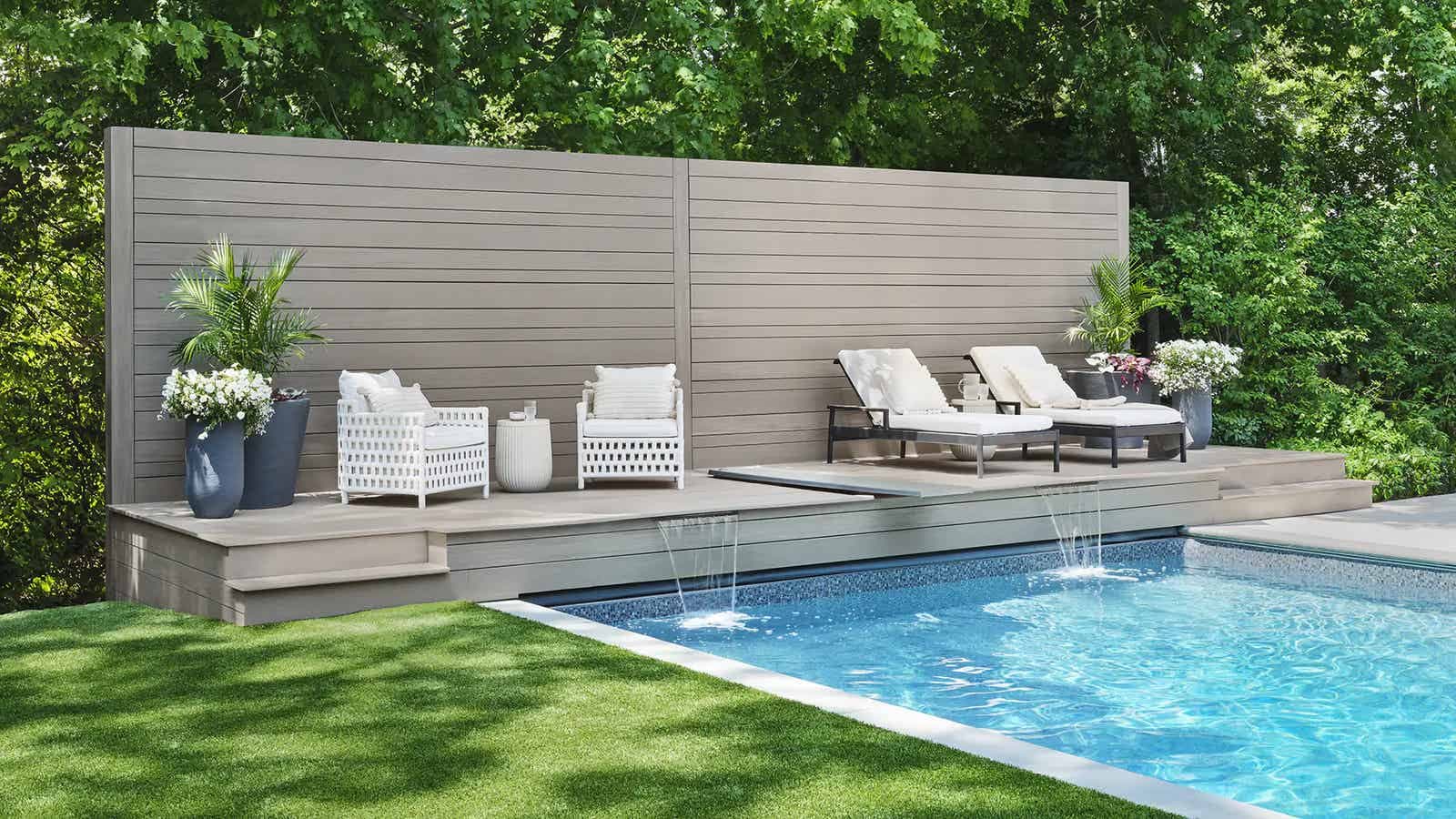
Why PVC Decking for Pool Terraces?
PVC decking, such as that from Azek and TimberTech Azek, is a 100% synthetic material. This composition means it contains no wood fiber, making it inherently waterproof to the core. For a pool terrace, this is a significant advantage, as standing water, splash zones, and even salt spray (if applicable) will not cause the material to swell, stain, or rot. This core characteristic distinguishes PVC from wood-based alternatives.
The advanced capping on full PVC boards further enhances their performance, providing a surface that sheds grease and wine, and can be cleaned with soap and water. These properties make PVC a practical choice for an area prone to spills and constant moisture, reducing the effort required for routine maintenance compared to some other decking materials.
Additionally, PVC decking weighs less than traditional hardwood and even many composite options. This can simplify handling during installation and may be a factor for projects involving rooftop pools or areas with structural weight limitations.
Material Properties and Appearance
PVC decking is available in various collections, including Vintage, Landmark, and Harvest, offering a range of aesthetics. These collections are designed to mimic the appearance of wood with deep textures and varied color options. While PVC is a synthetic material, advancements in manufacturing allow for sophisticated finishes that can complement different architectural styles and landscaping designs.
When selecting PVC for a pool terrace, consider color options that are described as heat-mitigating. Lighter colors or specific finishes may absorb less solar radiation, potentially making the deck surface more comfortable underfoot during hot Washington, DC summers. It's always advisable to review samples in person to assess both the visual appeal and any tactile differences.
Planning for Water Management and Drainage
Even with a waterproof material like PVC, proper planning for water management and drainage is critical for a pool terrace. Ensure your design incorporates adequate slopes and drainage solutions to direct water away from the pool and deck foundation.
The substructure supporting PVC decking should also be designed to withstand moisture. Traditional wood framing may require additional protection or be replaced with moisture-resistant alternatives in consistently wet environments. Proper ventilation beneath the deck is also important to prevent moisture buildup and maintain a stable environment.
Choosing Compatible Fasteners and Edges
For a pool terrace, the choice of fasteners and edge finishes is both aesthetic and functional. Hidden fastener systems are often preferred for PVC decking as they create a smooth, clean surface, which can be more comfortable for bare feet around a pool. Ensure that any chosen hidden fasteners are compatible with the specific PVC decking profile you select and are rated for outdoor, wet conditions.
Edge finishing options, such as fascia boards, are important for completing the look of your pool terrace and protecting the ends of the deck boards. Coordinate these trim pieces with your main decking to ensure a cohesive appearance. Consider how the deck edges will integrate with the pool coping, paving, or surrounding landscaping, aiming for a smooth transition that minimizes trip hazards.
Example: Calculating PVC Decking for a Pool Terrace
Let's consider a hypothetical pool terrace project in Washington, DC. Assume you are decking an area that is 16 feet wide and 20 feet long, with a standard rectangular shape surrounding one side of a pool. You've chosen PVC decking boards that are 5.5 inches wide and available in 16-foot lengths.
First, calculate the total area: 16 feet * 20 feet = 320 square feet.
Next, determine how many boards are needed for the width. A 16-foot width is 192 inches. Dividing by the board width (5.5 inches) gives approximately 34.9 boards. Since you cannot use a fraction of a board, you will need 35 boards to cover the width, assuming a standard installation with minimal gapping. Each of these boards will be 20 feet long.
If the boards are only available in 16-foot lengths, you will need to plan for seams. For a 20-foot length, each run would require one 16-foot board and one 4-foot section. This means for each 20-foot run, you would purchase two 16-foot boards, cutting one to 4 feet and using the remaining 12 feet as an offcut. This offcut could potentially be used for another 4-foot section, but careful planning of seam placement and support is essential. For simplicity in this example, assuming all boards are laid parallel to the 16-foot dimension, you would need 20 feet / 16 feet = 1.25 lengths per run. To avoid excessive waste and manage seams, consider a layout where boards run parallel to the 20-foot dimension if possible, or plan for staggered seams across the 35 board runs.
If boards are 16 feet long and laid across the 16-foot width, you'd need 35 boards, each 20 feet long. If 20-foot lengths are not available, you would need to achieve the 20-foot length by joining 16-foot and 4-foot sections. For 35 runs, this means 35 x 16-foot boards and 35 x 4-foot sections. If you cut 4 feet from a 16-foot board, you get a 12-foot offcut. You would need to purchase enough 16-foot boards to yield 35 x 4-foot sections. 35 / (16/4) = 35 / 4 = 8.75. So, you'd need 9 boards just for the 4-foot sections, plus the 35 full 16-foot boards. This is a total of 44 x 16-foot boards. Always confirm exact product dimensions and availability, and plan your cuts to minimize waste.
Maintenance and Care for a PVC Pool Deck
One of the key benefits of PVC decking for a pool terrace is its low-maintenance nature. Unlike wood, it does not require sanding, staining, or sealing. Routine cleaning with soap and water is typically sufficient to remove dirt, pool chemicals, and other residues. For tougher stains, consult the manufacturer's specific cleaning recommendations to ensure compatibility with the decking material.
While PVC is durable, it's important to avoid abrasive cleaners or tools that could scratch the surface. Regularly sweep or rinse the deck to remove debris that could become embedded or cause staining over time. Proper care helps maintain the aesthetic appeal of your PVC pool terrace for years.
Before you order
- Confirm PVC decking is approved for submerged or frequently wet applications by the manufacturer.
- Verify heat-mitigating color options for comfort underfoot.
- Plan for adequate drainage and ventilation beneath the deck.
- Select compatible hidden fasteners suitable for wet environments.
- Choose fascia and trim that coordinate with the decking and integrate with pool coping.
- Review manufacturer's cleaning guidelines for pool chemical compatibility.
- Measure project dimensions accurately to minimize waste and plan board lengths and seams.
Confirm installation details, approved uses and warranty terms in the current instructions for the exact product and profile. Your installer should verify the substrate, structure and applicable project requirements.
This is a planning guide for projects in Washington, DC. Ask our team to confirm availability, delivery to your ZIP code and which branch can support your order.
Questions to help you decide
Is PVC decking slippery when wet?
While PVC decking is designed for outdoor use, any surface can become slippery when wet, especially around a pool. Some PVC decking products may offer enhanced traction features or textured surfaces. Always exercise caution on wet surfaces, and consider incorporating non-slip mats in high-traffic areas if desired. It's important to verify any specific slip resistance claims with the product manufacturer.
Can PVC decking be installed directly over concrete?
The suitability of installing PVC decking directly over concrete depends on the specific product and manufacturer's instructions. Often, a proper substructure is required to allow for adequate drainage, ventilation, and fastening. Direct installation without a substructure can trap moisture and lead to issues. Always consult the manufacturer's installation guide for precise requirements.
How do I clean pool chemical stains from PVC decking?
For most pool chemical splashes or stains on PVC decking, a gentle cleaning solution of mild soap and water is usually effective. Apply the solution, scrub gently with a soft-bristle brush, and rinse thoroughly. Avoid harsh chemicals, abrasive cleaners, or pressure washers, as these can damage the decking surface. Always refer to the specific cleaning instructions provided by the PVC decking manufacturer for the best results and to ensure product compatibility.
Start Planning Your Washington, DC Pool Terrace with PVC Decking
Ready to explore PVC decking for your pool terrace project in Washington, DC? Request a material quote with your project dimensions, desired profile, and ZIP code. Confirm current availability and service options to bring your vision to life. Visit our product page to see available PVC decking options: PVC Decking. You may also be interested in other decking options such as Decking, Hardwood Decking, Ipe Decking, or Composite Decking.
Request a material quote →