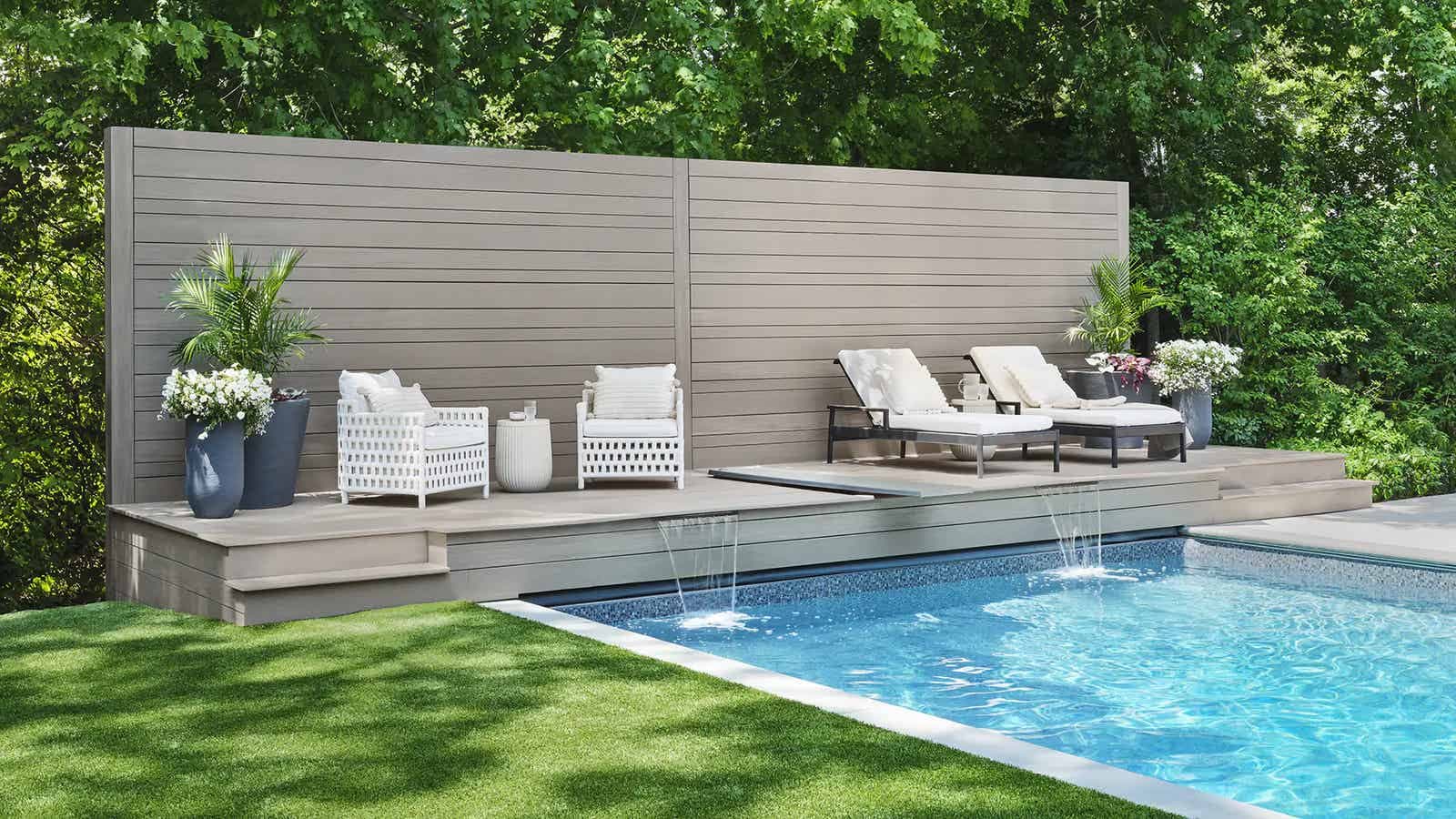
Why PVC Decking Suits Pool Terraces
PVC decking, a 100% synthetic material, is designed to withstand continuous exposure to moisture without swelling, staining, or rotting. This inherent resistance makes it particularly suitable for pool terraces where splash zones are a constant factor. Unlike wood-fiber composites or natural wood, PVC contains no organic material that can be affected by water.
The waterproof core of PVC boards means they perform reliably even when consistently wet, a common scenario around pools. This characteristic also contributes to a lower maintenance profile compared to materials that require sealing or staining to protect against moisture.
Manufacturers like Azek (a TimberTech brand) specifically highlight their PVC decking as a standard for pool decks due to its advanced capping and synthetic composition. This material is engineered to shed grease and wine, allowing for easy cleaning with soap and water, which is beneficial for areas prone to spills from poolside activities.
Additionally, PVC decking typically weighs less than traditional hardwood, which can simplify handling and installation, particularly for larger deck projects.
Understanding PVC Decking Profiles and Appearance
PVC decking is available in various collections and profiles, offering a range of aesthetic choices. For instance, the TimberTech Azek line includes Vintage, Landmark, and Harvest collections, which feature deep wood-look textures and diverse color palettes. These options allow for customization to complement your home's exterior and landscaping.
When selecting PVC decking for a pool terrace, consider colors that offer heat-mitigating properties. Lighter shades generally absorb less heat than darker ones, which can be a comfort factor for bare feet on sunny days.
The surface texture is also important. Many PVC boards are designed with advanced capping to enhance both appearance and surface characteristics. While specific slip-resistance ratings require verification for individual products, a textured surface can contribute to better footing when wet.
Planning for Water Management and Drainage
Even with waterproof decking, proper water management is crucial for any pool terrace. Ensure the deck design incorporates adequate slopes and drainage to prevent standing water on the surface and to direct water away from the pool structure and home foundation.
Consider the substructure beneath the PVC decking. While PVC boards are waterproof, water can still accumulate underneath if not properly managed. An open substructure that allows for airflow and drainage is generally recommended. This helps prevent moisture buildup and supports the overall longevity of the deck system.
For areas directly adjacent to the pool, plan for a slight gradient away from the pool edge. This helps direct splashed water into surrounding drainage systems or landscaping, rather than allowing it to pool on the deck surface.
Edge Details and Fascia for a Finished Look
The finishing touches on a pool terrace deck contribute significantly to its appearance and safety. PVC decking systems often include matching fascia boards and trim pieces that can be used to create a clean, finished edge around the perimeter of the deck and any steps.
Picture-frame borders are a popular design choice for pool decks, creating a defined edge and aesthetic appeal. When planning these details, ensure that all cuts are precise and that fasteners are installed according to manufacturer guidelines to maintain structural integrity and a uniform appearance.
For pool coping, ensure the decking material is compatible with the pool's edge treatment. A seamless transition between the pool coping and the deck boards is essential for both safety and aesthetics. Consult with your pool builder or decking installer to coordinate these elements effectively.
Hypothetical Project Example: A 12x20 Foot Pool Terrace
Let's consider a hypothetical pool terrace project: a rectangular deck measuring 12 feet by 20 feet, to be built with PVC decking. The homeowner desires a light-colored, wood-grain look to complement their modern home, with a picture-frame border.
First, calculate the total area: 12 feet * 20 feet = 240 square feet. Assuming a standard PVC deck board width of 5.5 inches (0.458 feet) and lengths of 12 or 16 feet.
For the main decking area, if boards are laid parallel to the 20-foot dimension, you would need approximately 12 feet / 0.458 feet/board = 26.2 boards across the width. Rounding up to 27 boards, and using 20-foot lengths, this would be 27 x 20-foot boards. If 16-foot lengths are used, more cuts and seams would be required.
For a picture-frame border: A single border around a 12x20 foot deck would require two 20-foot boards and two 12-foot boards for the outer frame. If an inner frame is also desired, additional boards would be needed, accounting for the board width. Always add a percentage (e.g., 10-15%) for cuts, waste, and future repairs.
This example illustrates the need for detailed measurements and a layout plan to accurately determine material quantities. Exact board lengths available will influence the final purchase quantity and cut plan.
Before you order
- Confirm local building codes and permits required for pool deck construction.
- Verify the specific PVC decking product is rated for poolside applications.
- Choose a color and finish that balances aesthetics with heat mitigation for bare feet.
- Plan for adequate drainage and ventilation beneath the deck.
- Select appropriate fasteners (hidden or face-fastened) compatible with the PVC decking.
- Consider matching fascia and trim boards for a cohesive look.
- Coordinate the decking installation with pool coping and surrounding landscaping.
- Review manufacturer's cleaning and maintenance guidelines for poolside environments.
Confirm installation details, approved uses and warranty terms in the current instructions for the exact product and profile. Your installer should verify the substrate, structure and applicable project requirements.
This is a planning guide for projects in Savannah, GA. Ask our team to confirm availability, delivery to your ZIP code and which branch can support your order.
Questions to help you decide
Is PVC decking slippery when wet around a pool?
Always verify the specific product's surface characteristics and consider lighter colors, which tend to be cooler underfoot. Maintaining a clean deck surface also contributes to better footing.
How do I clean PVC decking around a pool?
PVC decking is generally low-maintenance. Most manufacturers recommend cleaning with mild soap and water to remove dirt, pool chemicals, and other spills. For specific cleaning products or stubborn stains, always refer to the manufacturer's care instructions to ensure compatibility and avoid damaging the deck surface.
Can PVC decking be installed directly over an existing concrete pool deck?
Installing PVC decking over an existing concrete slab requires careful planning. You'll need to ensure proper drainage and ventilation are maintained. This typically involves creating a substructure (sleepers or a low-profile framing system) on top of the concrete to allow for airflow and water runoff. Consult with an experienced installer to evaluate your specific situation and ensure proper installation methods.
Start Planning Your PVC Pool Terrace Deck
Ready to explore PVC decking for your pool area? Request a material quote with your project dimensions, desired profile, and ZIP code. We can confirm current availability and service options for your project.
Request a material quote →