Evaluating Your Existing Deck Frame for Hardwood
Before selecting new decking material, a thorough inspection of your existing deck frame is crucial. The structural integrity of joists, beams, and posts must be sound to support the new decking. Hardwood, particularly dense species, can be heavier than some alternative decking materials. This weight difference necessitates a careful review of your frame's load-bearing capacity.
Check for any signs of rot, insect damage, or excessive deflection in the existing lumber. Pay close attention to connections and fasteners, ensuring they are secure and free from corrosion. If any part of the frame shows significant wear or damage, it will require repair or replacement before new decking can be installed. Consulting with a local structural engineer or experienced contractor is recommended to confirm the frame's suitability for a hardwood decking renovation.
Choosing the Right Hardwood Species for Savannah's Climate
Savannah's climate, characterized by humidity and potential for strong weather, influences material choices. Hardwood species like Ipe and Cumaru are recognized for their natural resistance to rot, insects, and moisture, making them suitable for outdoor applications in such environments.
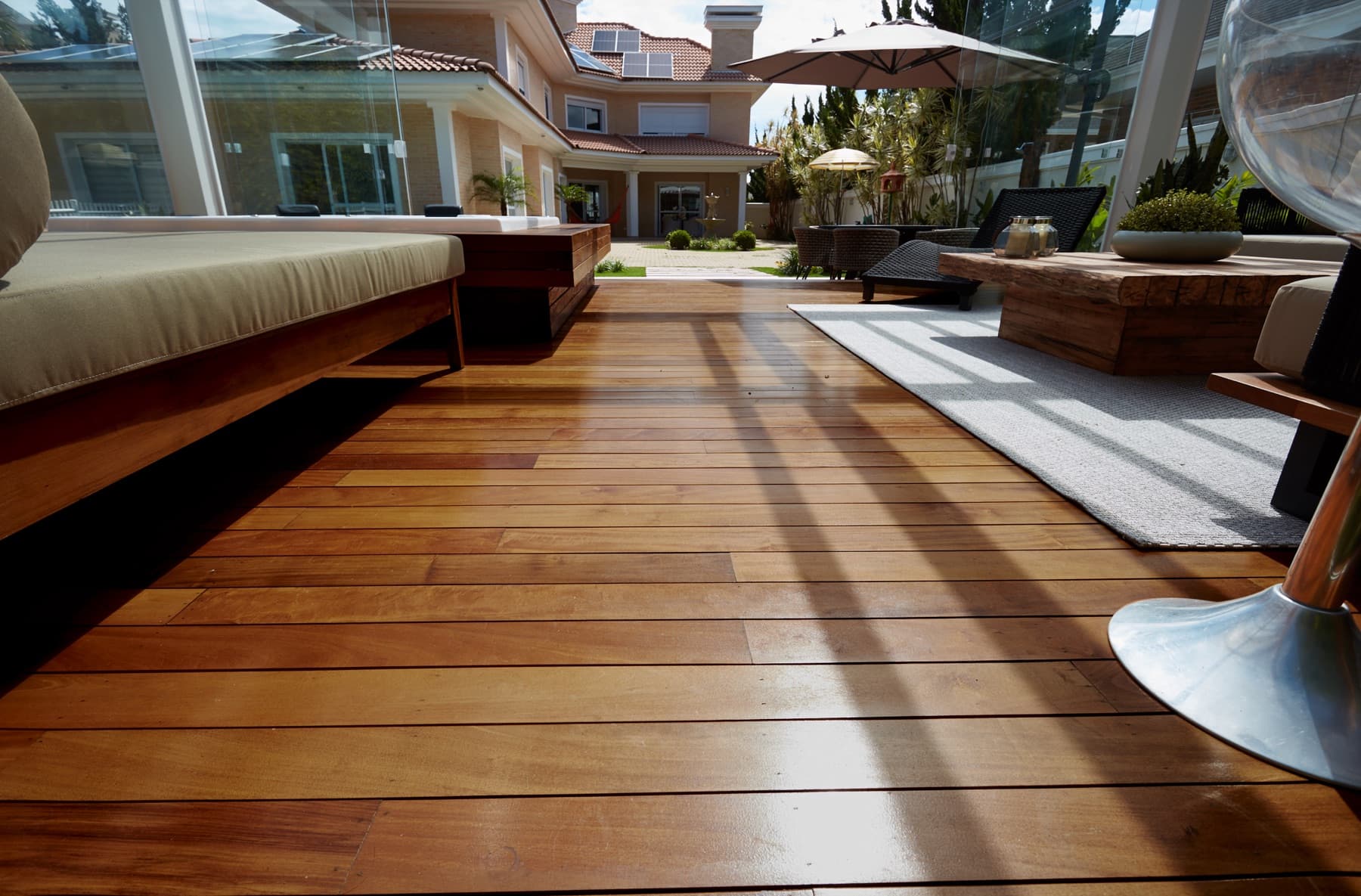
Ipe, also known as Brazilian walnut, is a dense hardwood that ranges from reddish-brown to olive-brown. It is noted for its minimal movement after installation and natural resistance to weather changes, mold, and termites. Its durability makes it a benchmark choice for demanding outdoor projects. Cumaru is another durable tropical hardwood, resistant to termites and weather changes. Both species can be left untreated to weather to a silvery-gray patina or maintained with a UV-blocking sealer to preserve their original color.
Consider the aesthetic you envision for your renovated deck. Ipe offers a bold grain and rich color variations, while Cumaru presents a warm, reddish-brown hue. Samples can help visualize how these materials will complement your home's exterior.
For coastal areas, Ipe and Cumaru are considered marine-grade standards, often specified for docks and boardwalks due to their resistance to salt air and spray. This inherent resistance makes them robust choices for properties near the coast.
Measuring Your Deck and Planning Board Layout
Accurate measurements are fundamental for a successful renovation. Begin by measuring the total length and width of your deck surface. Account for any irregularities, such as cut-outs for posts, planters, or unique architectural features. A detailed drawing of your deck layout, including the direction of your joists, will help in planning board orientation and minimizing waste.
When planning board layout, decide whether you want a traditional straight lay, a diagonal pattern, or a picture-frame border. Each layout will impact the quantity of material needed and the complexity of cuts. Hardwood decking is typically available in various profiles and lengths. Planning your layout with standard board lengths can reduce the number of seams and offcuts. For instance, if your deck is 12 feet long, choosing 12-foot boards can simplify installation.
Always add a waste factor to your material calculations, typically 10-15%, to account for cuts, potential mistakes, and future repairs. This is especially important for renovation projects where unforeseen issues might arise.
Worked Example: Material Takeoff for a Hardwood Deck Renovation
Let's consider a hypothetical deck renovation project in Savannah, GA. Suppose you have an existing rectangular deck measuring 16 feet by 10 feet. You plan to use 1x6 (nominal) Ipe decking boards, which are typically 5.5 inches wide for actual coverage, and run them parallel to the 10-foot dimension.
First, calculate the total deck area: 16 feet * 10 feet = 160 square feet. To determine the number of boards needed for the 16-foot length, divide the width of the deck by the board width: 10 feet * 12 inches/foot = 120 inches. 120 inches / 5.5 inches/board = 21.82 boards. Round up to 22 boards to ensure full coverage.
Since the boards will run parallel to the 10-foot dimension, and we need 22 boards, we would ideally order 10-foot lengths. However, if 10-foot lengths are not available, or if you prefer longer boards to minimize butt joints, you might consider 12-foot or 16-foot lengths and plan for cuts.
Assuming 10-foot boards are available, you would need 22 boards, each 10 feet long. Total linear footage: 22 boards * 10 feet/board = 220 linear feet. Adding a 10% waste factor: 220 linear feet * 1.10 = 242 linear feet. You would then convert this to board feet based on the nominal dimensions (e.g., 1x6 is 0.5 board feet per linear foot, so 242 * 0.5 = 121 board feet).
If you opt for 16-foot boards to run perpendicular to the 10-foot dimension, you would need 16 feet * 12 inches/foot = 192 inches. 192 inches / 5.5 inches/board = 34.9 boards. Round up to 35 boards. Each board would be 10 feet long (assuming the width is 10 feet and boards run across it). Total linear footage: 35 boards * 10 feet/board = 350 linear feet. With a 10% waste factor: 350 * 1.10 = 385 linear feet. This would be 192.5 board feet for 1x6 material.
Fastening and Installation Considerations
Hardwood decking, especially dense species like Ipe and Cumaru, requires specific fastening techniques. Due to their hardness, pre-drilling pilot holes is generally necessary for face fastening to prevent splitting. Specialized fasteners designed for hardwood, such as stainless steel screws, are recommended for their corrosion resistance, which is important in humid environments.
Hidden fastening systems are another option that provides a clean, fastener-free surface. These systems typically involve clips that attach to the side of the boards and secure them to the joists. Ensure that any chosen hidden fastener system is compatible with the specific hardwood species and board profile you select. Proper board spacing for drainage and ventilation is also critical, and manufacturer guidelines should always be followed.
Given the density and specific installation requirements, professional installation is often recommended for hardwood decking to ensure longevity and proper performance.
Maintenance and Longevity of Hardwood Decks
Hardwood decks require routine maintenance to preserve their appearance and maximize their lifespan. For species like Ipe and Cumaru, a simple wash once a year is typically sufficient to remove dirt and grime. If you prefer to maintain the wood's original rich brown color, an annual application of a UV-blocking sealer or deck oil is recommended.
If left untreated, these hardwoods will naturally weather to a silvery-gray patina, a process that does not compromise their structural integrity. This low-maintenance option is often chosen for its natural aesthetic. Regular cleaning helps prevent the buildup of mildew and algae, which can be more prevalent in humid climates. Always use cleaning products compatible with hardwood to avoid damage.
With proper care, Ipe decking can last for decades, and Cumaru also offers significant longevity, making them a long-term investment for your outdoor living space.
Before you order
- Have you inspected your existing deck frame for structural integrity and damage?
- Is your existing frame capable of supporting the weight of hardwood decking?
- Which hardwood species (e.g., Ipe, Cumaru) best suits your aesthetic and durability requirements for the Savannah climate?
- Have you accurately measured your deck area, considering all dimensions and irregularities?
- Have you planned your board layout (straight, diagonal, picture-frame) and accounted for a waste factor?
- Have you considered the type of fasteners (face-fastening with pre-drilling, hidden fasteners) compatible with hardwood?
- Do you have a plan for ongoing maintenance to achieve your desired deck appearance (e.g., natural weathering vs. color retention)?
- Have you confirmed current availability of preferred profiles and lengths for your chosen hardwood species?
Confirm installation details, approved uses and warranty terms in the current instructions for the exact product and profile. Your installer should verify the substrate, structure and applicable project requirements.
This is a planning guide for projects in Savannah, GA. Ask our team to confirm availability, delivery to your ZIP code and which branch can support your order.
Questions to help you decide
How do I know if my existing deck frame can support hardwood decking?
You should have a qualified contractor or structural engineer inspect your existing deck frame. They can assess the condition of joists, beams, and posts, and determine if the frame's load-bearing capacity is sufficient for the denser and heavier hardwood decking materials.
What is the typical lifespan of hardwood decking like Ipe or Cumaru in Savannah's climate?
With proper care and installation, Ipe decking can last up to 75 years, while Cumaru offers over 25 years of service. Their natural resistance to rot and insects helps them perform well in humid environments like Savannah, GA.
Does hardwood decking require special maintenance in a humid climate like Savannah?
Hardwood decking like Ipe and Cumaru is naturally resistant to many issues. Regular cleaning (once a year) is recommended to prevent mildew and dirt buildup. If you wish to maintain the original color, an annual application of a UV-blocking sealer or deck oil is advised. Otherwise, the wood will naturally weather to a silvery-gray patina without structural compromise.
Plan Your Hardwood Deck Renovation
Ready to renovate your deck with durable hardwood? Request a material quote for your project. Provide your project dimensions, desired hardwood profile, and ZIP code to confirm current availability and service options. Visit our website to explore our hardwood decking options: Hardwood Decking.
Request a material quote →