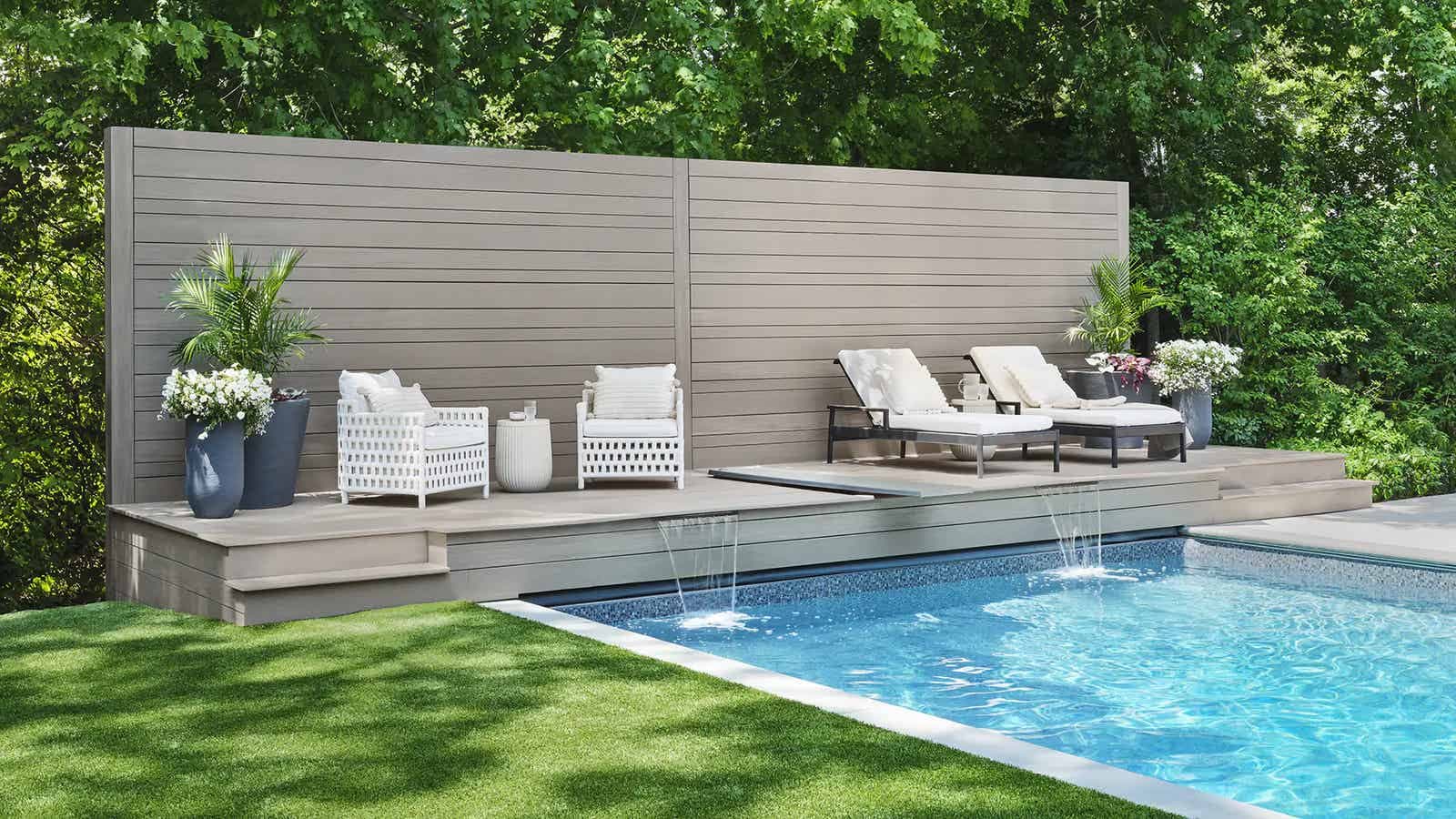
Why PVC Decking Excels Around Water
PVC decking is a 100% synthetic material, meaning it contains no wood fibers. This fundamental difference is key to its performance in pool terrace applications. Unlike wood or even wood-composite alternatives, PVC boards are waterproof to the core, making them highly resistant to moisture absorption.
This inherent water resistance means that standing water, constant splash zones, and even salt spray (if applicable) do not cause the material to swell, stain, or rot. This makes PVC a suitable choice for areas where boards are frequently wet, such as pool surrounds and docks, or even covered porches that may experience weather from multiple directions.
Additionally, PVC decking is engineered to be low maintenance. Its capped polymer surface is designed to shed common spills like grease and wine, allowing for easy cleaning with soap and water. This characteristic is particularly beneficial around a pool, where spills from sunscreens, drinks, or pool chemicals are more likely.
Certain PVC decking options may also offer heat-mitigating color choices, which can be a consideration for bare feet on sunny days around a pool.
PVC decking also weighs less than many hardwood options and even some composite materials. This lighter weight can facilitate easier handling during installation, which might be a factor for larger pool terrace projects.
Understanding PVC Decking Profiles and Appearance
Lumber Plus offers PVC decking from brands like Azek and TimberTech Azek, which are known for their advanced capped polymer boards. These lines, including Vintage, Landmark, and Harvest collections, aim to replicate the aesthetic of natural wood with deep, varied grain patterns and rich colors.
While 100% synthetic, the goal is often to provide a premium look that complements various architectural styles. When planning your pool terrace, consider how the chosen collection's appearance will integrate with your home's exterior and landscaping. Samples can help visualize the texture and color in your specific outdoor light.
The availability of different board widths and lengths can also influence your design. Planning your layout with these dimensions in mind can help minimize waste and create a more cohesive look. Fascia and trim boards are also available to create finished edges around the pool terrace and any steps.
Design Considerations for a Rochester Pool Terrace
For a pool terrace in Rochester, NY, several design factors come into play beyond just the decking material. The local climate, with its warm summers and snowy winters, necessitates a design that manages water effectively and withstands temperature fluctuations.
Drainage is paramount around a pool. Ensure your design incorporates proper sloping away from the pool and house foundation to prevent water accumulation on the deck surface or against structures. While PVC decking itself is waterproof, water pooling on the surface can still create slip hazards or contribute to ice formation in colder months.
Consider the overall layout: will the decking surround the entire pool, or will it connect to other paved areas or landscaping? Planning seamless transitions can enhance the usability and aesthetic of your outdoor space. Think about areas for lounge chairs, dining, or a fire pit, and how the decking will define these zones.
Ventilation beneath the deck is also important, even with PVC. While PVC doesn't rot, good airflow helps manage moisture and can contribute to the overall longevity of the substructure. Consult product-specific installation guides for recommended ventilation clearances.
Installation Planning and Substructure Requirements
Proper installation is crucial for the performance and lifespan of any decking, especially around a pool. While PVC decking is lighter than some alternatives, it still requires a robust and level substructure.
The substructure, typically made of pressure-treated lumber or steel, must be designed to meet local building codes and support the intended loads, including the weight of the decking, furniture, and people. It must also be able to withstand the moisture inherent in a pool environment.
Fastening methods also need careful consideration. Hidden fastening systems are popular for PVC decking as they create a clean, fastener-free surface, which can be more comfortable for bare feet around a pool. If face-fastening is used, ensure the fasteners are approved for PVC and suitable for outdoor, wet conditions to prevent corrosion and staining.
Board spacing is another critical detail. Always follow the manufacturer's specific guidelines for spacing between boards. This allows for proper drainage and accommodates any minor expansion or contraction due to temperature changes. Incorrect spacing can lead to issues with water management and the deck's appearance.
Hypothetical Project Example: A 12x20 Foot Pool Terrace
Let's consider a hypothetical pool terrace project measuring 12 feet by 20 feet, intended to surround one side of a swimming pool. The homeowner desires a seamless look with minimal visible fasteners.
If using 16-foot boards, fewer boards would be needed per run, but careful planning for cuts and waste would be essential.
Assuming a 5.5-inch wide board, and running the boards parallel to the 20-foot dimension, you would need 12 feet / (5.5 inches / 12 inches/foot) = 26.18 board widths. Rounding up, you'd need 27 boards of 20-foot length. Since 20-foot boards are not standard, you would likely use 12-foot or 16-foot boards. If using 12-foot boards, you would need 27 boards, each 12 feet long. If using 16-foot boards, you'd need 27 boards, each 16 feet long, and then cut them to fit the 12-foot width, resulting in some offcuts.
A more practical approach for a 12x20 foot area using common 12-foot and 16-foot board lengths would be to run the boards perpendicular to the 12-foot dimension, across the 20-foot length. For a 20-foot length, using 12-foot boards would require a seam. Using 16-foot boards would cover 16 feet, leaving a 4-foot section to be covered by cuts. If using 12-foot long boards, and laying them parallel to the 12-foot side, you would need 20 feet / (5.5 inches / 12 inches/foot) = 43.6 board widths. Rounding up, you would need 44 boards, each 12 feet long. This calculation does not account for waste from cuts or specific fastening system requirements.
For a clean, fastener-free surface, a hidden fastening system would be specified, requiring clips and screws suitable for PVC. Fascia boards would be selected to match the decking color and profile for the perimeter of the terrace. This example highlights the need for precise measurements and a detailed layout plan before ordering materials.
Before you order
- Confirm local building codes and permits required for deck construction in Rochester, NY.
- Measure your pool terrace area accurately, accounting for irregular shapes and transitions.
- Assess the existing substructure for condition, material, and compatibility with PVC decking.
- Choose a PVC decking collection (e.g., Vintage, Landmark, Harvest) that aligns with your aesthetic and performance needs.
- Select board widths and lengths to optimize layout and minimize waste.
- Plan for proper drainage and ventilation to manage moisture around the pool.
- Determine your preferred fastening method (hidden vs. face-fastened) and select compatible hardware.
- Consider fascia and trim options for a finished look.
- Account for any steps, railings, or built-in features in your design.
- Review cleaning and maintenance guidelines for your chosen PVC decking.
Confirm installation details, approved uses and warranty terms in the current instructions for the exact product and profile. Your installer should verify the substrate, structure and applicable project requirements.
This is a planning guide for projects in Rochester, NY. Ask our team to confirm availability, delivery to your ZIP code and which branch can support your order.
Questions to help you decide
Is PVC decking slippery when wet, especially around a pool?
The actual slip resistance can vary by product line and finish. Always ensure proper drainage to prevent standing water, which can contribute to slipperiness on any surface. For specific concerns, consult product specifications or consider samples to assess texture.
How does PVC decking withstand Rochester's winter weather?
PVC decking is engineered to be highly durable and resistant to moisture, which is beneficial for Rochester's snowy and icy winters. However, ice accumulation can still create slip hazards, so proper snow and ice removal practices are recommended. The material itself is designed to maintain its integrity in cold temperatures.
What kind of maintenance does PVC decking require around a pool?
PVC decking is known for its low maintenance. Around a pool, this typically involves regular cleaning with soap and water to remove dirt, sunscreen, and pool chemical residues. Avoid abrasive cleaners or harsh chemicals that could damage the capped surface. Refer to the manufacturer's cleaning guidelines for specific product recommendations to ensure you maintain any fade and stain coverage. Unlike wood, it does not require sanding, staining, or sealing.
Start Planning Your PVC Pool Terrace Today
Ready to transform your pool area with durable, low-maintenance PVC decking? Request a material quote with your project dimensions, desired profile, and ZIP code. Our team can help confirm current availability and service options for your Rochester, NY project.
Request a material quote →