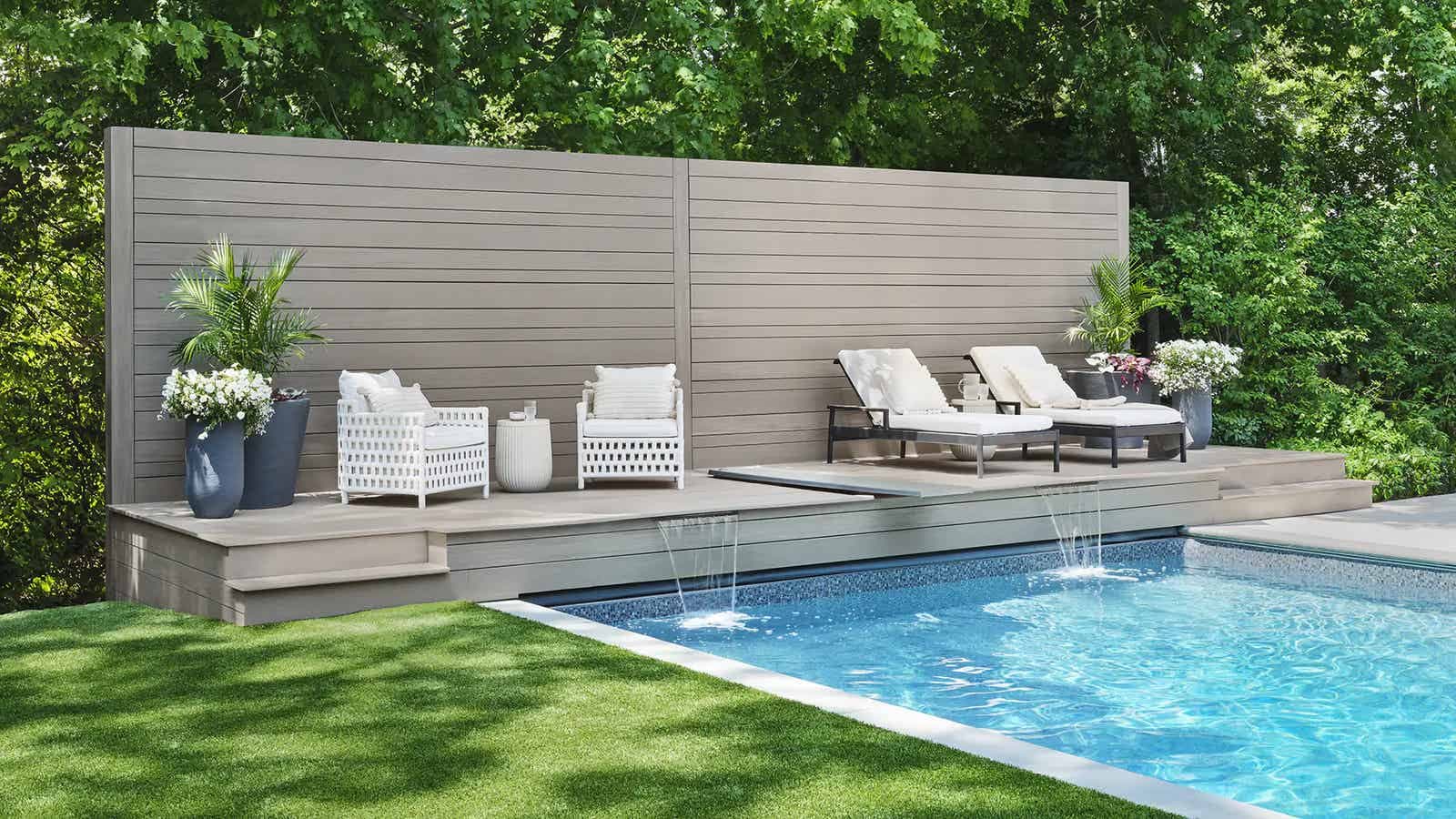
Why PVC Decking Suits Pool Terraces
The primary benefit of PVC decking for a pool terrace is its complete imperviousness to water. This makes it a reliable choice for areas where boards will frequently be wet.
Beyond water resistance, PVC decking is designed for low maintenance. Capped polymer surfaces shed common spills like grease and wine, allowing for easy cleaning with soap and water. This is particularly useful in a pool area where sunscreen, drinks, and food spills are common. Additionally, many PVC decking options offer heat-mitigating color choices, which can be a consideration for bare feet on hot Little Rock days.
PVC decking is also lighter than many hardwood and composite options, which can facilitate easier handling and installation. This can be an advantage for projects with specific structural requirements or for rooftop installations, though pool terraces are typically ground-level.
Selecting Your PVC Decking Profile and Finish
PVC decking is available in various collections, offering different aesthetics. For instance, the TimberTech Azek line includes Vintage, Landmark, and Harvest collections, which are known for their wood-look finishes. These collections provide a range of colors and textures that can complement your home's exterior and landscaping. When choosing a profile, consider the desired aesthetic – some mimic traditional wood grain closely, while others offer a more contemporary, smooth finish.
The choice of color is crucial, especially for a pool terrace. Lighter colors generally absorb less heat than darker ones, which can be more comfortable underfoot during sunny Arkansas summers. However, darker colors can create a striking visual contrast. Consider obtaining physical samples to see how different colors and finishes appear in natural light next to your pool and home.
Planning for Water Drainage and Substructure
While PVC decking itself is waterproof, proper substructure design and drainage are still essential for any deck, especially around a pool. Ensure your deck frame is built to allow for adequate water runoff away from the house and pool area. This prevents water from pooling underneath the deck, which can lead to issues with the substructure materials, even if the PVC boards are unaffected.
Consulting with a local contractor familiar with deck building codes and practices in Little Rock, AR, is recommended to ensure your substructure is properly designed and installed. They can advise on appropriate joist spacing, ledger board attachment, and ventilation for your specific project.
Edging and Fascia for a Finished Look
The edges of your pool terrace play a significant role in its overall appearance and safety. PVC decking systems typically offer matching fascia boards and trim pieces that can be used to create a clean, finished edge around the perimeter of your deck. These components are designed to coordinate with your chosen decking boards, ensuring a cohesive look.
Consider how the decking will meet other surfaces, such as coping stones around the pool, existing concrete patios, or landscaping. Proper transitions are key for both aesthetics and to prevent tripping hazards. Your contractor can help plan these details to ensure a seamless integration with your existing pool area.
Worked Example: Designing a 10x15 Foot Pool Terrace
Let's consider a hypothetical pool terrace project: a rectangular area measuring 10 feet by 15 feet. For this example, we'll use standard PVC decking boards that are 12 feet long and 5.5 inches wide, with a nominal coverage of 0.458 square feet per linear foot (5.5 inches / 12 inches per foot = 0.458 feet; 1 foot length * 0.458 feet width = 0.458 square feet).
The total area to cover is 10 feet * 15 feet = 150 square feet. If we run the boards parallel to the 15-foot dimension, each board will be 15 feet long. Since our available boards are 12 feet long, we will need to create seams. A common practice is to stagger seams for a more aesthetically pleasing and structurally sound deck.
To cover the 10-foot width, we need to determine how many 5.5-inch wide boards are required. 10 feet * 12 inches/foot = 120 inches. 120 inches / 5.5 inches/board = approximately 21.8 boards. We round up to 22 full boards to ensure full coverage.
Now, for the length. If we use 12-foot boards, to cover 15 feet, each row will require one full 12-foot board and a 3-foot section. For 22 rows, this means 22 * 12-foot boards and 22 * 3-foot sections. However, to minimize waste and create staggered seams, a more efficient approach would be to plan cuts. For instance, you could start one row with a full 12-foot board and a 3-foot cut, and the next row with a 3-foot cut and a 12-foot board. This effectively means for every 15 feet of linear coverage (one row), you need 1.25 of the 12-foot boards (15 ft / 12 ft per board = 1.25).
So, for 22 rows, you would need 22 rows * 1.25 boards/row = 27.5 boards. Since you can only purchase full boards, you would need to purchase 28 boards. This calculation assumes that the 3-foot offcuts from some boards can be used to start other rows. If offcuts are not reusable due to layout or damage, more boards may be needed. Always consult with your installer for a precise material takeoff, as specific product lengths and installation methods can impact the final quantity.
Before you order
- Confirm local building codes for deck construction around pools in Little Rock, AR.
- Evaluate PVC decking collections for desired color, texture, and heat-mitigating properties.
- Plan for proper drainage away from the pool and home, beneath the deck surface.
- Select matching fascia and trim for a finished edge, especially where the deck meets the pool coping.
- Consider the substructure materials to ensure compatibility and longevity in a moist environment.
- Review manufacturer's cleaning guidelines for compatible products to maintain your PVC deck.
- Consult with a professional for precise material takeoffs and installation planning.
Confirm installation details, approved uses and warranty terms in the current instructions for the exact product and profile. Your installer should verify the substrate, structure and applicable project requirements.
This is a planning guide for projects in Little Rock, AR. Ask our team to confirm availability, delivery to your ZIP code and which branch can support your order.
Questions to help you decide
Is PVC decking slippery when wet, especially around a pool?
Many manufacturers also offer specific collections or finishes that enhance slip resistance. It's always wise to exercise caution around wet pool areas, regardless of the decking material. Review specific product specifications for any slip resistance ratings.
How do I clean PVC decking around a pool?
PVC decking is generally easy to clean. Most spills, including pool chemicals, sunscreen, and food, can be wiped away with soap and water. For stubborn stains, manufacturers typically recommend specific cleaning products that are compatible with their decking materials. Avoid abrasive cleaners or pressure washers, as these can damage the surface. Always refer to the manufacturer's care and maintenance guidelines for the specific PVC decking product you choose.
Can PVC decking be installed directly on concrete around a pool?
While PVC decking can be installed over existing surfaces, it typically requires a proper substructure to allow for ventilation and drainage. Installing directly on concrete without adequate airflow can trap moisture and lead to issues with the substructure or even the underside of the decking. It's crucial to follow the manufacturer's installation instructions and local building codes, which usually require a framed substructure for adequate support and ventilation.
Request a Quote for Your Pool Terrace PVC Decking
Ready to plan your Little Rock, AR pool terrace? Provide your project dimensions, desired PVC decking profile, and ZIP code to request a material quote. Our team can help confirm current availability and service options for your project.
Request a material quote →