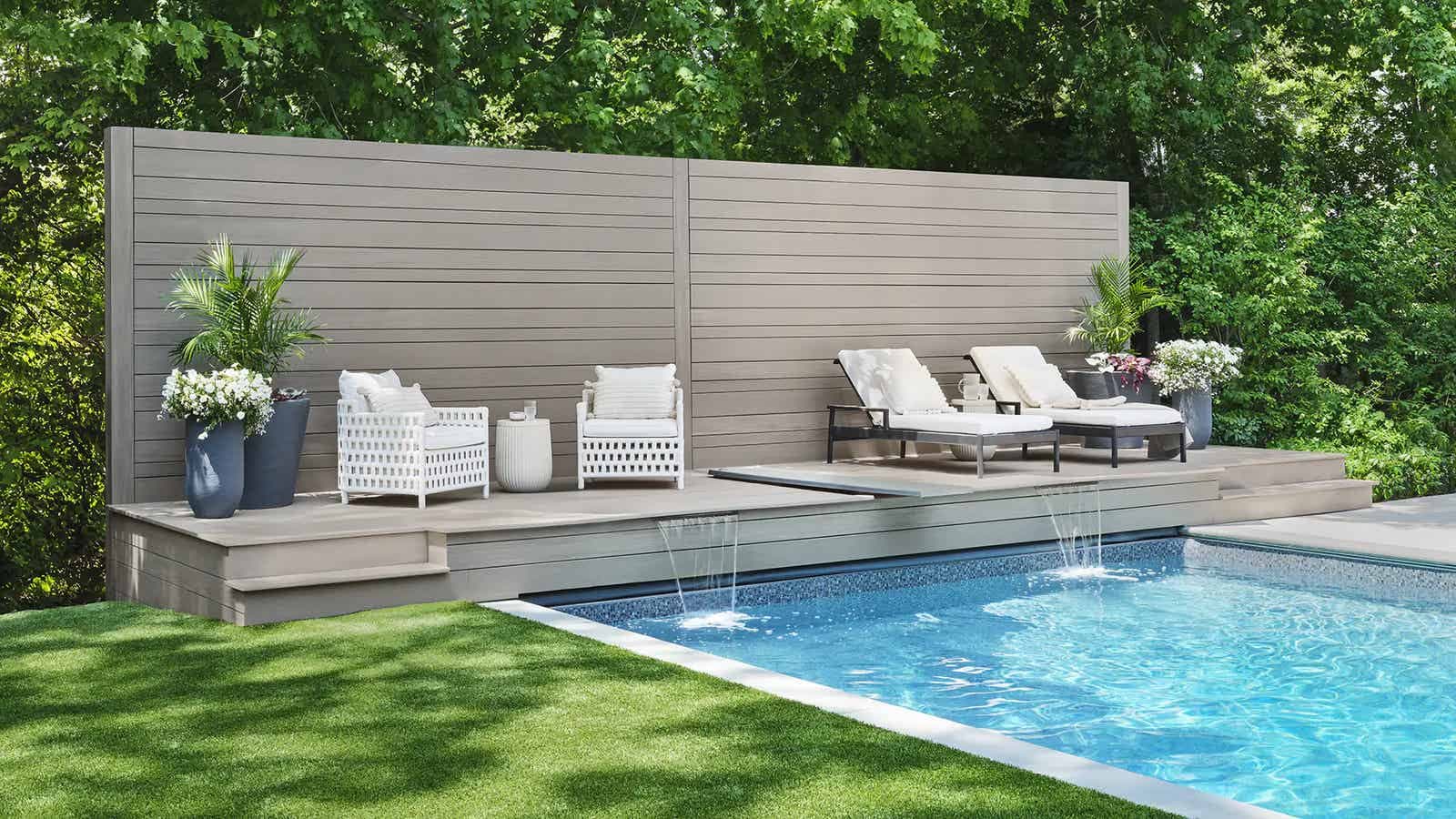
Why PVC Decking Excels Around Pools
PVC decking is a fully synthetic material, meaning it contains no wood fibers. This characteristic is crucial for pool surrounds because it makes the material inherently waterproof to its core. Where other materials might absorb moisture, leading to swelling, warping, or the potential for mold and mildew, PVC remains stable.
This imperviousness to water makes PVC decking a preferred option for areas that are consistently wet, such as pool surrounds and splash zones. It eliminates concerns about water damage that can compromise the structural integrity and appearance of a deck over time. Additionally, the lack of wood content means PVC decking is not susceptible to rot, a common issue for wood products in high-moisture environments.
Beyond its water resistance, PVC decking is designed for easy maintenance. Spills like grease or wine can typically be wiped clean with soap and water, which is a significant advantage in a high-traffic area like a pool terrace. Some PVC options also offer heat-mitigating color choices, which can make the deck surface more comfortable underfoot during hot Lincoln summers. These combined features contribute to a low-maintenance deck that allows more time for enjoyment and less for upkeep.
The material's lighter weight compared to hardwood and some composites can also simplify installation, particularly for larger projects or those involving elevated structures.
Considering Appearance and Collections
PVC decking is available in various collections that offer different aesthetic profiles, from deep wood looks to more contemporary finishes. For a pool terrace, the visual appeal is as important as the functional benefits, contributing to the overall ambiance of your outdoor living space.
For example, collections such as Vintage, Landmark, and Harvest often feature advanced capping and deeper wood grain textures, providing a sophisticated look that can complement various architectural styles. These options allow you to achieve the rich appearance of natural wood without the associated maintenance challenges.
When selecting a collection, consider the existing architecture of your home and landscaping. A lighter color might be desirable for its heat-mitigating properties, while a darker shade could offer a striking contrast. Lumber Plus offers PVC decking options from manufacturers like Azek and TimberTech Azek, which are known for their range of styles and finishes. Visiting the product page at /decking/pvc can help you visualize the available choices and how they might integrate with your pool terrace design.
Planning for Drainage and Ventilation
Even with a waterproof material like PVC, proper drainage and ventilation beneath your deck are essential. While the boards themselves are resistant to water absorption, water can still accumulate on the surface and in the substructure. Effective drainage prevents standing water, which can contribute to algae growth on the deck surface and may affect the longevity of the substructure components.
Adequate ventilation helps to dry out the space beneath the deck, reducing humidity and preventing potential issues with mold or mildew on the framing. This is particularly important in a humid environment or after heavy rainfall. Consult manufacturer guidelines for recommended board spacing and substructure ventilation requirements to ensure optimal performance.
Consider the slope of your sub-grade or concrete slab beneath the deck. A slight slope away from the pool and house can help direct water runoff efficiently. If your deck is built over a concrete slab, ensure there are sufficient gaps or channels for water to escape.
Edge Finishing and Safety Around the Pool
The edges of your pool terrace require careful planning for both aesthetics and safety. PVC decking can be finished with various trim options, including fascia boards and stair risers, to create a cohesive and polished look. These finishing pieces are designed to match the decking boards, providing a seamless transition from the deck surface to the surrounding areas.
For pool surrounds, consider how the deck meets the pool coping. A smooth, well-defined edge is important to prevent tripping hazards. Some designs incorporate a picture-frame border, which not only enhances the visual appeal but can also define the perimeter of the deck.
The texture and finish of the specific PVC product you choose will influence its traction. Always refer to manufacturer specifications for details on slip resistance and ensure the chosen product meets your expectations for a safe pool environment. Regular cleaning helps maintain the surface texture and prevent the buildup of slippery residues.
Hypothetical Project Example: A 15x20-foot Pool Terrace
Let's consider a hypothetical pool terrace project in Lincoln, NE, measuring 15 feet by 20 feet, totaling 300 square feet. For this example, we'll assume a standard PVC decking board width of 5.5 inches and various available lengths, such as 12, 16, and 20 feet.
If we opt for a linear layout, running the 20-foot long boards parallel to the 15-foot side, we would need 15 feet / 5.5 inches (or 15 * 12 / 5.5) approximately 32.7 boards to cover the width. Since boards must be purchased in full lengths, we would need 33 boards. For the 20-foot length, we would use 20-foot boards, requiring 33 boards x 20 feet = 660 linear feet.
However, to minimize waste and account for potential cuts, a detailed layout plan is crucial. For instance, if the 15-foot dimension is perpendicular to the house, and we are using 16-foot boards, we might need a combination of 16-foot and 12-foot boards or strategic cuts. A professional layout plan will optimize material use and account for cutting. Assuming a simple linear layout with 20-foot boards running the full 20-foot length, you would need enough boards to cover the 15-foot width.
15 feet = 180 inches. Board width = 5.5 inches. Number of boards needed: 180 inches / 5.5 inches = 32.72. Round up to 33 boards. Each board is 20 feet long. Total linear feet: 33 boards * 20 feet/board = 660 linear feet. This equates to 33 individual 20-foot boards.
Remember to also account for fascia boards for the perimeter. If the 15x20-foot deck has three exposed sides (one side against the house), the perimeter for fascia would be 15 + 20 + 15 = 50 linear feet. If 16-foot fascia boards are available, you would need 50 / 16 = 3.125, so 4 boards. Always add a percentage for waste and future repairs, typically 5-10% for decking and fascia. For this example, 660 linear feet of decking plus 4 boards of fascia, with a 10% waste factor, would be approximately 726 linear feet of decking and 5 fascia boards.
Before you order
- Confirm the specific PVC decking product's suitability for continuous wet exposure and pool chemicals.
- Review available color and texture options, considering heat mitigation properties for summer conditions.
- Verify manufacturer recommendations for substructure, drainage, and ventilation around pool environments.
- Plan for edge finishes, fascia boards, and transitions to pool coping or surrounding hardscaping.
- Calculate material quantities accurately, accounting for waste and potential cuts, especially for irregular shapes.
- Understand the cleaning and maintenance requirements for the chosen PVC decking to preserve its appearance.
- Consider the project timeline and lead times for material delivery to Lincoln, NE.
Confirm installation details, approved uses and warranty terms in the current instructions for the exact product and profile. Your installer should verify the substrate, structure and applicable project requirements.
This is a planning guide for projects in Lincoln, NE. Ask our team to confirm availability, delivery to your ZIP code and which branch can support your order.
Questions to help you decide
Is PVC decking slippery when wet?
The specific slip resistance can vary by product line and finish. Always review the manufacturer's specifications for the chosen PVC decking to understand its performance in wet conditions. Regular cleaning can also help maintain the surface texture and prevent the buildup of residues that might reduce traction.
How do I clean PVC decking around a pool?
PVC decking is generally easy to clean. For routine maintenance, a simple wash with soap and water is often sufficient to remove dirt, pool chemicals, and light stains. For more stubborn marks, always refer to the manufacturer's specific cleaning guidelines for the product you have selected. Avoid abrasive cleaners or pressure washers that could damage the surface finish.
Does PVC decking get hot in the sun?
All decking materials, including PVC, can absorb heat from the sun. However, many PVC decking lines offer 'heat-mitigating' or lighter color options that are designed to absorb less solar radiation and remain cooler to the touch compared to darker colors. When selecting your PVC decking, consider the sun exposure of your pool terrace in Lincoln, NE, and inquire about specific color properties if surface temperature is a concern.
Ready to Plan Your PVC Decking Pool Terrace?
Request a material quote with your project dimensions, desired PVC decking profile, and your ZIP code. We can confirm current availability and service options for your Lincoln, NE project. Explore our full range of decking options, including hardwood and composite, at /decking, /decking/hardwood, /decking/hardwood/ipe, and /decking/composite.
Request a material quote →