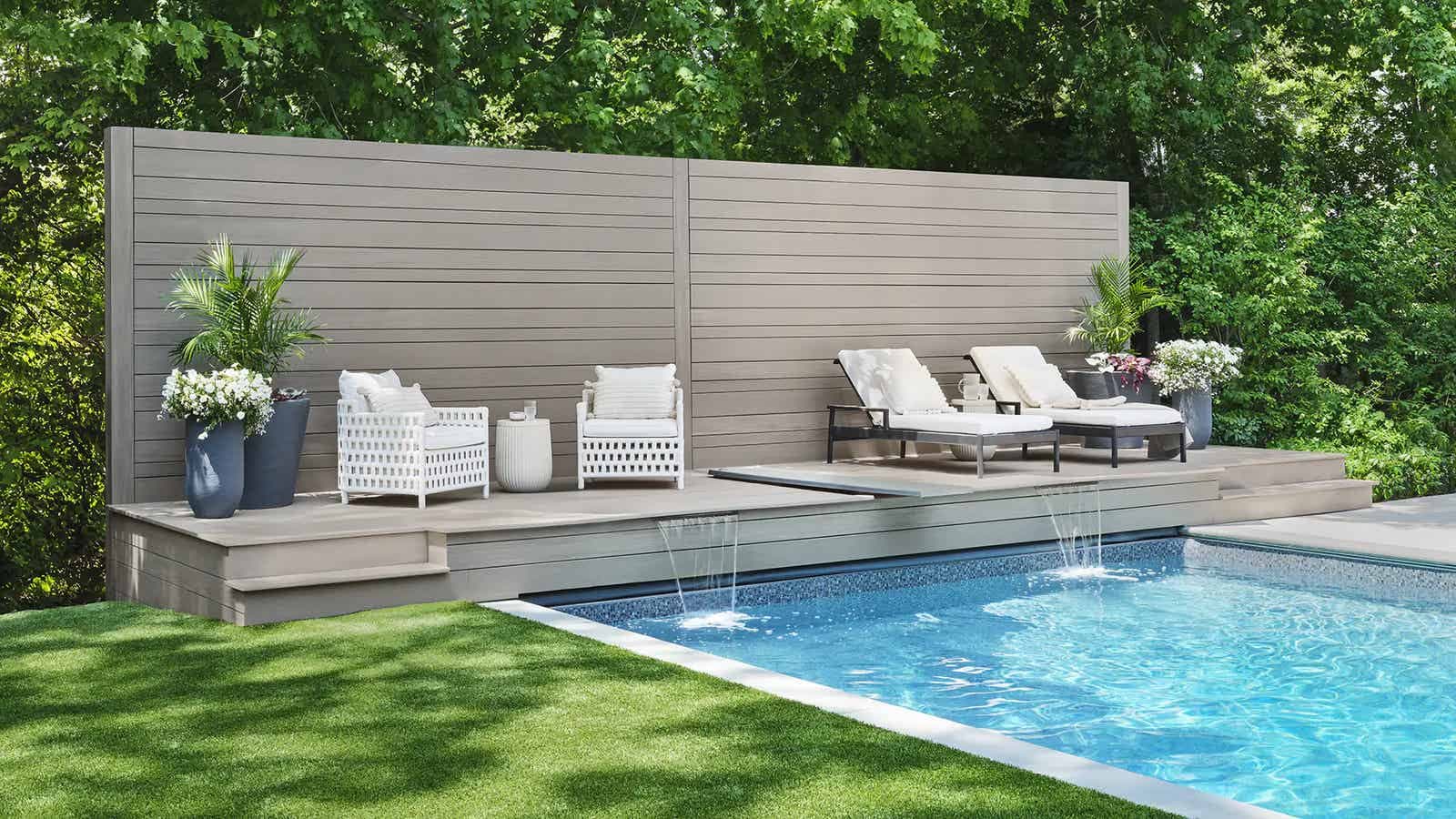
Why PVC Decking for Pool Terraces?
PVC decking is engineered for environments where moisture is a constant factor. Its 100% synthetic composition means that standing water, splash zones, and even salt spray from a pool have no wood fiber to swell, stain, or rot. This core waterproof characteristic makes it a suitable option for pool surrounds and other areas that experience frequent wetting.
Beyond its water resistance, PVC decking is known for its low maintenance requirements. Capped polymer surfaces are designed to shed common spills like grease and wine, often cleaning with just soap and water. This ease of cleaning is a practical benefit for pool areas where spills and splashes are common occurrences. Some PVC decking options also feature heat-mitigating color choices, which can be a consideration for bare feet on sunny Jefferson City days.
The material also tends to be lighter than traditional hardwood and some composite options, which can facilitate easier handling during installation, particularly for larger projects or elevated structures. This lightweight nature does not compromise its structural integrity when installed correctly over an appropriate substructure.
Understanding PVC Decking Profiles and Appearance
PVC decking is available in various collections, offering different aesthetics and textures. For example, lines like TimberTech Azek offer full PVC boards with advanced capping designed to mimic the appearance of natural wood, including deep wood grains.
These collections, such as Vintage, Landmark, and Harvest, provide a range of colors and finishes. When selecting for a pool terrace, consider how the chosen profile and color will complement your home's exterior and landscaping. Lighter colors may offer better heat reflection, a practical benefit for sun-exposed pool decks in Jefferson City summers, while darker tones might offer a more dramatic aesthetic.
It's important to view physical samples of the decking to accurately assess color, texture, and how it might appear in different lighting conditions around your pool area. The exact profiles and available lengths will influence your design and installation plan.
Planning for Water Management and Drainage
Even with a waterproof decking material like PVC, proper water management beneath and around your pool terrace is crucial. The substructure must be designed to allow for adequate drainage, preventing water from pooling underneath the deck boards. This helps maintain the integrity of the substructure and prevents issues like mildew or pest harborage.
Consider the slope of the ground beneath the deck and ensure any landscaping or hardscaping adjacent to the deck is graded away from the structure. For ground-level pool surrounds, ensuring a permeable base or sufficient gaps for water runoff is important. While PVC boards themselves resist moisture, the environment they are installed in still requires attention to drainage.
Review manufacturer guidelines for recommended board spacing, as this can play a role in surface water runoff. While PVC is waterproof, ensuring water can escape the deck surface quickly contributes to a safer, less slippery environment around the pool.
Installation Considerations for Pool Terraces
Proper installation is essential for any decking material, and PVC decking around a pool has specific requirements. Always follow the manufacturer's installation instructions precisely. This includes guidelines for joist spacing, fastener types (hidden or face-fastened), and expansion/contraction gaps.
For pool surrounds, consistent board spacing is particularly important to manage water runoff and ensure a uniform appearance. Fasteners must be suitable for wet environments to prevent corrosion. If using hidden fasteners, confirm they are compatible with the chosen PVC board profile and intended for outdoor, wet applications.
Consider the edges of your pool terrace. Fascia boards and trim pieces are available to provide a finished look and conceal the substructure. Planning these details during the design phase ensures a cohesive and professional appearance for your Jefferson City pool area.
Worked Example: Designing a Rectangular Pool Terrace
Let's consider a hypothetical rectangular pool terrace project for a home in Jefferson City, MO. The pool is 15 feet long by 8 feet wide, and the homeowner wants a surrounding deck that extends 3 feet out from all sides of the pool, creating a 3-foot wide perimeter walkway.
First, calculate the total dimensions of the deck: (15 ft + 3 ft + 3 ft) long by (8 ft + 3 ft + 3 ft) wide, which is 21 feet by 14 feet. The total deck area is 21 ft * 14 ft = 294 square feet. We will use PVC decking boards that are 5.5 inches wide (0.458 feet) and available in 16-foot lengths.
To estimate the number of boards needed for the 21-foot length, we would need 21 ft / 0.458 ft/board = 45.85 boards. Since boards are typically laid parallel to the shorter dimension (14 feet) to minimize cuts and seams, we'll calculate the number of boards needed to cover the 21-foot length. For a 21-foot length, using 16-foot boards would require one 16-foot board and one 5-foot cut piece per run. So, 21 ft / 0.4684 ft/board = 44.83, meaning 45 board runs are needed. Each run is 14 feet long. So, 45 runs * 14 ft/run = 630 linear feet. If using 16-foot boards, 630 linear feet / 16 ft/board = 39.375 boards. This would mean purchasing 40 boards of 16-foot length. This calculation assumes minimal waste and ideal cuts. Always add a waste factor (typically 5-10%) for cuts and errors. For this example, let's add 10%, bringing the total to 44 boards. This is a simplified calculation; a detailed cut plan is recommended.
This example illustrates the need for precise measurements and accounting for board dimensions, gaps, and waste when planning your material order. Always confirm the exact board dimensions and recommended spacing from the manufacturer.
Before you order
- Confirm the local building codes and permits required for deck construction around a pool in Jefferson City, MO.
- Verify manufacturer recommendations for PVC decking suitability in continuous wet environments and direct sun exposure.
- Select a PVC decking color and finish that complements your home's aesthetic and considers heat mitigation for bare feet.
- Plan for adequate drainage beneath and around the deck structure to prevent water pooling.
- Choose appropriate fasteners (hidden or face-fastened) designed for outdoor and wet applications, compatible with your chosen PVC boards.
- Account for expansion and contraction of PVC boards based on local temperature fluctuations in Jefferson City.
- Design an edge treatment using fascia or trim boards for a finished appearance around the pool terrace.
- Estimate material quantities, including a waste factor, based on your deck dimensions and chosen board lengths.
- Review cleaning and maintenance instructions specifically for your selected PVC decking to ensure longevity.
Confirm installation details, approved uses and warranty terms in the current instructions for the exact product and profile. Your installer should verify the substrate, structure and applicable project requirements.
This is a planning guide for projects in Jefferson City, MO. Ask our team to confirm availability, delivery to your ZIP code and which branch can support your order.
Questions to help you decide
Is PVC decking slippery when wet, especially around a pool?
While PVC decking is designed for wet environments, any surface can become slippery when wet, particularly if algae, leaves, or other debris are present. Some PVC decking products may offer textured surfaces or specific finishes to enhance traction. Regular cleaning and ensuring proper drainage can help minimize slipperiness. Always exercise caution on any wet deck surface.
How does PVC decking withstand the sun and heat in Jefferson City, MO?
PVC decking is engineered to be durable in various climates. Many PVC decking lines offer 'heat-mitigating' color options that are designed to absorb less heat, which can be a consideration for pool decks exposed to direct sunlight in Jefferson City summers. However, all decking materials will absorb some heat, and darker colors generally absorb more. It's advisable to check manufacturer specifications regarding heat performance for specific product lines.
What kind of maintenance does PVC decking require for a pool terrace?
PVC decking is known for being low-maintenance compared to wood. For a pool terrace, regular cleaning with soap and water is typically sufficient to remove dirt, pool chemicals, and general debris. It's important to promptly clean up spills, especially those from sunscreens or food, to prevent staining. Always refer to the manufacturer's specific cleaning and maintenance guidelines for your chosen PVC decking product, as some cleaning agents may not be compatible.
Ready to Plan Your PVC Decking Pool Terrace?
Request a material quote with your project dimensions, exact profile preferences, and ZIP code to confirm current availability and service options for your Jefferson City, MO, home.
Request a material quote →