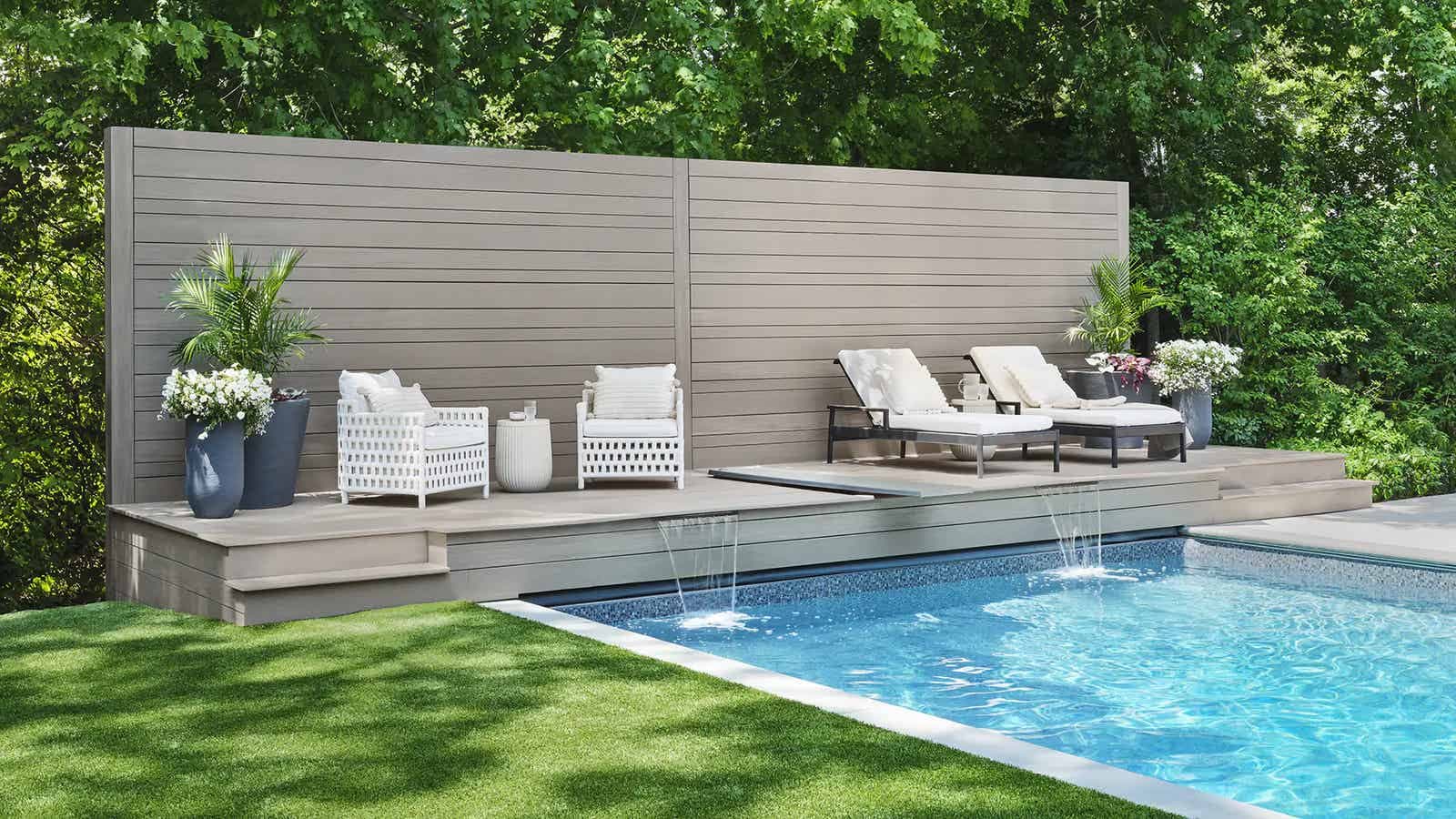
Why PVC Decking Excels in Pool Environments
A pool terrace demands a material that can endure constant moisture without degradation. PVC decking is entirely synthetic, meaning it contains no wood fibers. This characteristic makes it inherently waterproof to the core and resistant to the effects of standing water, splash zones, and even salt spray. Traditional wood can swell, warp, or rot over time in such conditions, requiring significant upkeep.
The advanced capping on high-quality PVC boards further enhances their performance, making them resistant to stains from common poolside spills like sunscreen, food, or drinks. This ease of cleaning contributes to a lower maintenance routine compared to wood or some composite options, allowing more time to enjoy your outdoor space. Many PVC options also offer heat-mitigating color choices, which can be a valuable consideration for bare feet on sunny Detroit days.
PVC decking is often a default specification for areas where boards frequently get wet, including pool surrounds and docks, due to its inherent resistance to moisture and its ability to shed grease and wine, wiping clean with soap and water.
Understanding PVC Decking Profiles and Appearance
PVC decking is available in various collections that offer different aesthetics, from deep wood looks to more contemporary finishes. For a pool terrace, consider profiles that complement your home's architecture and landscaping.
For instance, the TimberTech Azek line, a full PVC board with advanced capping, is available in collections like Vintage, Landmark, and Harvest, which are known for their deep wood-like textures and varied color palettes. These options provide the visual appeal of wood without the associated maintenance concerns of a poolside environment. When planning your project, consider obtaining samples to assess how the colors and textures appear in different lighting conditions around your pool.
Planning for Weight and Installation Efficiency
PVC decking offers a practical advantage in terms of weight, which can impact handling and installation. PVC generally weighs less than hardwood and even some composite decking materials. This lighter weight can translate to faster handling during installation, which can be particularly beneficial for larger pool terrace projects.
While PVC is lighter, proper framing and support are still crucial. Always follow the manufacturer's specific installation guidelines for joist spacing and fastening systems to ensure structural integrity and proper ventilation beneath the deck. Consult with your contractor or installer to confirm the suitability of your existing or planned substructure for PVC decking.
Maintenance and Longevity in a Pool Setting
One of the primary reasons homeowners choose PVC decking for a pool terrace is its low-maintenance profile. The 100% synthetic composition means there's no need for sanding, staining, or sealing, which are typical requirements for wood decks.
Routine cleaning typically involves soap and water to remove dirt, pool chemicals, and common spills. For specific cleaning products, always refer to the manufacturer's recommendations to ensure compatibility and avoid damaging the surface. The advanced capping on PVC boards helps them resist stains and fading, contributing to their long-term appearance and minimizing the need for intensive upkeep, even with consistent exposure to sun and pool water.
A Hypothetical Pool Terrace Project Example
Consider a rectangular pool terrace project for a Detroit home, measuring 20 feet by 15 feet. This area totals 300 square feet. If you select PVC decking boards that are 5.5 inches wide and 16 feet long, you'll need to calculate the number of boards.
First, determine how many boards are needed to cover the 15-foot width: 15 feet = 180 inches. 180 inches / 5.5 inches per board = approximately 32.73 boards. Round up to 33 boards for the width. Each board is 16 feet long, so for the 20-foot length, you'll have some offcuts. However, since the boards are typically installed parallel to the longer dimension, you'll need to plan for cuts. For a 20-foot length, you'll need two 10-foot pieces from each 16-foot board, or one 16-foot piece and one 4-foot piece. Given the 16-foot board length, you would need to purchase enough boards to cover the 20-foot run, potentially requiring more cuts and careful planning to minimize waste. Always add a percentage (e.g., 5-10%) for cuts and waste.
For a 20-foot x 15-foot area, assuming boards run parallel to the 20-foot length: The 15-foot width (180 inches) divided by 5.5-inch board width means approximately 33 boards laid side-by-side. Each board needs to be at least 20 feet long. If using 16-foot boards, you would need to plan for seams. If you prefer seamless runs, you would need to source longer boards or accept a seam. If using 16-foot boards, you'd need 33 boards for the width, and each 'run' would require two boards (one 16-foot and one 4-foot cut from another board), resulting in 33 x 2 = 66 board segments. To minimize waste, you would need to plan precise cuts and utilize offcuts effectively. A more straightforward approach would be to calculate linear footage: 20 feet x 33 boards = 660 linear feet. If boards are 16 feet long, 660 / 16 = 41.25, so you would need to purchase 42 boards of 16-foot length, plus waste.
Before you order
- Assess your pool's specific exposure to sun, shade, and splash zones.
- Review PVC decking collections for desired aesthetics (wood grain, solid color, texture).
- Verify manufacturer's installation guidelines for joist spacing and fastening for your region.
- Consider heat-mitigating color options if your deck will be in direct sun.
- Plan for proper drainage and ventilation underneath the deck to prevent moisture buildup.
- Confirm cleaning and maintenance requirements for the chosen PVC product.
- Measure your project area accurately and calculate material needs, including waste factor.
Confirm installation details, approved uses and warranty terms in the current instructions for the exact product and profile. Your installer should verify the substrate, structure and applicable project requirements.
This is a planning guide for projects in Detroit, MI. Ask our team to confirm availability, delivery to your ZIP code and which branch can support your order.
Questions to help you decide
Is PVC decking slippery when wet?
Many manufacturers design their boards with embossed textures that help provide grip. Always consult product specifications for specific slip resistance ratings, and consider textured finishes for areas prone to being wet, such as around a pool.
Can PVC decking be installed directly on concrete around a pool?
Installing PVC decking directly on concrete is generally not recommended without proper ventilation and a substructure. PVC decking, like most decking materials, requires adequate airflow underneath to prevent moisture buildup and allow for proper thermal expansion and contraction. A sleeper system or a traditional joist and beam frame would typically be installed over concrete to create the necessary air gap and support the decking boards. Always follow the manufacturer's installation instructions for your specific product.
How does PVC decking handle Detroit's winter weather?
PVC decking is engineered to withstand various weather conditions, including freezing temperatures and snow common in Detroit winters. Its synthetic composition prevents it from absorbing moisture, which means it is less susceptible to freeze-thaw damage, cracking, or warping that can affect wood. However, proper installation with adequate ventilation is crucial for optimal performance in all seasons.
Ready to Plan Your PVC Pool Terrace?
Request a material quote for your project. Provide your project dimensions, desired PVC decking profile, and ZIP code to get started. Our team can help confirm current availability and service options for your Detroit-area project. Explore our full range of PVC decking products here: [https://www.lumberplus.com/decking/pvc](https://www.lumberplus.com/decking/pvc) and other decking options like [https://www.lumberplus.com/decking](https://www.lumberplus.com/decking), [https://www.lumberplus.com/decking/hardwood](https://www.lumberplus.com/decking/hardwood), [https://www.lumberplus.com/decking/hardwood/ipe](https://www.lumberplus.com/decking/hardwood/ipe), and [https://www.lumberplus.com/decking/composite](https://www.lumberplus.com/decking/composite).
Request a material quote →