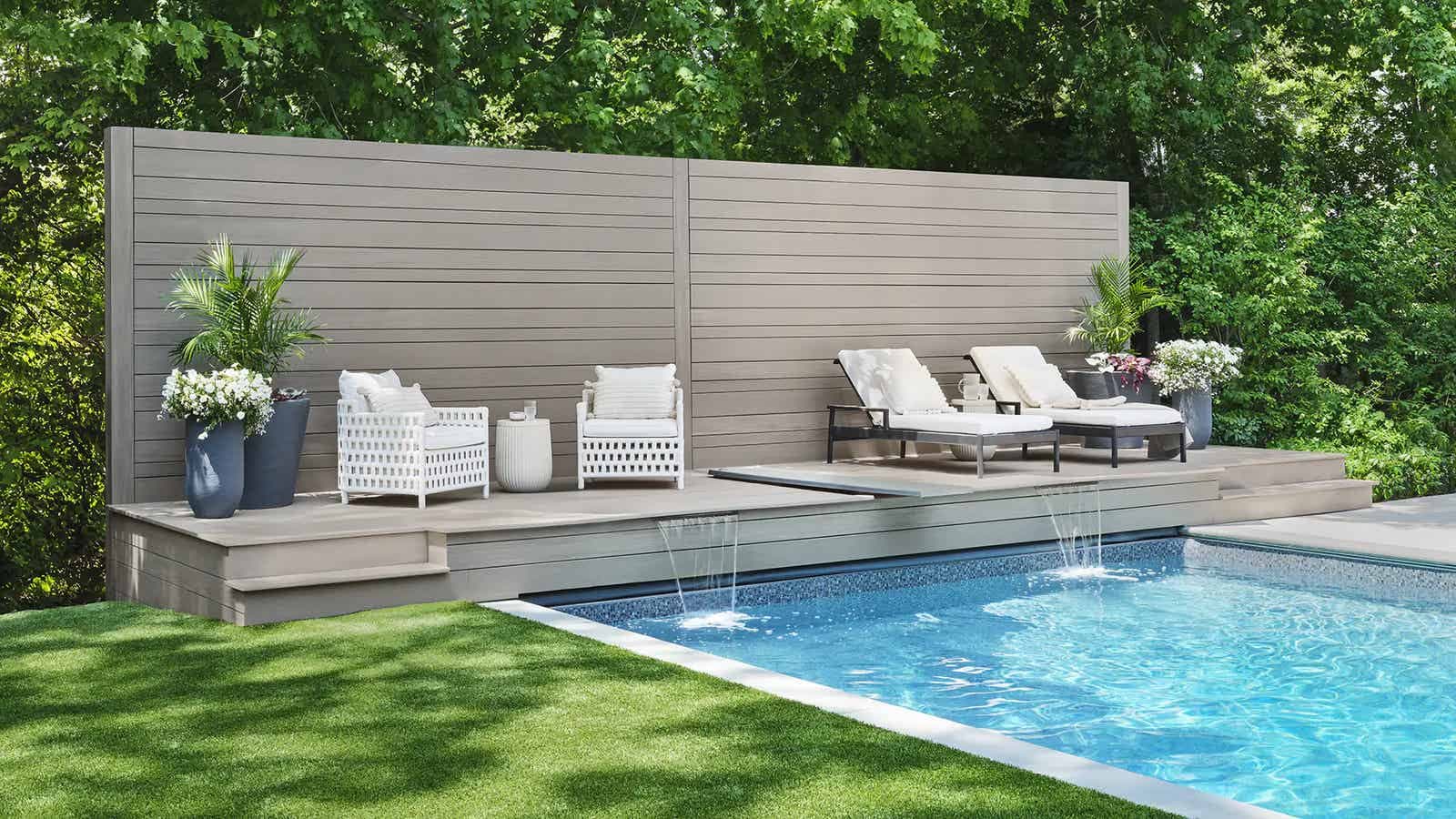
Why PVC Decking Excels in Pool Environments
Pool terraces are inherently exposed to water, chlorine, and UV radiation. These conditions can challenge many decking materials, leading to issues like swelling, staining, or rot over time. PVC decking, being 100% synthetic and free of wood fiber, is designed to resist these common problems.
Its waterproof nature means that standing water, splash zones, and even occasional chemical exposure from pool water are less likely to impact the material's integrity. This resilience helps maintain the deck's appearance and structural stability in a consistently wet environment. The material's advanced capping also contributes to its ability to shed liquids and resist stains from common poolside spills like grease or wine, making cleaning straightforward.
Furthermore, PVC decking is often chosen for areas where boards are expected to live wet, such as docks and covered porches that may experience weather from both sides. This inherent resistance to moisture makes it a practical choice for the consistent splash and humidity associated with a pool area.
Key Benefits for Columbus, OH Pool Owners
For homeowners in Columbus, OH, planning a pool terrace, PVC decking offers several practical advantages. The material's low maintenance requirements mean less time spent on sealing, staining, or sanding, allowing more time to enjoy your outdoor space. Its capped polymer surface is designed to be easy to clean, typically requiring only soap and water.
The lighter weight of PVC compared to hardwood or even some composite materials can also be a benefit during installation, potentially leading to faster handling and easier installation. This can be a consideration for projects with specific logistical challenges or tight timelines.
Additionally, some PVC decking options offer heat-mitigating color choices, which can be an important factor for pool decks that receive significant sun exposure, helping to keep the surface more comfortable underfoot.
Designing Your Pool Terrace with PVC Decking
PVC decking is available in various collections, such as the Vintage, Landmark, and Harvest lines, which offer a range of aesthetic options, including deep wood looks. This allows for design flexibility to complement different architectural styles and landscaping themes.
When planning your pool terrace, consider the overall layout, including pathways, seating areas, and transitions to other hardscaping or landscaping elements. PVC decking can be integrated with other outdoor materials to create a cohesive design. Think about board widths and lengths to minimize seams and create a visually appealing pattern. For projects that require specific edge finishes or fascia, ensure that compatible PVC trim options are available to maintain a consistent look.
While PVC decking is resistant to moisture, proper deck design should still account for adequate drainage around the pool area to prevent water from pooling against the house foundation or other structures. Consult with your installer to ensure appropriate spacing between boards for water runoff and ventilation, following manufacturer guidelines.
Considerations for Installation and Maintenance
While PVC decking is known for its low maintenance, regular cleaning is still recommended to keep your pool terrace looking its best. The capped polymer surface generally sheds grease and wine and can be wiped clean with soap and water. Always refer to the manufacturer's specific cleaning instructions to ensure compatibility with cleaning products.
For installation, it's important to follow the manufacturer's guidelines for fastening and board spacing. These instructions are critical for ensuring the deck's stability and proper performance, especially in areas with significant temperature fluctuations. While PVC is lighter, proper substructure planning is still essential to support the deck and any planned loads, such as furniture or planters.
When planning your project, remember that PVC decking is designed to be 100% synthetic, with zero wood fiber. This means it behaves differently from wood, and installation techniques should reflect these material properties. Confirm the exact assembly and support requirements for your chosen product.
Example: Calculating PVC Decking for a 10x15 Foot Pool Terrace
Let's consider a hypothetical pool terrace project in Columbus, OH, measuring 10 feet by 15 feet. This area totals 150 square feet. For this example, we'll assume PVC decking boards are available in 12-foot lengths and are 5.5 inches wide.
First, calculate the square footage per board: 12 feet * (5.5 inches / 12 inches/foot) = 5.5 square feet per board. To cover 150 square feet, you would need approximately 150 / 5.5 27.27 boards. Since you cannot purchase partial boards, you would need to buy 28 boards to cover the area. This calculation provides an area-equivalent coverage.
However, a practical layout will influence the actual quantity. To cover the 15-foot length, you would need 15 feet / (5.5 inches / 12 inches/foot) 32.7 boards. Rounding up, you would need 33 boards, each 12 feet long. This yields 33 * 12 = 396 linear feet.
If laying boards parallel to the 10-foot dimension, you would need 10 feet / (5.5 inches / 12 inches/foot) 21.8 boards. Rounding up, you would need 22 boards, each 15 feet long. Since boards are 12 feet long, you would need to run two boards end-to-end for each row, creating a seam. For a 10-foot width, you'd need 22 rows. Each row requires two 12-foot boards (totaling 24 feet), with a 10-foot section used from each. Therefore, 22 rows * 2 boards/row = 44 boards. This yields 44 * 12 = 528 linear feet.
This example illustrates that the layout direction and available board lengths significantly impact the required quantity and potential for seams and offcuts. Always create a detailed cut plan for your specific project dimensions to accurately determine the number of full boards needed, accounting for waste and any reusable offcuts. It's advisable to order a small percentage extra for cuts and unforeseen circumstances.
Before you order
- Is PVC decking suitable for constant wet exposure around my pool?
- What specific cleaning and maintenance routines are recommended for PVC pool decks?
- Are there heat-mitigating color options available for my sun-exposed terrace?
- What are the available board profiles, widths, and lengths for my design?
- How does PVC decking compare in weight and installation ease to other materials?
- What are the specific manufacturer guidelines for substructure, fastening, and board spacing?
- Are compatible fascia and trim pieces available for a finished look?
- How will the decking integrate with existing landscaping and drainage around the pool?
- What is the estimated material quantity based on my specific layout and board lengths?
Confirm installation details, approved uses and warranty terms in the current instructions for the exact product and profile. Your installer should verify the substrate, structure and applicable project requirements.
This is a planning guide for projects in Columbus, OH. Ask our team to confirm availability, delivery to your ZIP code and which branch can support your order.
Questions to help you decide
Is PVC decking slippery when wet?
While PVC decking is designed for wet environments, its slip resistance can vary by product line and surface texture. Some manufacturers offer specific textures or finishes intended to enhance traction. It is always recommended to review the product specifications for slip resistance ratings and consider how the chosen finish will perform in a wet pool area.
How does PVC decking withstand chlorine and pool chemicals?
PVC decking is inherently resistant to many common pool chemicals, including chlorine, due to its synthetic composition. However, it's always best to clean up spills promptly and follow manufacturer guidelines for cleaning and maintenance to preserve the deck's appearance over time.
Can PVC decking be installed directly over an existing concrete patio?
The feasibility of installing PVC decking directly over an existing concrete patio depends on several factors, including the condition of the concrete, proper drainage, and the specific installation system. Often, a sleeper system or adjustable pedestals are used to create a level surface and allow for ventilation and drainage beneath the deck. Consult with an experienced installer and refer to manufacturer guidelines for approved installation methods over concrete.
Ready to Plan Your PVC Pool Terrace?
Request a material quote with your project dimensions, desired PVC profile, and ZIP code to confirm current availability and service options for your Columbus, OH project. Our team can assist with product selection and provide guidance for your outdoor space.
Request a material quote →