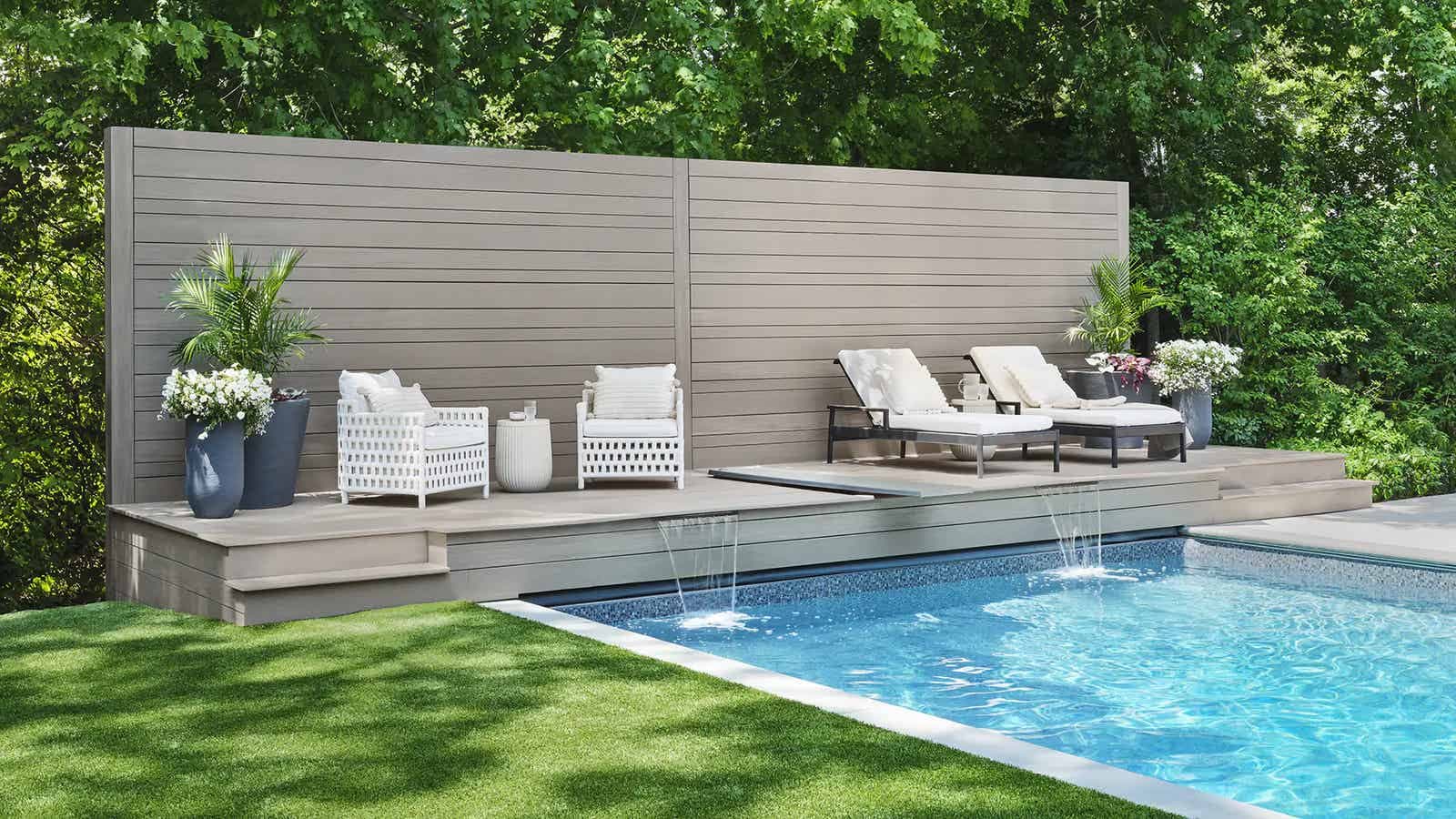
Why PVC Decking for Pool Areas?
The primary advantage of PVC decking for pool terraces is its 100% synthetic composition. It contains no wood fiber, which means it is not susceptible to the same issues that can affect wood-based materials in consistently wet environments.
This inherent water resistance makes PVC decking a practical choice for splash zones and areas where standing water might occur. The material does not swell, stain, or rot due to moisture exposure, offering a durable surface around a pool. This characteristic distinguishes it from materials that require more intensive sealing or frequent drying to prevent water damage.
Manufacturers like TimberTech Azek offer full PVC boards with advanced capping designed for demanding outdoor applications, including pool surrounds and docks. These products are specifically developed to perform where boards are frequently wet.
Durability and Maintenance in a Wet Environment
PVC decking is designed to be low maintenance, which is a significant benefit for a pool terrace. The capped polymer surface sheds common pool-area spills like grease and wine and can typically be cleaned with soap and water. This ease of cleaning helps maintain the appearance of the deck without requiring specialized products or extensive scrubbing.
The material's resistance to moisture also means it is less likely to harbor mold or mildew, which can be a concern in humid conditions or shaded areas around a pool. Regular cleaning helps prevent buildup and keeps the surface looking fresh.
While PVC decking is resistant to water, it is important to follow manufacturer guidelines for cleaning to avoid damaging the surface. Using compatible cleaning products is key to long-term performance and appearance.
Appearance and Design Options
PVC decking is available in various collections, such as the Vintage, Landmark, and Harvest lines from TimberTech Azek, which offer a range of aesthetic options. These collections provide finishes that mimic the look of natural wood, with deep wood grain textures and diverse color palettes. This allows for design flexibility, enabling homeowners to create a poolside aesthetic that complements their home's architecture and landscaping.
Some PVC decking options also include heat-mitigating color choices. While no decking material remains completely cool in direct sunlight, these options are designed to reduce heat absorption compared to darker colors, which can be a consideration for bare feet around a pool in the Atlanta sun. It is important to note that all decking materials will absorb some heat when exposed to direct sunlight.
Installation Considerations for Pool Terraces
PVC decking is generally lighter than hardwood and some composite options, which can facilitate easier handling and potentially faster installation. This can be an advantage for projects with specific logistical challenges, though professional installation is recommended to ensure proper assembly and adherence to local building practices.
Proper ventilation underneath the deck is crucial for any decking material, including PVC, to prevent moisture buildup and ensure air circulation. While PVC itself is waterproof, the substructure beneath still requires protection and adequate airflow. Consult the manufacturer's installation instructions for specific requirements regarding joist spacing, fasteners, and ventilation gaps.
When planning the layout, consider how the decking will meet the pool coping and any surrounding landscaping. Proper transitions and edging are important for both aesthetics and safety. Manufacturers offer compatible fascia and trim boards to create a finished look.
Hypothetical Project Example: Atlanta Pool Terrace
Consider an Atlanta homeowner planning a new pool terrace measuring 20 feet by 15 feet. They choose a TimberTech Azek Vintage Collection PVC decking board, available in 12-foot and 16-foot lengths, with a nominal width of 5.5 inches. For simplicity, we assume a straight lay pattern and minimal waste for illustrative purposes.
The total area is 20 ft * 15 ft = 300 square feet. Each 12-foot board (5.5 inches wide) covers approximately 5.5 in / 12 in/ft * 12 ft = 5.5 square feet. Each 16-foot board covers 5.5 in / 12 in/ft * 16 ft = 7.33 square feet.
To cover the 20-foot length, they would need approximately 20 ft / (5.5 in / 12 in/ft) = 43.6 boards. Rounding up, they would purchase 44 boards. If using 16-foot boards, they would need 44 boards * (15ft / 16ft) = 41.25 boards for the 15-foot width. This example simplifies cuts and assumes no picture frame border. A professional quote will factor in waste for cuts, specific board lengths to minimize seams, and any special design elements like borders or curves. For this example, assuming 16-foot boards are preferred for fewer seams across the 15-foot width, they would need 20 feet / (16 feet per board / 12 feet of usable length per board) * 15 feet / (5.5 inches / 12 inches per foot) = approximately 41 boards of 16-foot length, plus an allowance for waste and cuts. A more precise calculation for a 20x15 area using 16-foot boards and a 5.5-inch width: 20 feet / (5.5 inches / 12 inches per foot) = 43.63 boards needed for the length. Since boards run across the 15-foot width, they would need 15 feet / (5.5 inches / 12 inches per foot) = 32.7 boards. Using 16-foot boards, they would need 20 feet / 16 feet = 1.25 boards for length if laid parallel to the 20-foot side, or 15 feet / 16 feet = 0.93 boards if laid parallel to the 15-foot side. The number of boards needed would be (20 feet / (5.5 inches / 12 inches per foot)) * (15 feet / 16 feet) = 32.7 boards. Rounding up to the nearest full board, and accounting for cuts and waste, one might estimate around 35-40 boards of 16-foot length for a project of this size. This calculation is illustrative and a full material take-off should be performed by a professional.
The homeowner would also factor in the cost of hidden fasteners, suitable trim boards for the edges, and any necessary substructure materials. The choice of color would consider the intensity of the Atlanta sun, opting for a lighter shade if heat retention is a concern for bare feet.
Before you order
- Assess the primary use: Is the area directly adjacent to a pool, experiencing frequent splashes and standing water?
- Consider local climate conditions: How will Atlanta's heat, humidity, and sun exposure affect the decking material?
- Evaluate maintenance expectations: Are you looking for a surface that is easy to clean with minimal upkeep?
- Determine aesthetic preferences: Do you prefer a wood-look finish, and are there specific color tones that complement your home?
- Review heat retention: Are heat-mitigating color options important for comfortable barefoot use around the pool?
- Plan for installation: Have you considered the substructure, ventilation, and specific fastening requirements for PVC?
- Budget for all components: Include decking boards, fasteners, trim, and any necessary substructure upgrades in your project estimate.
Confirm installation details, approved uses and warranty terms in the current instructions for the exact product and profile. Your installer should verify the substrate, structure and applicable project requirements.
This is a planning guide for projects in Atlanta, GA. Ask our team to confirm availability, delivery to your ZIP code and which branch can support your order.
Questions to help you decide
Is PVC decking slippery when wet?
However, any wet surface, especially around a pool, can present a slip hazard. Always exercise caution on wet decking, and consider adding non-slip mats in high-traffic areas if concerns persist. Check manufacturer specifications for any specific slip resistance ratings.
How does PVC decking withstand the Atlanta sun?
PVC decking is designed with UV inhibitors to resist fading from sun exposure. Additionally, some manufacturers offer heat-mitigating color options that are formulated to absorb less heat, which can make the surface more comfortable to walk on in direct sunlight compared to darker, standard colors. However, all decking materials will warm up under direct sun. It is advisable to choose lighter colors for pool areas if heat is a significant concern.
Can I install PVC decking myself around my pool?
While some homeowners may undertake DIY decking projects, installing PVC decking around a pool requires careful attention to detail, especially regarding proper substructure, ventilation, board spacing, and adherence to manufacturer installation guidelines. Given the proximity to water and the need for a safe, durable surface, professional installation is often recommended to ensure the project meets all specifications and local building practices. Improper installation can void warranties and compromise performance.
Ready to Plan Your PVC Pool Terrace?
Request a material quote today. Provide your project dimensions, desired PVC decking profile, and ZIP code to confirm current availability and service options for your Atlanta, GA project.
Request a material quote →