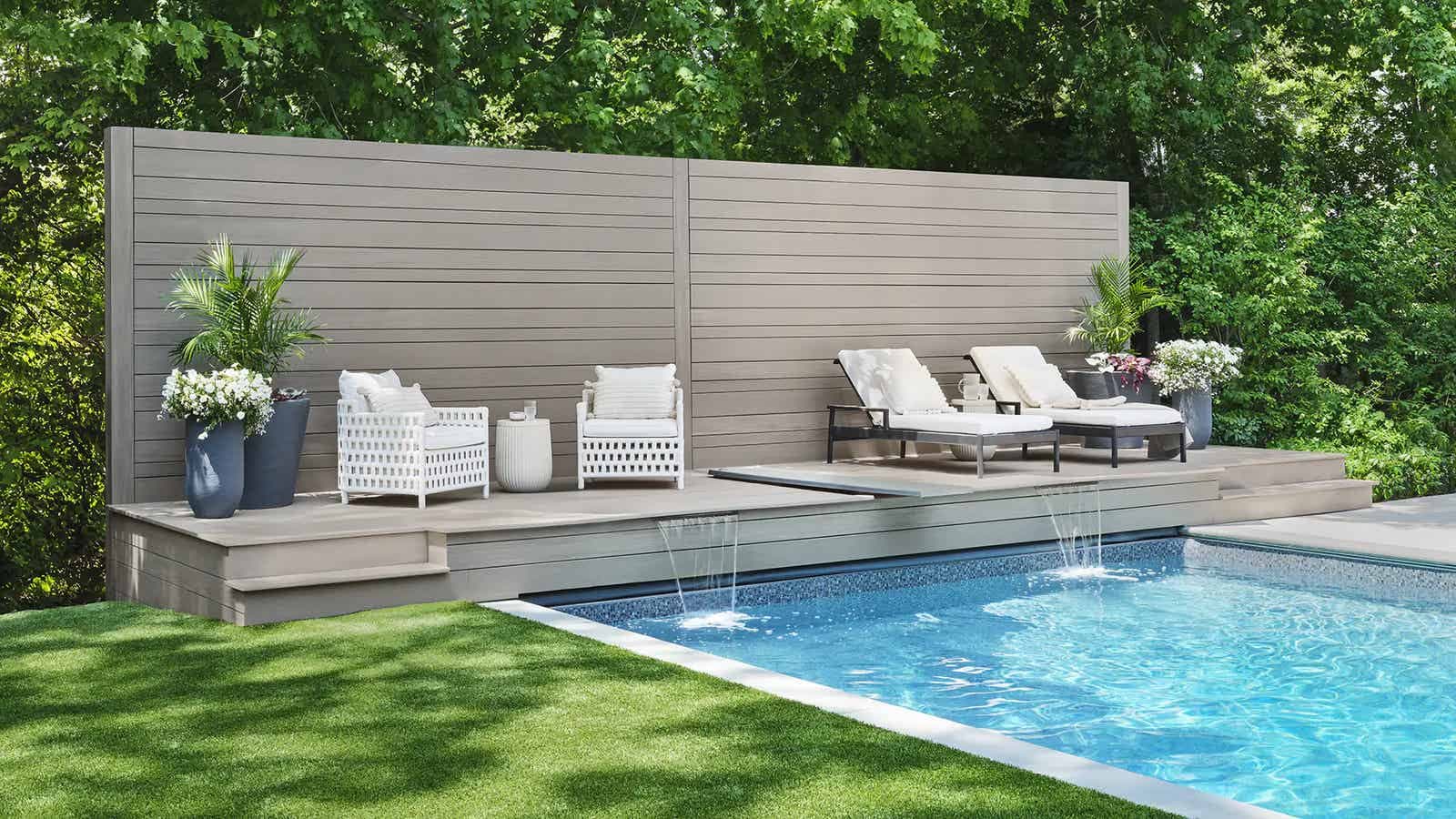
Understanding PVC Decking for Wet Environments
PVC (polyvinyl chloride) decking is a 100% synthetic material, distinct from composite decking which contains wood fibers. This complete absence of wood is a key advantage for pool surrounds. In an Annapolis, MD climate, where humidity and seasonal rain are common, a material that resists moisture absorption is beneficial for long-term performance.
The core of PVC decking is waterproof, preventing the material from swelling, staining, or rotting even when exposed to continuous moisture, such as from pool splashes or standing water. This makes it a preferred specification for areas that are consistently wet, including pool decks, docks, and covered porches where weather can affect both sides of the boards.
Beyond its water resistance, capped polymer PVC decking is designed to shed common spills like grease and wine, allowing for cleaning with soap and water. Some lines also offer heat-mitigating color options, which can be a consideration for bare feet on sunny Annapolis afternoons.
Key Considerations for Poolside Installation
When planning a PVC deck around a pool, several factors require attention. The sub-structure must be robust and properly ventilated, regardless of the decking material. While PVC decking itself is resistant to moisture, the underlying frame, if wood, still requires protection and adequate airflow to prevent moisture buildup.
Board spacing is critical for proper drainage and airflow. Always adhere to the manufacturer's specific instructions for gapping between boards. This ensures that water can drain effectively and that the deck surface can dry, which is important for both material longevity and user safety. For poolside applications, consider how water will drain off the deck and away from the pool area.
Fastening methods should also be chosen carefully. Hidden fasteners are often preferred for their clean appearance and to minimize tripping hazards around a pool. Ensure that the chosen fasteners are compatible with PVC decking and are rated for outdoor, wet conditions.
Choosing PVC Decking Profiles and Colors
PVC decking is available in various collections and finishes, often designed to mimic the appearance of natural wood. The TimberTech Azek line, for example, offers collections like Vintage, Landmark, and Harvest, which feature deeper wood looks with advanced capping. These options provide aesthetic flexibility to complement different architectural styles in Annapolis, MD.
Color selection is an important design choice, particularly for a pool terrace. Lighter colors may absorb less heat, potentially making the deck more comfortable underfoot during direct sun exposure. Some PVC decking lines offer specific 'heat-mitigating' color options, which can be beneficial in sunny locations. It is advisable to review physical samples to assess true color and texture.
Consider the overall design of your outdoor space. PVC decking can be combined with other materials, such as stone coping around the pool, or integrated with landscaping elements. The consistent appearance and low maintenance of PVC can provide a cohesive look for a modern pool area.
Maintenance and Longevity in a Poolside Setting
One of the primary advantages of PVC decking for a pool terrace is its low maintenance. Unlike wood, PVC does not require sanding, staining, or sealing. Routine cleaning with soap and water is typically sufficient to remove dirt, pool chemicals, and other residues that may accumulate. Always consult the manufacturer's cleaning guidelines for specific product recommendations.
The advanced capping on PVC boards is designed to resist stains from common poolside substances. This resistance helps maintain the appearance of the deck over time, even with frequent use. This low-maintenance aspect can be particularly appealing for homeowners seeking to minimize upkeep time for their outdoor living spaces.
PVC decking is also a 100% recyclable material. Boards that are removed from a deck can often be returned to the recycling stream, contributing to a more sustainable material lifecycle.
Worked Example: Planning a 200 sq ft Pool Terrace in Annapolis
Let's consider a hypothetical pool terrace project in Annapolis, MD, requiring approximately 200 square feet of decking. The area is a rectangular section, 10 feet wide by 20 feet long, directly adjacent to a swimming pool. The homeowner desires a low-maintenance, light-colored deck to complement a contemporary home.
Assuming a standard PVC decking board width of 5.5 inches (0.458 feet) and available lengths of 12, 16, and 20 feet. For a 10-foot width, you would need 10 feet / 0.458 feet per board ≈ 21.8 boards. Rounding up, we'd plan for 22 full-width boards across the 10-foot dimension.
For the 20-foot length, using 20-foot long boards would minimize seams and waste. Thus, 22 boards at 20 feet long each would be 440 linear feet. With each board covering 0.458 ft * 20 ft = 9.16 sq ft, 22 boards would cover approximately 201.52 sq ft. This calculation provides an estimate for ordering, but always add a waste factor (typically 5-10%) for cuts and potential errors. This would mean ordering closer to 460-484 linear feet.
For the sub-structure, if using pressure-treated lumber, ensure it is spaced according to manufacturer guidelines for PVC decking, typically 16 inches on center for perpendicular installations. Adequate ventilation beneath the deck is crucial, especially in a humid climate like Annapolis, MD. A border or picture frame around the perimeter can provide a finished look and define the pool edge, requiring additional linear footage calculations for those specific board lengths.
Before you order
- Confirm the exact dimensions of your pool terrace area, including any curves or irregular shapes.
- Evaluate the sun exposure and consider lighter, heat-mitigating PVC decking colors for comfort.
- Review manufacturer specifications for recommended board spacing and fastening methods for poolside applications.
- Plan for proper drainage away from the pool and ensure adequate ventilation for the deck substructure.
- Consider the aesthetic compatibility of PVC decking profiles and colors with your home and landscaping.
- Factor in a waste percentage (5-10%) when calculating material quantities for cuts and potential adjustments.
- Inquire about specific cleaning and maintenance instructions for the chosen PVC decking product.
- Determine if a picture-frame border or other design elements will be incorporated and calculate those material needs separately.
Confirm installation details, approved uses and warranty terms in the current instructions for the exact product and profile. Your installer should verify the substrate, structure and applicable project requirements.
This is a planning guide for projects in Annapolis, MD. Ask our team to confirm availability, delivery to your ZIP code and which branch can support your order.
Questions to help you decide
Is PVC decking slippery when wet?
The degree of slip resistance can vary by manufacturer and specific product line. It's always prudent to exercise caution on any wet surface, especially around a pool.
How does PVC decking handle chlorine or saltwater?
PVC decking, being 100% synthetic and waterproof to the core, is generally resistant to the corrosive effects of chlorine and saltwater. However, it's still advisable to rinse off heavy concentrations of chemicals or salt regularly to maintain the deck's appearance.
Can PVC decking be installed directly over an existing concrete patio?
Installing PVC decking over an existing concrete patio is possible, but it requires careful planning to ensure proper drainage and ventilation. A suitable sub-structure (such as sleepers or a low-profile framing system) must be installed over the concrete to elevate the decking boards, allowing water to drain and air to circulate. Direct contact with concrete without a gap can trap moisture and lead to issues. Always follow the manufacturer's specific installation guidelines for this type of application.
Ready to Plan Your PVC Pool Terrace?
Request a material quote today with your project dimensions, desired PVC decking profile, and ZIP code. We can help confirm current availability and service options for your Annapolis, MD project. For further assistance, explore our comprehensive selection of PVC decking at /decking/pvc, or compare options with /decking/hardwood and /decking/composite.
Request a material quote →