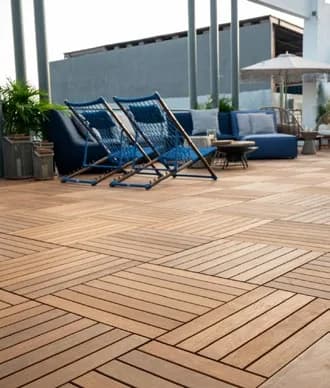
Understanding Garapa Deck Tile Characteristics
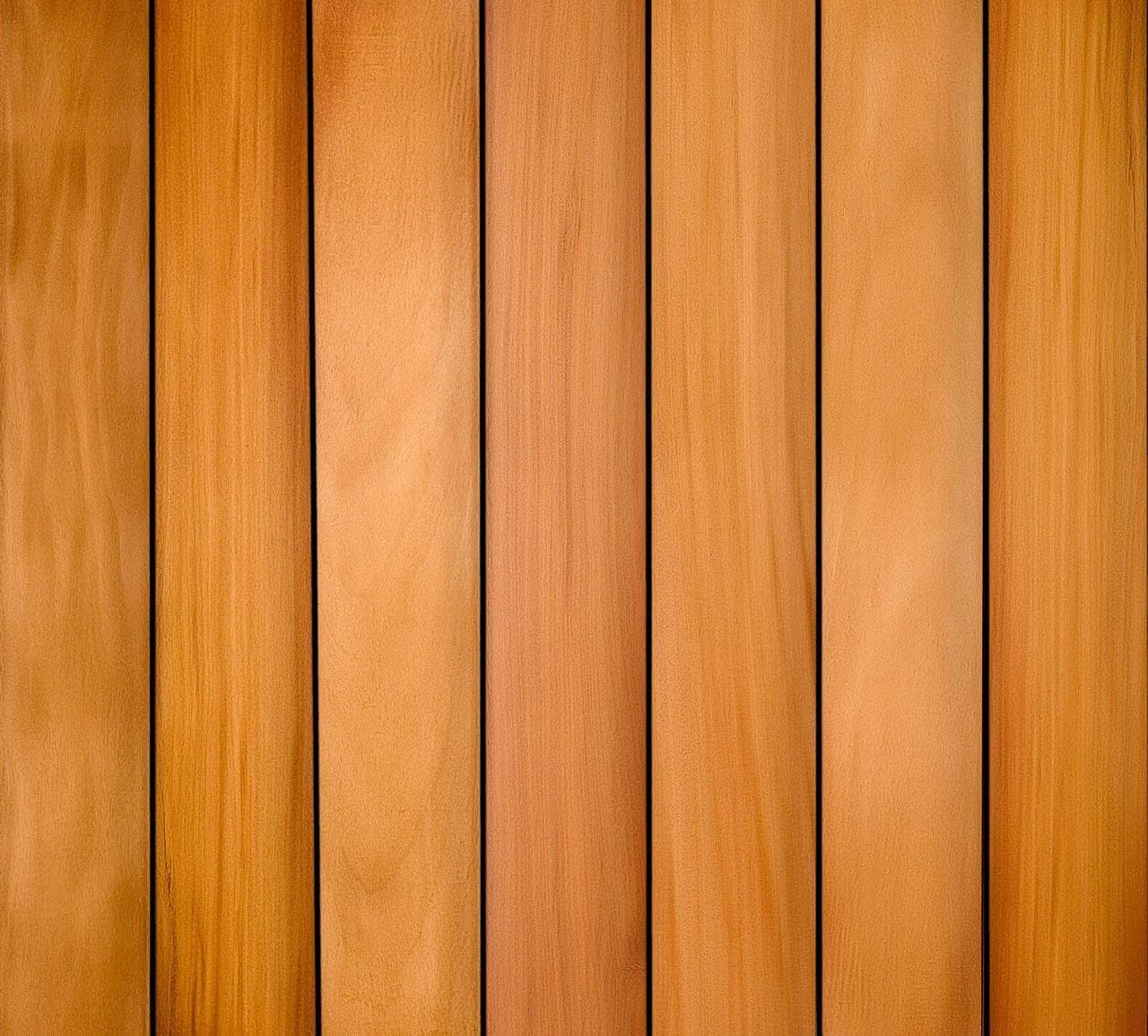
Garapa is a popular choice for deck tiles due to its appealing characteristics. It features warm golden tones that can brighten terraces, balconies, and other outdoor rooms. While not as dense as some other tropical hardwoods, Garapa offers a balance of natural beauty and suitability for outdoor applications.
Both 12 x 12 and 24 x 24 Garapa deck tiles share these core material attributes. The primary difference lies in their dimensions, which dictates the visual scale and the practicalities of installation for a given area.
For more information on Garapa as a material, you can visit our main Garapa Deck Tiles product page.
12 x 12 Garapa Deck Tiles: Compact and Versatile
The 12 x 12 inch (1 square foot per tile) Garapa deck tile is a compact format. Its smaller size offers versatility, particularly for smaller areas, intricate layouts, or spaces with numerous edges, curves, or transitions. This size can create a more detailed grid pattern, which some designers prefer.
Projects that benefit from 12 x 12 tiles include small balconies, pathways, or areas where the deck surface needs to navigate around fixed elements like columns, planters, or built-in seating. The smaller module can be easier to handle and cut for precise fits in these situations.
24 x 24 Garapa Deck Tiles: Expansive and Modern
The 24 x 24 inch (4 square feet per tile) Garapa deck tile is a larger format. This size is often chosen for more expansive terraces, rooftops, or open surfaces where a streamlined look with fewer visible seams is desired. The larger tiles can visually expand a space and create a more contemporary aesthetic.
For projects with large, unobstructed areas, 24 x 24 tiles can mean a faster installation due to covering more area per tile. They can also contribute to a sense of spaciousness, reducing the visual clutter of many grid lines.
Layout and Cuts: A Worked Example
Let's consider a hypothetical rectangular patio measuring 10 feet wide by 12 feet long. The total area is 120 square feet. We will compare the material needed for both 12 x 12 and 24 x 24 Garapa deck tiles, assuming a straight lay pattern and accounting for necessary cuts.
For the 12 x 12 inch tiles (1 foot x 1 foot), you would need 10 tiles across the 10-foot width and 12 tiles along the 12-foot length. This results in 10 x 12 = 120 tiles. Since each tile is 1 square foot, this directly matches the area. In this ideal scenario, no cuts are needed for the perimeter if the dimensions are exact multiples of the tile size.
Now, consider the 24 x 24 inch tiles (2 feet x 2 feet). For the 10-foot width, you would need 10 feet / 2 feet/tile = 5 tiles. For the 12-foot length, you would need 12 feet / 2 feet/tile = 6 tiles. This results in 5 x 6 = 30 tiles. Each tile covers 4 square feet, so 30 tiles x 4 sq ft/tile = 120 square feet. Again, in this ideal scenario where dimensions are exact multiples, no cuts are needed for the perimeter.
However, real-world projects rarely have dimensions that are perfect multiples of tile sizes. Let's adjust our hypothetical patio to 10 feet 6 inches wide by 12 feet 6 inches long (10.5 ft x 12.5 ft). The total area is 131.25 square feet.
For 12 x 12 inch tiles (1 ft x 1 ft): You would need 10.5 tiles across and 12.5 tiles along. Since you cannot purchase half tiles, you must round up. This means 11 tiles across and 13 tiles along, totaling 11 x 13 = 143 tiles. The excess tiles account for cuts. You would cut the last tile in each row/column, and the offcut might be usable for another edge, depending on its size and the layout. The purchased quantity in this case would be 143 tiles.
For 24 x 24 inch tiles (2 ft x 2 ft): You would need 10.5 ft / 2 ft/tile = 5.25 tiles across, and 12.5 ft / 2 ft/tile = 6.25 tiles along. Rounding up to full tiles for purchase, you would need 6 tiles across and 7 tiles along, totaling 6 x 7 = 42 tiles. Each tile covers 4 square feet, so the purchased area is 42 tiles x 4 sq ft/tile = 168 square feet. The difference between the actual project area (131.25 sq ft) and the purchased area (168 sq ft) represents the material needed for cuts and potential waste. The larger offcuts from 24x24 tiles might be more challenging to reuse for smaller edge pieces compared to 12x12 offcuts, depending on the cut plan.
This example illustrates that while 24 x 24 tiles cover more area per piece, the need to cut and the potential for unusable offcuts can increase the percentage of material waste, especially in projects with many non-standard dimensions. Conversely, 12 x 12 tiles, while requiring more individual pieces, may offer more flexibility for smaller cuts and less noticeable waste, depending on the project's specific dimensions and complexity.
Visual Impact and Aesthetic Considerations
Beyond the practicalities of ordering, the choice of tile size significantly impacts the visual appeal of your finished project. Larger 24 x 24 tiles create a more expansive, uninterrupted look, often preferred for modern designs or to make a smaller space feel larger by reducing the number of grid lines.
Smaller 12 x 12 tiles, on the other hand, produce a more detailed, intricate pattern. This can be desirable for traditional designs, to delineate zones within a larger area, or to add visual texture. The increased number of seams can also help mask minor irregularities in the sub-surface more effectively than larger tiles might.
Installation Considerations and Pedestal Systems
The installation method can also influence your tile size choice. When using pedestals, ensure that the chosen pedestal system is designed to support the specific dimensions and weight of your selected tile size. Larger tiles may require specific pedestal layouts or more robust support points.
For projects requiring access to the sub-surface (e.g., for roof maintenance, drainage, or utility lines), removable deck tiles on pedestals are a practical solution. The choice between 12 x 12 and 24 x 24 might depend on the frequency of access needed and the size of the access points required.
Before you order
- What are the exact dimensions of your project area, including any alcoves or protrusions?
- Are there many fixed obstacles (columns, planters, drains) that will require intricate cuts?
- What aesthetic do you prefer: a clean, expansive look (larger tiles) or a more detailed, grid-like pattern (smaller tiles)?
- Will you be using a pedestal system, and if so, is it compatible with both tile sizes?
- What is your comfort level with cutting tiles, and do you have the necessary tools?
- Have you accounted for a waste factor in your material calculations (typically 10-15%)?
Confirm installation details, approved uses and warranty terms in the current instructions for the exact product and profile. Your installer should verify the substrate, structure and applicable project requirements.
Questions to help you decide
Can I mix 12 x 12 and 24 x 24 Garapa deck tiles in the same project?
While it is technically possible to mix tile sizes, it requires careful planning to ensure proper alignment and a cohesive aesthetic. The different module sizes can create complex patterns and may require custom cuts to integrate smoothly. Most projects benefit from choosing a single tile size for consistency.
Do larger 24 x 24 tiles cost more per square foot than 12 x 12 tiles?
The cost per square foot can vary based on the specific product and current supply. It's important to check the current pricing for both sizes on our product pages. While a 24 x 24 tile covers four times the area of a 12 x 12 tile, the price per tile will not necessarily be exactly four times higher. Always compare the unit price per square foot when evaluating costs.
How do I calculate the number of tiles needed for my project?
Measure the length and width of your project area in feet and inches. Convert inches to a decimal (e.g., 6 inches = 0.5 feet). Divide the length by the tile dimension (1 ft for 12x12, 2 ft for 24x24) and round up to the next whole number. Do the same for the width. Multiply these two rounded-up numbers to get the total number of tiles to purchase. Always add an additional 10-15% for waste and future replacements, especially for projects with many cuts. For complex shapes, consider drawing a scaled layout.
Ready to Plan Your Garapa Deck Tile Project?
Request a material quote with your project dimensions, desired Garapa deck tile profile (12x12 or 24x24), and ZIP code. Our team can confirm current availability and service options. Explore our full range of Garapa Deck Tiles, or consider alternatives like Ipe Deck Tiles and Cumaru Deck Tiles for different aesthetics.
Request a material quote →