Understanding Garapa Deck Tiles
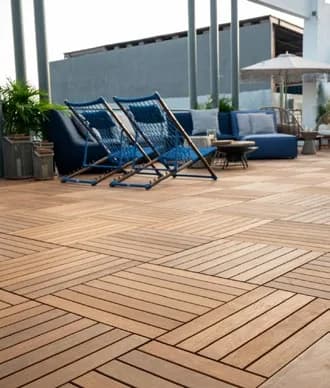
Garapa deck tiles are crafted from Garapa hardwood, known for its warm golden tones. This material can bring a bright, inviting appearance to outdoor areas. The tiles are available in common square formats, such as 12 x 12 inches and 24 x 24 inches. The 12 x 12 inch tiles (1 square foot each) are often chosen for smaller spaces or layouts that require more cuts and intricate patterns, while the 24 x 24 inch tiles (4 square feet each) are suitable for larger, more open surfaces where fewer seams are desired.
When planning your project, consider the specific dimensions of the Garapa deck tiles and how they will fit your intended space. This initial assessment helps determine the quantity needed and influences the overall project budget.
Material Quantity Calculation: A Worked Example
Accurately calculating the number of Garapa deck tiles needed is the foundation of your material budget. It is important to account for cuts, waste, and a small contingency. Let's consider a hypothetical project: a rectangular balcony measuring 10 feet long by 8 feet wide, to be covered with 24 x 24 inch Garapa deck tiles.
First, calculate the total area: 10 feet * 8 feet = 80 square feet. Each 24 x 24 inch tile covers 4 square feet. Dividing the total area by the area per tile (80 sq ft / 4 sq ft/tile) suggests 20 tiles.
However, this calculation assumes perfect fit and no waste. For a more practical estimate, consider the dimensions in terms of tile modules. The 10-foot length is 120 inches, requiring 120 / 24 = 5 tiles. The 8-foot width is 96 inches, requiring 96 / 24 = 4 tiles. Therefore, you would need 5 tiles along the length and 4 tiles along the width, totaling 5 * 4 = 20 tiles. In this specific scenario, with dimensions perfectly aligning with the tile size, the area calculation matches the modular calculation.
For projects where dimensions do not align perfectly, such as an 11-foot by 8-foot area, you would need 11 feet (132 inches) / 24 inches = 5.5 tiles along one side. Since you cannot purchase half a tile, you'd need 6 tiles. The other side would be 8 feet (96 inches) / 24 inches = 4 tiles. This would result in 6 * 4 = 24 tiles, even though the area is only 88 square feet (88 sq ft / 4 sq ft/tile = 22 tiles). Always round up to the nearest whole tile for each dimension to ensure full coverage. It's also prudent to add an additional 5-10% for cuts, breakage, or future replacements. For the 20-tile project, adding 10% means purchasing 22 tiles.
You can find Garapa deck tiles at this link: [https://www.lumberplus.com/deck-tiles/garapa](https://www.lumberplus.com/deck-tiles/garapa).
Essential Accessories and Their Impact on Budget
Beyond the tiles themselves, several accessories are often necessary for a complete and functional Garapa deck tile installation. These items directly influence your project budget and should be factored in from the outset.
Pedestal systems are frequently used to create a level surface over uneven sub-surfaces, facilitate drainage, and allow for service access beneath the tiles. The number of pedestals needed depends on the tile size and the support points required for each tile. Edge and corner trim pieces provide a finished look and help contain the tile assembly, especially important for exposed edges on balconies or raised platforms.
Fasteners, if required for your specific installation method, are another consideration. While many deck tile systems are designed for interlocking or gravity-held placement, some applications may call for securing tiles or trim. Additionally, consider any sub-surface preparation materials, such as leveling compounds or protective membranes, if your existing surface requires it. These items, while seemingly minor, can accumulate and significantly impact the overall cost.
Considering Installation Labor
The cost of installation labor can be a substantial part of your Garapa deck tile project budget, especially for larger or more complex installations. If you plan to hire a contractor, obtain multiple quotes that detail the scope of work, including surface preparation, tile laying, edge finishing, and debris removal. Some contractors might charge by the square foot, while others may offer a flat project rate.
For DIY projects, while you save on labor costs, factor in the time commitment and any tool rentals you might need. Specialized tools for cutting hardwood, for example, may be necessary. Accurately estimating labor allows for a realistic overall project budget.
Contingency and Other Indirect Costs
Even with meticulous planning, unexpected issues can arise. It is wise to allocate a contingency fund, typically 10-15% of your total estimated costs, to cover unforeseen expenses. This could include additional materials if cuts go awry, minor repairs to the sub-surface discovered during installation, or changes to the project scope.
Other indirect costs might include delivery charges for materials, disposal fees for old flooring or construction waste, and any permits required by local building authorities, particularly for rooftop or elevated installations. Factor in the cost of any finishes or sealers you plan to apply to the Garapa to maintain its appearance or enhance its durability, along with the necessary application tools.
Explore other deck tile options like Ipe ([https://www.lumberplus.com/deck-tiles/ipe](https://www.lumberplus.com/deck-tiles/ipe)) or Cumaru ([https://www.lumberplus.com/deck-tiles/cumaru](https://www.lumberplus.com/deck-tiles/cumaru)) if you are comparing material characteristics and costs. You can also view our full range of deck tiles here: [https://www.lumberplus.com/deck-tiles](https://www.lumberplus.com/deck-tiles).
Before you order
- Have I accurately measured my project area, considering any irregularities or obstructions?
- Have I accounted for waste and a contingency of 5-10% when calculating tile quantities?
- Do I need a pedestal system, and have I estimated the number of pedestals required?
- Are edge and corner trim pieces necessary for my installation, and have I specified their quantity?
- What sub-surface preparation is needed, and what materials will this entail?
- Will I be hiring a contractor, and have I obtained detailed quotes for labor?
- Have I budgeted for any required tools or equipment rentals?
- Is there a contingency fund (10-15%) included in my budget for unexpected costs?
- Have I considered delivery fees, disposal costs, and potential permit fees?
- Have I factored in any desired finishes, sealers, or maintenance products?
Confirm installation details, approved uses and warranty terms in the current instructions for the exact product and profile. Your installer should verify the substrate, structure and applicable project requirements.
Questions to help you decide
What is the typical waste factor for Garapa deck tiles?
A typical waste factor for deck tiles, especially when making cuts around obstacles or for edge pieces, is usually 5-10% of the total area. For projects with many intricate cuts or an irregular shape, it's safer to lean towards the higher end of that range, or even slightly more, to ensure you have enough material.
How do I estimate the number of pedestals needed for deck tiles?
The number of pedestals needed depends on the size of your Garapa deck tiles and the manufacturer's recommendations for support. Generally, each corner of a tile requires support. It's best to consult the specific pedestal system documentation or a layout plan to get an accurate count.
Are there different grades of Garapa deck tiles that affect cost?
While Garapa hardwood itself can have different grades when sold as lumber, deck tiles are typically manufactured to a consistent standard within a product line. Any variations in appearance or quality would usually be reflected in the product description. Always review the product specifications to understand what you are purchasing, focusing on the profile and dimensions rather than relying on assumed grading.
Request a Material Quote for Your Garapa Deck Tile Project
Ready to move forward with your Garapa deck tile project? Contact us for a detailed material quote. Provide your project dimensions, desired tile profile (e.g., 12x12 or 24x24), and your ZIP code to confirm current availability and service options. Our team can help you finalize your material list.
Request a material quote →