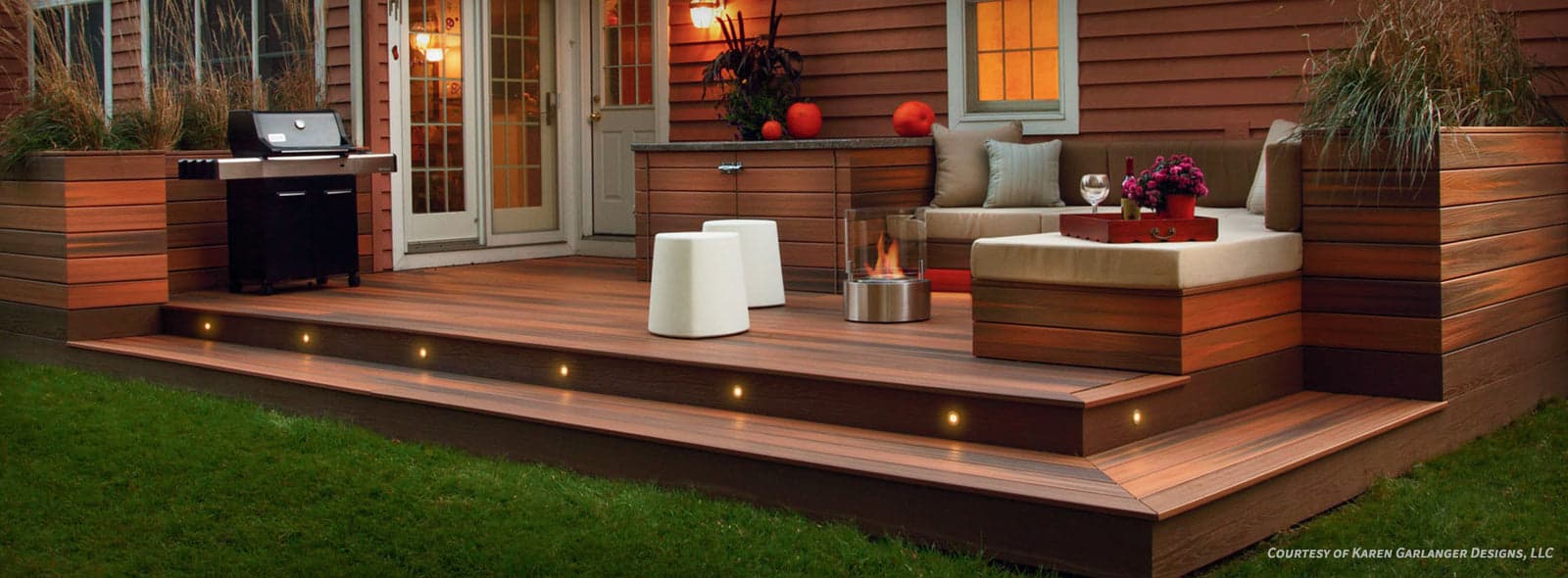
Understanding Your Urban Backyard's Constraints and Potential
Before selecting any material, assess the specific dimensions and characteristics of your urban backyard. Consider natural light exposure, existing landscaping, privacy concerns, and access points. A narrow yard might benefit from a linear layout that emphasizes depth, while a more square space could accommodate a central feature or distinct zones.
Thinking about how these elements can work with your space, rather than against it, is key.
Consider the surrounding structures – fences, walls, and adjacent buildings – and how they influence the perception of space. Lighter decking colors, for instance, might reflect more light and make an area feel larger, while darker tones can create a cozier, more intimate atmosphere.
Choosing Fiberon Lines for Urban Aesthetics and Performance
All lines are American-made capped composite with recycled content.
The <a href="/brands/fiberon">Fiberon Concordia</a> line, their flagship, features four-sided capped boards with deep, multi-tonal color blends. Options like "Ipe" or "Graphite" can offer a sophisticated, modern look that complements contemporary urban design.
Its natural aesthetic can soften the hard lines often found in urban environments.
Maximizing Space with Layout and Board Orientation
In a compact urban backyard, board orientation can significantly impact the perceived size and flow of the space. Running boards parallel to the longest dimension of your yard can make it appear longer, while a diagonal layout can add visual interest and a sense of expansiveness. However, diagonal layouts typically require more cuts and can generate more waste.
Consider a picture-frame border using square-edge Fiberon boards to define the decking area, which can help delineate the space from surrounding landscaping or paving. This also provides a clean finish around the perimeter.
For very narrow areas, a simple, straight layout is often the most efficient and visually uncluttered. Avoid overly complex patterns that might make the space feel busy or smaller. The standard 1" x 5.5" board profile of Fiberon decking is a versatile size that works well in most applications.
A Hypothetical Urban Decking Project: The 10x12 Foot Retreat
Let's consider a hypothetical urban backyard measuring 10 feet wide by 12 feet deep, intended as a small seating area. The goal is to create a functional deck with space for two chairs and a small table, while maintaining a sense of openness.
We choose <a href="/brands/fiberon">Fiberon Concordia</a> in "Graphite" for a modern, sophisticated look that contrasts with surrounding greenery. Given the 10-foot width, we opt for a linear layout, running the 12-foot boards parallel to the longer dimension to emphasize depth.
Using 12-foot Fiberon boards (1" x 5.5" profile) for the main decking surface minimizes cuts. For the 10-foot width, approximately 22 boards (120 inches / 5.5 inches per board) would be needed, plus extra for the picture frame.
A picture-frame border would use square-edge boards. For the perimeter of a 10x12 foot deck, you'd need two 12-foot boards and two 10-foot boards (cut from 12-foot lengths) for the outer frame. This creates a clean edge and helps contain the space.
Total main decking area: 10 ft x 12 ft = 120 sq ft. Each 12-foot board is 5.5 inches wide, or approximately 0.458 feet. So, 10 feet / 0.458 feet/board = 21.8 boards. We'd purchase 22 boards (12 ft length) for the main field. For the picture frame, we'd need two 12-foot boards and two 10-foot sections. We'd likely purchase two additional 12-foot boards and cut them to size, accounting for mitered corners if desired. This brings the total to 24-26 boards (12 ft length), plus any waste factor. Always confirm specific dimensions and cut plans with your installer and supplier.
This layout creates a distinct zone for relaxation, with the darker decking providing a grounded feel. The low-maintenance nature of Fiberon Concordia means more time enjoying the space and less time on upkeep.
Integrating with Existing Elements and Future Use
Consider how your new Fiberon deck will integrate with existing hardscaping, softscaping, or other features in your urban backyard. Will the deck be flush with a patio, or will it be slightly elevated? Fiberon's full system, including matching fascia and riser boards, allows for a cohesive look when transitioning between levels or finishing edges.
Think about lighting. Integrated deck lighting or strategically placed external fixtures can enhance the ambiance and usability of a small deck after dark, extending its functionality. Vertical elements like trellises or planters can add greenery and privacy without consuming precious deck space.
Finally, plan for furniture. In a small space, multi-functional furniture or pieces that fold away can be invaluable. Ensure your chosen deck size and layout allow for comfortable circulation around any planned seating or dining arrangements. Fiberon's durability and stain resistance mean you don't have to worry about spills from entertaining.
Before you order
- Measure your urban backyard's exact dimensions and note any irregular shapes or existing features.
- Determine the primary function of your deck: dining, lounging, or a combination.
- Choose a Fiberon decking line (Concordia, Sanctuary, Good Life) based on desired aesthetic, performance, and warranty.
- Select a board color that complements your home and surrounding urban environment.
- Decide on board orientation (linear or diagonal) to optimize perceived space and minimize waste.
- Plan for a picture-frame border using square-edge boards for a finished look.
- Consider how the deck will integrate with existing landscaping, paving, and vertical elements.
- Account for furniture placement and circulation pathways in your design.
- Obtain a detailed material quote based on your project dimensions, chosen profile, and ZIP code.
Confirm installation details, approved uses and warranty terms in the current instructions for the exact product and profile. Your installer should verify the substrate, structure and applicable project requirements.
Questions to help you decide
Can Fiberon decking withstand heavy urban use?
Yes, Fiberon composite decking is designed for durability. Its capped surface resists stains and fading, making it suitable for areas with regular foot traffic and potential spills from entertaining.
What maintenance does Fiberon decking require in a small urban space?
Fiberon decking is low maintenance. It does not require staining, sealing, or sanding. Typically, an annual soap-and-water wash is sufficient to keep the deck clean. This is a significant advantage in urban settings where time and space for maintenance tasks might be limited.
Are there specific fastening options for Fiberon decking in compact areas?
Fiberon offers both hidden clip fasteners for grooved-edge boards and face screws for square-edge boards. Hidden fasteners create a smooth, uninterrupted surface, which can be desirable in a compact area for a clean aesthetic. Face screws are suitable for picture-frame borders or when a visible fastener is acceptable.
Ready to Plan Your Urban Backyard Deck with Fiberon?
Request a material quote with your project dimensions, exact Fiberon profile choice, and ZIP code. We can help confirm current availability and service options for your decking project.
Request a material quote →