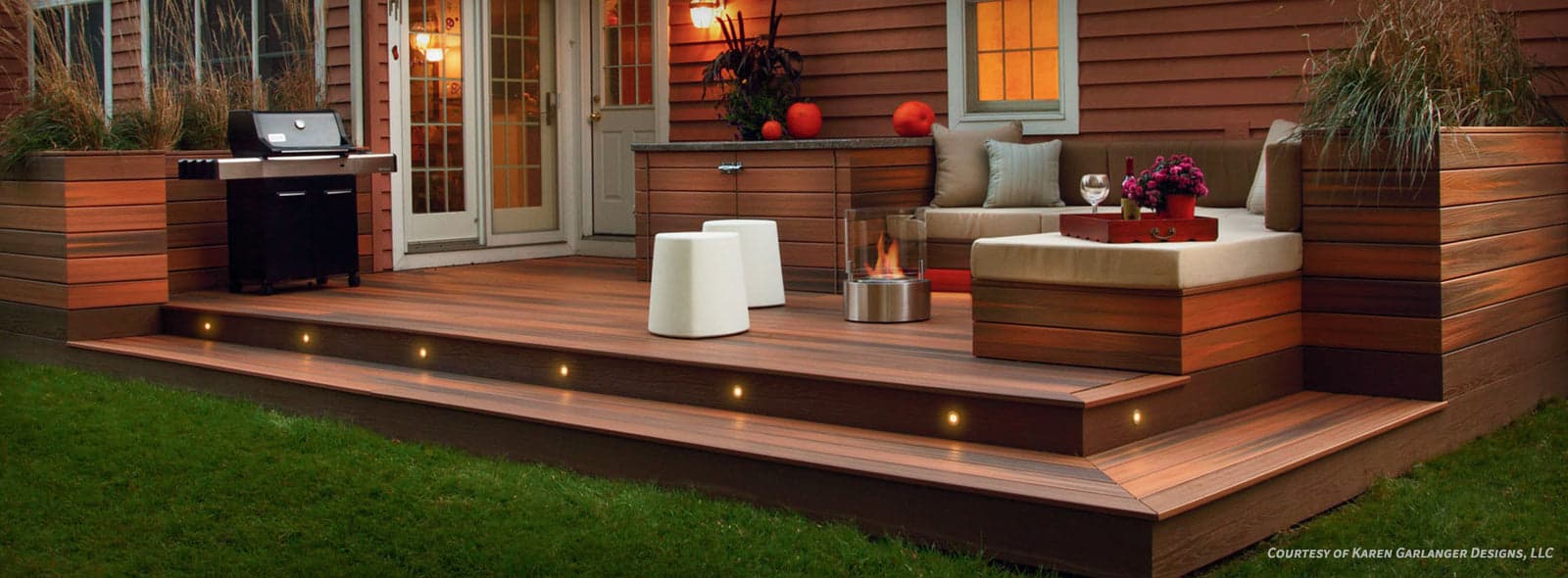
Understand Fiberon Decking Board Dimensions and Types
Fiberon decking boards are available in standard dimensions and lengths, which are crucial for accurate quantity calculations. The typical board profile is 1 inch by 5.5 inches. These boards come in both grooved and square-edge profiles. Grooved-edge boards are designed for use with hidden fastening systems, while square-edge boards are suitable for face screws, picture framing, and stair treads.
Available lengths commonly include 12, 16, and 20 feet. For projects requiring fascia or riser boards, matching options are typically available to ensure a consistent aesthetic throughout the deck system. Knowing these standard sizes and your chosen board type is the first step in planning your layout and calculating material needs.
Measure Your Deck Area Accurately
Begin by drawing a detailed diagram of your deck area. This diagram should include all dimensions, noting any irregularities, cutouts for posts, or changes in direction. For rectangular or square decks, measure the length and width of the main deck surface. For more complex shapes, break the area down into smaller, manageable rectangles or squares.
Record all measurements in feet and inches. Double-check your measurements to minimize errors. Consider the intended direction of your decking boards, as this will influence how board lengths are utilized and where cuts will be made.
Calculate the Total Decking Surface Area
Once you have your measurements, calculate the total surface area of your deck in square feet. For a simple rectangular deck, multiply the length by the width. For example, a 10-foot by 15-foot deck has a surface area of 150 square feet.
For irregular shapes, sum the areas of the individual sections you identified in your diagram. This total square footage provides the basis for estimating the number of boards required, but it is not the final purchase quantity.
Estimate Board Coverage and Account for Waste
Fiberon decking boards are typically 5.5 inches wide. To determine the linear feet of decking needed per square foot of area, convert the board width to feet (5.5 inches / 12 inches/foot = 0.4583 feet). Then, divide 1 by this width (1 / 0.4583 feet 2.18 linear feet per square foot). So, a 100 square foot deck would need approximately 218 linear feet of boards.
However, this calculation does not account for necessary spacing between boards (follow manufacturer guidelines for specific product lines) or for cuts and waste. It is prudent to add a waste factor to your calculations. A common waste factor for straight, simple deck layouts is 10-15%. For decks with complex angles, diagonal layouts, or many cuts, a waste factor of 15-20% or more may be advisable. This ensures you have enough material for cuts, mistakes, and potential future repairs. For example, if you need 218 linear feet, adding 15% waste brings the total to approximately 250 linear feet.
Worked Example: Calculating Fiberon Decking for a 12x18 Foot Deck
Let's consider a hypothetical rectangular deck measuring 12 feet by 18 feet. We will use 16-foot long boards to minimize seams, and assume a 15% waste factor.
1. **Calculate Total Surface Area:** 12 feet * 18 feet = 216 square feet.
2. **Determine Linear Feet per Square Foot:** Each board is 5.5 inches (0.4583 feet) wide. To cover 1 square foot, you need approximately 1 foot / 0.4583 feet = 2.18 linear feet of decking.
3. **Calculate Base Linear Feet Required:** 216 square feet * 2.18 linear feet/square foot = 470.88 linear feet.
4. **Apply Waste Factor:** Add 15% for waste: 470.88 linear feet * 1.15 = 541.51 linear feet.
5. **Calculate Number of Boards:** Since we are using 16-foot boards, divide the total linear feet by the board length: 541.51 linear feet / 16 feet/board 33.84 boards.
6. **Round Up to Full Boards:** Always round up to the next whole number of boards, as you cannot purchase partial boards. Therefore, you would need to purchase 34 Fiberon Sanctuary 16-foot boards.
This calculation provides a robust estimate. For precise ordering, consider how each board will be cut and used across your specific layout, especially if you have significant offcuts that can be reused.
Consider Fascia and Riser Boards
Don't forget to include fascia boards and riser boards in your material list. Fascia boards are used to finish the perimeter of the deck, while riser boards are used for stair risers. These typically come in specific lengths and dimensions to match your chosen decking line.
Measure the total linear perimeter where fascia will be applied. For stairs, measure the width of each stair and multiply by the number of risers. Apply a similar waste factor (e.g., 10%) to these calculations to ensure you have enough material for cuts and alignment.
Before you order
- Have I measured all deck dimensions accurately, including any irregular shapes or cutouts?
- Do I know the exact Fiberon product line (Concordia, Sanctuary, Good Life) and color I intend to use?
- Have I selected the correct board profile (grooved or square edge) for my fastening system?
- What board lengths are available for my chosen Fiberon line (12, 16, 20 ft)?
- What is the intended direction of my decking boards on the deck surface?
- Have I calculated the total square footage of my deck surface?
- What waste factor have I applied (e.g., 10-20%) based on my deck's complexity?
- Have I accounted for fascia and riser boards, if applicable, and their respective linear footage?
- Have I double-checked all calculations before finalizing my material list?
Confirm installation details, approved uses and warranty terms in the current instructions for the exact product and profile. Your installer should verify the substrate, structure and applicable project requirements.
Questions to help you decide
What is the typical width of Fiberon decking boards?
Fiberon decking boards typically have a nominal width of 5.5 inches. This dimension is important for calculating how many boards are needed to cover a given area.
Why do I need to add a waste factor to my decking order?
A waste factor accounts for necessary cuts, potential miscuts, damaged boards, and the need for shorter pieces at the end of runs. It ensures you have enough material to complete your project without delays. A typical waste factor is 10-15% for simple layouts, and more for complex designs.
Can I mix different Fiberon product lines on one deck?
While technically possible, it is generally recommended to stick to one Fiberon product line for a consistent appearance and performance. Each line (Concordia, Sanctuary, Good Life) has distinct colors, capping, and profiles. If you consider mixing, ensure the dimensions and fastening methods are compatible and that you are satisfied with the aesthetic outcome.
Ready to Plan Your Fiberon Decking Project?
For a material quote tailored to your project, provide your deck dimensions, preferred Fiberon profile, and ZIP code. We can help confirm current availability and service options for your chosen materials. Request a material quote today.
Request a material quote →