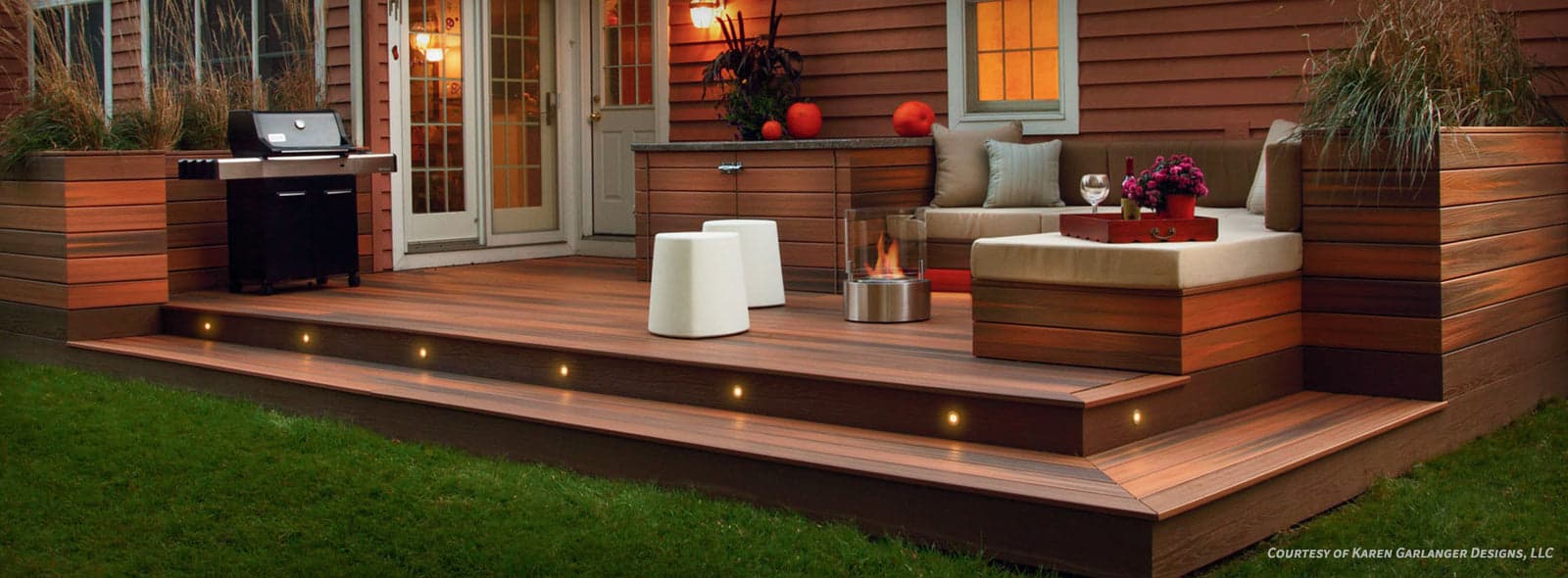
Fiberon Decking Options for Stair Treads
Fiberon offers several lines of capped composite decking, each suitable for stair treads. The primary considerations for treads are board profile and aesthetic. For stair treads, square-edge boards are often preferred for their clean finish, especially when face-fastened, or when creating a picture-frame border around the tread.
When selecting your Fiberon line, consider the desired look and performance. Fiberon Concordia features four-sided capping and deep multi-tonal blends, offering a premium aesthetic. Fiberon Sanctuary provides three-sided capping with cathedral grain and warm wood tones. Fiberon Good Life, an entry-level option, offers a scalloped profile with honest colors. All lines are designed to resist stains and fading, ensuring a consistent appearance over time. The choice of line should match the decking used on the main deck surface for visual continuity.
For a robust stair tread, a single 5.5-inch board may be sufficient for narrower stairs, while wider stairs often benefit from two or more boards joined to achieve the desired tread depth. Ensure any seams are properly supported and fastened according to manufacturer guidelines.
Specific product link: Fiberon Decking: /brands/fiberon
Riser Boards for a Finished Look
Riser boards are the vertical components of a stair, connecting one tread to the next. Fiberon offers matching fascia and riser boards for a complete system, ensuring a uniform appearance with your deck boards. Using dedicated riser boards provides a clean, finished look, concealing the stair stringers and any underlying structure.
Matching riser boards are available in colors and finishes that coordinate with the main decking, contributing to a cohesive design. While deck boards can sometimes be used as risers, dedicated riser boards are often thinner and specifically designed for vertical application, reducing material waste and providing a streamlined profile. Confirm the availability of matching riser boards in your chosen Fiberon line and color.
Structural Support and Joist Spacing for Stairs
Stair treads require adequate structural support to ensure safety and prevent deflection. For stairs, this translates to stringer spacing. Stringers are the angled support beams that form the backbone of the stair system.
The number and spacing of stringers will depend on the width of your stairs and the expected load. Generally, stringers should be spaced to meet or exceed the joist spacing requirements for the decking material. For wider treads, additional intermediate stringers may be necessary. Always consult local building codes and the Fiberon installation guide for specific structural requirements and recommended fastener types. Lumber Plus carries a range of decking and related outdoor materials, including structural lumber for stringers and framing.
Fastening Methods for Fiberon Stair Components
Fiberon decking can be installed using hidden clips for grooved-edge boards or face screws for square-edge boards. For stair treads, face fastening is often the preferred method for its secure hold and visibility, particularly where safety is paramount. When face-fastening, use color-matched composite deck screws that are approved for use with Fiberon products.
Hidden fasteners can be used for treads if the design allows for grooved-edge boards and proper support. However, for the robust nature of stair treads, especially those experiencing heavy foot traffic, face fastening provides a more direct and secure connection to the stringers. Risers are typically face-fastened to the stringers and the underside of the treads. Always follow Fiberon's specific fastening instructions, including screw type, length, and pilot hole requirements, to maintain the product warranty.
Worked Example: Designing a Two-Step Staircase with Fiberon
Let's consider a hypothetical two-step staircase that is 48 inches wide, connecting a deck to ground level. We'll assume a total rise of 14 inches, resulting in two steps with a 7-inch rise each. For treads, we'll aim for a 10.5-inch run (depth) to allow for comfortable foot placement.
For each tread, we'll use two Fiberon boards (1" x 5.5") laid side-by-side to achieve a 11-inch depth (5.5" + 5.5"). This provides a slight overhang beyond the 10.5-inch run. Since the stairs are 48 inches wide, we will need two 48-inch long pieces for each tread, totaling four 48-inch pieces of Fiberon square-edge decking. For the risers, we will use two 48-inch pieces of matching Fiberon fascia/riser board, cut to the 7-inch rise.
Structural support would involve three stringers: one at each end and one in the middle, spaced 24 inches on center. Each tread board would be face-fastened to all three stringers. The riser boards would also be face-fastened to the stringers. This setup ensures stability and adherence to typical support guidelines. Always confirm all dimensions and structural calculations with a qualified professional and local building codes before construction.
Integrating with Existing Structures and Local Codes
When adding Fiberon stairs to an existing deck or structure, evaluate the condition and suitability of the existing framing. Ensure that the connection points for the stair stringers are robust and properly flashed to prevent moisture intrusion. If replacing existing stairs, assess whether the current stringer layout is compatible with Fiberon's recommended joist spacing and tread depth requirements.
Local building codes are paramount for stair construction. These codes dictate minimum and maximum rise and run dimensions, handrail requirements, guardrail height, and structural load capacities. Always obtain necessary permits and ensure your stair design complies with all local regulations. A project team including a contractor familiar with local codes can help navigate these requirements. Lumber Plus recommends consulting with your local building department prior to any construction.
Before you order
- Confirm desired tread depth and how many Fiberon boards are needed per tread.
- Select square-edge Fiberon decking for treads, matching your main deck color and line.
- Identify if matching Fiberon fascia/riser boards are available and needed.
- Choose appropriate face-fasteners for Fiberon decking and ensure they are color-matched.
- Review local building codes for rise, run, handrail, and guardrail requirements.
- Assess existing deck framing for secure stair attachment points.
- Plan for proper drainage and ventilation around stair components.
- Estimate total material quantities for treads, risers, stringers, and fasteners.
Confirm installation details, approved uses and warranty terms in the current instructions for the exact product and profile. Your installer should verify the substrate, structure and applicable project requirements.
Questions to help you decide
Can I use grooved-edge Fiberon boards for stair treads?
While grooved-edge Fiberon boards are primarily designed for hidden fasteners on the main deck surface, they can potentially be used for stair treads if face-fastened securely. However, square-edge boards are generally recommended for treads, especially for their clean edges and ease of face fastening, which is often preferred for stair safety and stability.
Are Fiberon stair risers structural?
Fiberon riser boards are primarily aesthetic components designed to cover the vertical space between treads and conceal the stair stringers. They are not intended to be structural. The structural integrity of the stairs relies on properly sized and spaced stringers, which support the treads and risers.
How do I ensure my Fiberon deck stairs meet local building codes?
To ensure compliance, you must consult your local building department for specific requirements regarding stair rise, run, width, handrails, guardrails, and structural support. Obtaining necessary permits and working with a qualified contractor who is familiar with local codes are crucial steps. Always follow Fiberon's installation guidelines in conjunction with local code requirements.
Ready to Plan Your Fiberon Deck Stairs?
Request a material quote with your project dimensions, desired Fiberon profile, and ZIP code to confirm current availability and service options for your decking and stair components.
Request a material quote →