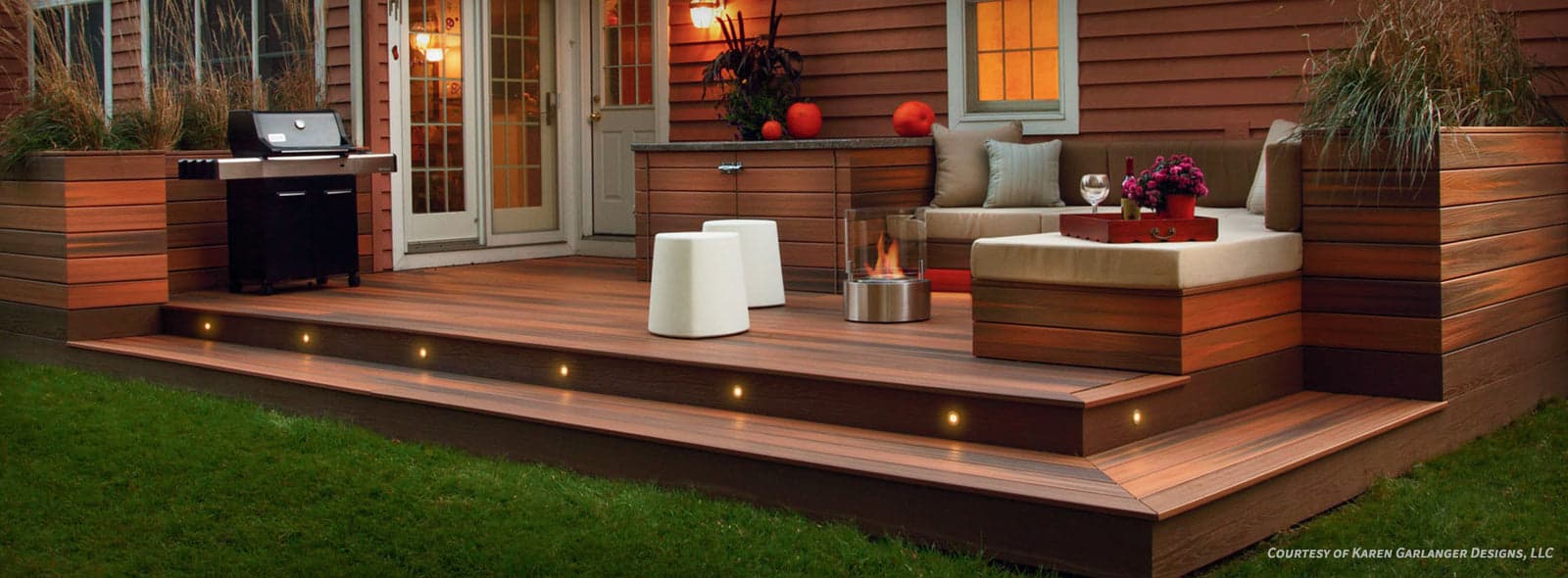
Understanding Fiberon Composite Decking
Fiberon decking is a capped wood-plastic composite, meaning each board has a protective outer layer (the cap) that encases a wood-plastic core. This cap is designed to resist staining and fading, which is particularly beneficial in a pool environment where chlorine, sunscreen, and spilled drinks are common.
The brand offers three main lines: Fiberon Concordia, Fiberon Sanctuary, and Fiberon Good Life. Fiberon Concordia features four-sided capping and deep, multi-tonal color blends. Fiberon Sanctuary has three-sided capping with a cathedral grain and warm wood tones. Fiberon Good Life is an entry-level option with a scalloped profile and honest colors, also featuring a protective cap. Each line carries a written stain and fade warranty, a key consideration for materials exposed to the elements around a pool. Fiberon boards are made with 94% recycled content by weight and are manufactured in the USA.
For pool surrounds, the protective cap is crucial. It helps prevent water absorption into the core, which can be a concern with uncapped composites or natural wood. The composition of Fiberon decking also means it does not require staining, sealing, or sanding, simplifying maintenance to an annual soap-and-water wash.
Water Exposure and Drainage Considerations
Pool surrounds are inherently wet environments. Fiberon decking is designed to withstand moisture exposure, but proper installation and drainage are still critical. Ensure the deck structure allows for adequate airflow and water runoff. This prevents water from pooling on or under the deck, which can lead to issues over time.
Adhering to these guidelines ensures proper support for the boards and helps maintain structural integrity, especially in areas with frequent foot traffic and potential for standing water. Proper gapping between boards is also essential to allow water to drain through the deck surface, preventing accumulation.
While Fiberon decking resists staining from pool chemicals, it's always advisable to rinse off any concentrated spills promptly. Regular cleaning with soap and water will help remove residues and maintain the deck's appearance.
Edge Finishes and Aesthetics
The appearance of the deck's edges around a pool contributes significantly to the overall aesthetic and safety. Fiberon offers both grooved-edge boards for hidden fasteners and square-edge boards for picture framing. Matching fascia and riser boards are also available, ensuring a cohesive look for the entire deck system.
For pool surrounds, consider how the deck meets the pool coping. A clean, finished edge is important for both safety and visual appeal. Square-edge boards can be used for a picture-frame border around the pool, creating a defined perimeter. This can also help to manage the transition between the deck and the pool's edge, especially if the coping material is different.
When planning the layout, think about how board lengths and seams will align with the pool's shape. Fiberon boards are available in 12, 16, and 20-foot lengths, allowing for flexibility in design and minimizing the number of visible seams.
Cleaning and Maintenance for Poolside Decks
One of the advantages of Fiberon composite decking for a pool surround is its low maintenance requirements. Unlike wood, it does not need staining, sealing, or sanding. The recommended maintenance is a simple annual wash with soap and water.
For poolside decks, regular rinsing with a garden hose can help remove loose debris, dirt, and light chemical residues from the surface. For more thorough cleaning, a mild soap and water solution, along with a soft-bristle brush, is generally sufficient. Always follow the manufacturer's specific cleaning instructions for your chosen Fiberon line to ensure compatibility with cleaning products.
While Fiberon's cap resists stains, immediate cleanup of spills like sunscreen, food, or drinks is still recommended to prevent potential issues.
Hypothetical Project Example: Rectangular Pool Deck
Consider a rectangular pool that measures 15 feet by 30 feet, with a desired Fiberon deck surround of 5 feet width on all sides. This creates an outer deck dimension of 25 feet by 40 feet (15 + 5 + 5 = 25; 30 + 5 + 5 = 40).
The total deck area would be 25 ft x 40 ft = 1000 square feet. The pool area is 15 ft x 30 ft = 450 square feet. Therefore, the actual decking area needed is 1000 - 450 = 550 square feet.
If using Fiberon boards that are 1 inch thick and 5.5 inches wide, and assuming 16-foot lengths are chosen for efficiency, each board covers (16 ft * 5.5 in / 12 in/ft) = 7.33 square feet. For 550 square feet, you would need approximately 550 / 7.33 = 75 boards. This is a material-equivalent calculation. In practice, you would need to account for cuts, waste, and a potential 5-10% overage. For example, if designing a layout where boards run parallel to the longer 40-foot dimension, you would need 40 ft / 16 ft = 2.5 boards end-to-end, meaning 3 boards. The width coverage would be 25 ft / (5.5 in / 12 in/ft) = 54.5 boards. So, 3 boards in length x 55 boards in width = 165 boards, then subtract the pool area. A precise cut plan is essential for an accurate material takeoff. Always factor in extra for cuts and potential future repairs.
The picture frame border could be created using square-edge boards of the same color or a complementary shade for visual contrast.
Before you order
- Evaluate color choice: Lighter colors may feel cooler underfoot in direct sun, while darker colors can absorb more heat.
- Plan for proper drainage: Ensure the deck structure and board gapping allow water to flow away from the pool and off the deck surface.
- Select board profile: Grooved-edge for hidden fasteners or square-edge for face-fastening and picture-frame borders.
- Account for board lengths: Choose 12, 16, or 20 ft lengths to minimize seams and waste based on your pool dimensions.
- Factor in fascia and riser boards: Plan for matching trim to create a finished look around the deck perimeter.
- Review cleaning and maintenance requirements: Confirm you are comfortable with the recommended soap-and-water wash for your chosen product.
- Request physical samples: View actual board samples to confirm color and texture in your project's light conditions.
Confirm installation details, approved uses and warranty terms in the current instructions for the exact product and profile. Your installer should verify the substrate, structure and applicable project requirements.
Questions to help you decide
Is Fiberon decking slippery when wet?
The texture of the capped surface helps with traction. Always exercise caution on any wet surface.
Can chlorine or saltwater pools damage Fiberon decking?
Fiberon's capped composite decking is engineered to resist staining and fading, including exposure to common pool chemicals like chlorine. However, it's always best practice to rinse off any concentrated chemical spills promptly to maintain the deck's appearance over time. For specific concerns about saltwater, consult product documentation.
How do I clean my Fiberon pool deck?
Fiberon decking requires minimal maintenance. For a pool surround, an annual cleaning with mild soap and water, using a soft-bristle brush, is generally sufficient. Regular rinsing with a garden hose can help remove surface debris and light chemical residues. Always refer to the specific cleaning guidelines for your Fiberon product line.
Plan Your Fiberon Pool Deck Project
Ready to enhance your pool area with Fiberon composite decking? Request a material quote with your project dimensions, desired Fiberon profile, and ZIP code. We'll help confirm current availability and service options for your project.
Request a material quote →