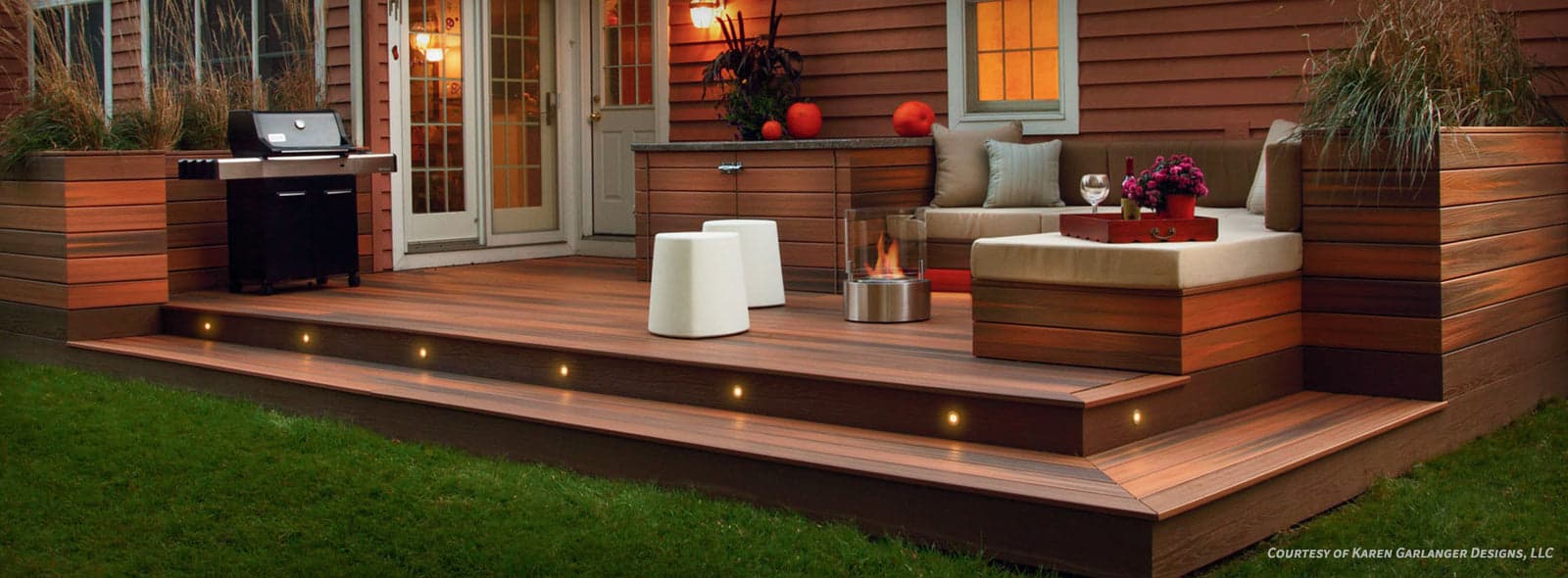
Prioritizing Durability and Low Maintenance for Guest Satisfaction
In hospitality settings, a deck's surface must endure heavy use, from constant foot traffic to spills from food and beverages. Traditional wood decks often require frequent sanding, staining, or sealing to maintain their appearance and structural integrity, leading to downtime and ongoing operational expenses. Fiberon composite decking is engineered to resist stains, fading, and rot, reducing the need for intensive maintenance.
The capped composite construction means boards are protected on multiple sides, providing a resilient surface that is easier to clean. This translates to less disruption for guests and lower labor costs for property management. An annual soap-and-water wash is typically sufficient to keep the deck looking its best, a significant advantage in busy commercial environments.
Consider the specific Fiberon lines: Fiberon Concordia offers four-sided capping and deep, multi-tonal blends, designed for high-visibility areas where premium aesthetics and maximum protection are paramount. Fiberon Sanctuary features three-sided capping with warm, natural wood tones, suitable for areas that require both durability and a classic look. Even the entry-level Fiberon Good Life, with its scalloped profile, provides a no-stain, no-seal ownership experience that can be a cost-effective choice for less trafficked areas or back-of-house applications.
Achieving Visual Consistency Across Diverse Outdoor Spaces
A cohesive visual identity is crucial for hospitality brands. Fiberon decking allows for consistent material and color palettes across different outdoor areas of a property, such as poolside lounges, restaurant patios, rooftop bars, and connecting walkways. The available color range, from coastal grays to tropical browns, facilitates integration with various architectural styles and interior design schemes.
For instance, a resort might use Fiberon Concordia's "Ipe" or "Bordeaux" to evoke a rich, exotic feel for a high-end dining terrace, while opting for "Graphite" in a modern rooftop lounge. Maintaining visual consistency helps to create a seamless guest experience, reinforcing the property's aesthetic standards. Matching fascia and riser boards are available, ensuring a complete, unified appearance for the entire deck system.
Planning for High Traffic and Structural Requirements
Hospitality decks are subject to concentrated loads from large groups of people, heavy planters, and commercial furniture. While Fiberon decking itself is robust, the underlying support structure is critical. For commercial applications with potentially higher loads, consulting with a structural engineer is essential to confirm that the substructure meets all local building codes and can safely support the anticipated weight.
Consider the layout of furniture and potential heavy features during the planning phase. Concentrated loads from large planters or water features should be supported directly by the substructure, not solely by the decking boards. This ensures the longevity and safety of the deck in a commercial setting.
Example: Renovating a Hotel Pool Deck and Restaurant Patio
Consider a hypothetical hotel renovating its 1,200 square foot pool deck and an adjacent 500 square foot restaurant patio. The goal is to create a unified, upscale look with minimal maintenance. The design calls for a rich, multi-tonal wood aesthetic around the pool and a complementary, slightly darker tone for the dining area. Both areas will experience high foot traffic and potential spills.
For the pool deck, Fiberon Concordia in "Ipe" is selected for its four-sided capping and deep, luxurious appearance, resisting chlorine splashes and sunscreen stains. The boards are 1 inch x 5.5 inches and come in 16-foot lengths. The total linear footage for the deck boards would be approximately 1,200 sq ft / (5.5 inches / 12 inches/ft) = 2,618 linear feet. Accounting for cuts and waste, purchasing around 2,800-3,000 linear feet of 16-foot boards would be a reasonable estimate, equating to 175-188 boards.
For the restaurant patio, Fiberon Sanctuary in "Espresso" is chosen. This three-sided capped board offers a slightly more subdued, warm tone that complements the "Ipe" while providing excellent stain and fade resistance for food and drink spills. The patio design includes a picture-frame border. The total linear footage for the patio decking would be approximately 500 sq ft / (5.5 inches / 12 inches/ft) = 1,091 linear feet. With waste and cuts, around 1,200-1,300 linear feet of 16-foot boards, or 75-82 boards, would be needed. Square-edge boards would be required for the picture frame border.
Both areas will use hidden fasteners for a clean, uninterrupted surface, important for guest comfort and safety around a pool and dining area. Matching fascia boards in both "Ipe" and "Espresso" will be ordered to finish the perimeter of both decks, ensuring a consistent look from every angle. This approach provides a durable, aesthetically pleasing, and easy-to-maintain solution that elevates the guest experience across both high-traffic zones.
Considerations for Installation and Fastening Systems
Fiberon decking offers flexibility in fastening, with options for hidden clips or face screws. For hospitality projects, hidden fasteners are often preferred as they create a smooth, uninterrupted surface, minimizing trip hazards and enhancing the overall aesthetic. This also prevents screw heads from becoming loose or exposed over time due to heavy traffic, which can be a maintenance issue.
When planning, ensure the chosen fastening system is compatible with the specific Fiberon board profile (grooved-edge for hidden clips, square-edge for face screws or picture framing). Proper installation by experienced contractors is paramount to ensure the deck's longevity and compliance with commercial safety standards. Adequate ventilation beneath the deck is also crucial to prevent moisture buildup and ensure the long-term performance of the composite material.
Before you order
- Identify the specific use case (poolside, dining, walkway) to determine required durability and aesthetic.
- Select Fiberon product line (Concordia, Sanctuary, Good Life) based on capping, color, and budget.
- Confirm desired board profile (grooved for hidden fasteners, square for face fastening/picture frame).
- Specify board lengths (12, 16, 20 ft) to minimize waste and seams.
- Choose complementary fascia and riser boards for a finished look.
- Account for waste factor (typically 5-10%) in material calculations.
- Verify local building codes and ADA compliance requirements for commercial decks.
- Consider the long-term maintenance plan and cleaning product compatibility.
Confirm installation details, approved uses and warranty terms in the current instructions for the exact product and profile. Your installer should verify the substrate, structure and applicable project requirements.
Questions to help you decide
What are the primary maintenance requirements for Fiberon decking in a hospitality setting?
Fiberon composite decking is designed for low maintenance. Typically, an annual cleaning with soap and water is sufficient to keep the deck looking good. This significantly reduces the labor and cost associated with maintaining traditional wood decks, which require regular staining, sealing, or painting.
Can Fiberon decking withstand heavy commercial traffic?
Yes, Fiberon decking is engineered to be durable. However, for hospitality applications with very high traffic or heavy point loads (like large planters or commercial equipment), it is crucial to ensure the underlying structural support (joists and beams) is designed to meet or exceed commercial load requirements. Always consult with a structural engineer to confirm the substructure's capacity.
Are there different color and texture options suitable for various hospitality aesthetics?
Fiberon offers a range of color palettes and textures across its product lines, from deep multi-tonal blends in Concordia to warm, natural wood tones in Sanctuary and honest colors in Good Life. This variety allows designers to select options that complement diverse hospitality aesthetics, from modern and sleek to traditional and rustic. Physical samples are recommended to confirm color and texture before making a final decision.
Request a Quote for Your Hospitality Deck Project
Planning a new deck or renovating an existing outdoor space for your hotel, resort, or restaurant? Provide your project dimensions, desired Fiberon profile, and ZIP code to request a material quote. Our team can help confirm current availability and service options for your commercial decking needs.
Request a material quote →