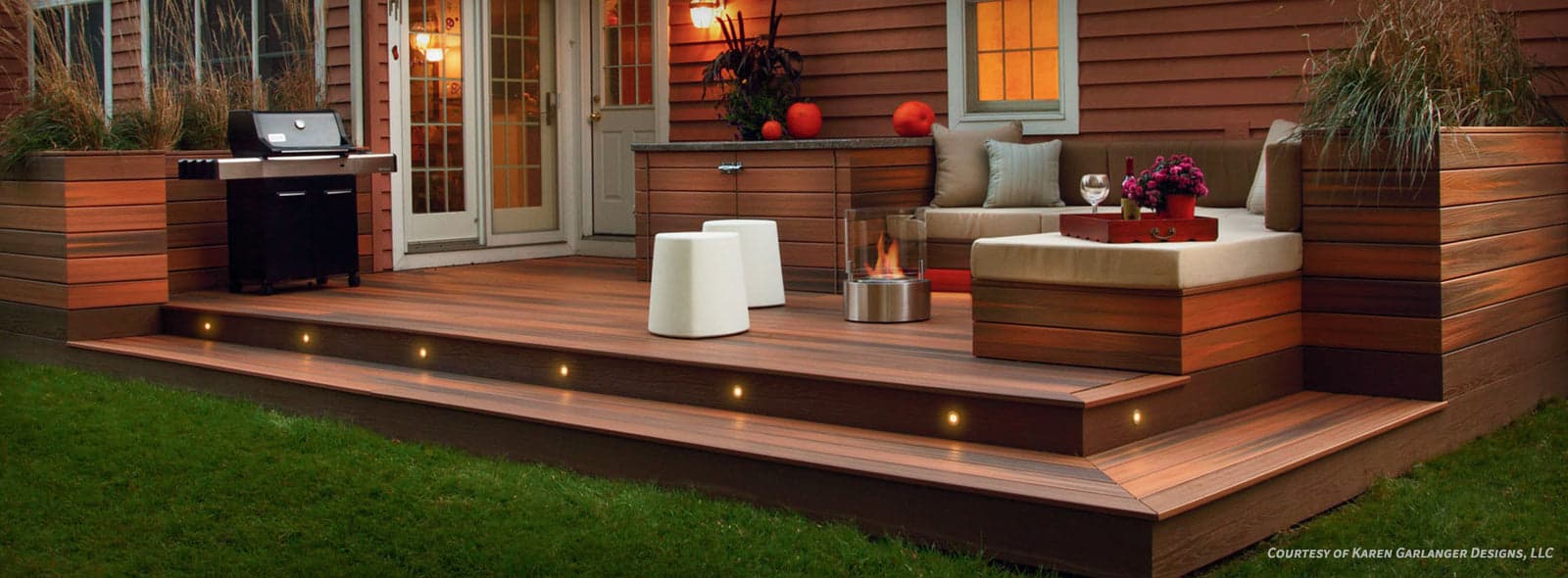
Understanding Fiberon's Capped Composite Technology
Fiberon decking utilizes capped composite technology, meaning each board has a protective outer layer, or 'cap,' fused to its core. This cap is engineered to resist staining and fading, a key differentiator from traditional wood or uncapped composites. The specific properties of this cap, including its thickness, composition, and multi-tonal blends, are what primarily define the finished appearance and how it holds up over decades of outdoor exposure.
The core of Fiberon boards contains recycled wood and plastic materials. This internal structure provides strength and stability, while the cap delivers the desired aesthetic and performance. Fiberon offers boards with three-sided or four-sided capping, influencing how the board looks from different angles and its resistance to environmental factors on all exposed surfaces.
Fiberon Concordia: Deep Multi-Tonal Blends
Fiberon Concordia is the flagship line, characterized by its four-sided capping and deep, multi-tonal color blends. This line is designed to mimic the appearance of exotic hardwoods with nuanced variations in color across and within individual boards. The four-sided cap ensures that all visible surfaces, including the grooves, are protected and contribute to the consistent aesthetic.
Colors available in the Concordia line, such as Ipe, Bordeaux, and Graphite, feature complex pigmentation that creates a rich, varied look. This multi-tonal quality helps to conceal minor surface imperfections and provides a sophisticated, high-end finish that stands out. The enhanced capping is intended to offer superior resistance to stains and fading, preserving the initial appearance over a longer period.
The aesthetic goal of Concordia is to provide a premium look at a competitive value, with colors that offer significant visual depth. This line is often chosen for projects where a luxurious and detailed wood-like appearance is desired without the maintenance associated with natural hardwoods.
Fiberon Sanctuary: Warm, Believable Wood Tones
The Fiberon Sanctuary line offers a mid-range option with three-sided capped composite boards. These boards feature a cathedral grain pattern and warm, believable wood tones designed to replicate the natural look of traditional lumber. The capping covers the top and two sides, providing protection for the primary visible surfaces.
Sanctuary colors like Chestnut, Moringa, and Espresso are selected for their natural appeal, aiming for a classic deck aesthetic. While still offering multi-tonal effects, the blends tend to be more subtle than the Concordia line, providing a consistent yet inviting appearance. The three-sided cap offers robust protection against common stains and fading on the main walking surface and exposed edges.
This line is a popular choice for homeowners seeking a custom-look deck without the higher price point of more elaborate composites. It balances aesthetic appeal with practical performance, offering a finish that integrates well into various outdoor settings.
Fiberon Good Life: Honest Colors and Scalloped Profile
Fiberon Good Life represents the entry-level offering, featuring honest colors and a scalloped profile. This line is also capped, providing protection against stains and fading, and is designed to be a cost-effective alternative to pressure-treated wood over its lifetime. The scalloped underside reduces weight, which can simplify handling, while the visible surface maintains a clean, durable finish.
Colors such as Cabin and Beach House in the Good Life line are straightforward and consistent, offering a solid, dependable aesthetic. While the color blends are less complex than those in the Concordia or Sanctuary lines, they still provide a pleasant and functional appearance suitable for a variety of projects, from simple backyard decks to cottage escapes.
The Good Life line emphasizes durability and low maintenance, making it an attractive option for those prioritizing long-term value and ease of care. The finish is designed to resist the elements and retain its color without the need for staining or sealing.
Weathering and Maintenance: What to Expect
A key advantage of Fiberon decking is its minimal maintenance requirement. Unlike natural wood, which needs regular staining or sealing to protect its finish and color, Fiberon boards are designed to be 'no maintenance cycle' products. This means no staining, sealing, or sanding is typically required to maintain their appearance. An annual soap-and-water wash is generally sufficient to keep the deck clean.
While Fiberon decking is engineered to resist fading, all outdoor materials will experience some degree of natural weathering over time. The advanced capping on Fiberon boards is designed to significantly slow this process, with warranties specifically covering stain and fade resistance. However, minor shifts in color or gloss may occur gradually due to prolonged exposure to UV light and environmental factors. These changes are generally uniform and subtle, contributing to a natural, aged aesthetic rather than a degraded appearance.
It is important to avoid applying paints, stains, or sealants to Fiberon decking unless specifically approved by the manufacturer for composite materials. These products are not typically necessary and can potentially damage the cap, voiding the warranty and negatively impacting the board's intended performance and appearance. Always refer to the manufacturer's care instructions for specific guidance.
Coordinating with Fascia and Risers
To achieve a cohesive finished appearance, Fiberon offers matching fascia and riser boards for each of its decking lines. Fascia boards are used to finish the perimeter of the deck, covering the exposed joists and rim joists, while riser boards are used for the vertical surfaces of stairs. Using coordinated fascia and risers ensures that the entire deck system presents a unified aesthetic.
The availability of matching trim components from the same product line eliminates the need to source separate materials that might not perfectly match in color or texture. This attention to detail helps create a professionally finished look, ensuring that edges and transitions are seamless and consistent with the main decking surface.
When planning your project, remember to include the necessary quantities of matching fascia and riser boards to complement your chosen Fiberon decking line and color. This ensures a complete and visually integrated deck system.
Before you order
- Consider the overall aesthetic goal: Do you prefer deep multi-tonal blends, warm natural wood tones, or consistent, honest colors?
- Evaluate the level of detail desired: Is four-sided capping important for all visible surfaces, or is three-sided sufficient for your design?
- Review physical samples: Screens can shift color; always view actual board samples in your project's lighting conditions.
- Understand weathering expectations: While designed for fade resistance, acknowledge that all outdoor materials will experience some subtle changes over time.
- Plan for trim: Ensure matching fascia and riser boards are available and included in your material list for a cohesive finish.
- Confirm maintenance expectations: Fiberon is low maintenance, but understand that no additional stains or sealants are typically permitted or necessary.
- Budget considerations: Balance your aesthetic preferences with the price point of each Fiberon line (Concordia, Sanctuary, Good Life).
Confirm installation details, approved uses and warranty terms in the current instructions for the exact product and profile. Your installer should verify the substrate, structure and applicable project requirements.
Questions to help you decide
Can I paint or stain Fiberon decking to change its appearance?
No, Fiberon decking is designed to be a low-maintenance product that does not require painting, staining, or sealing. Applying these products can damage the protective cap, potentially void the warranty, and may lead to an unsatisfactory finish. The factory-applied cap is engineered to resist stains and fading, and its appearance should be maintained with simple soap and water cleaning.
How do Fiberon's multi-tonal colors resist fading compared to solid colors?
Fiberon's multi-tonal colors, particularly in the Concordia line, are created using complex pigmentation within the protective cap. This advanced cap is engineered for superior fade resistance. While all outdoor materials will experience some degree of weathering, the multi-tonal blends are designed to maintain their visual depth and resist noticeable fading more effectively than simpler, solid colors found in some other decking materials. The variations in tone can also help mask minor dust or wear over time.
What is the difference between three-sided and four-sided capping in terms of appearance?
Three-sided capping covers the top surface and two long edges of the board, which are the most visible parts in a standard installation. Four-sided capping, found in the Concordia line, covers all four sides, including the underside. Visually, this means that even the grooves of a grooved-edge board or the underside of a square-edge board, if exposed (e.g., on a second-story deck where the underside might be seen), will have the same protective and aesthetic finish as the top surface. This provides a more uniform and complete appearance from all angles.
Ready to Plan Your Fiberon Decking Project?
Request a material quote with your project dimensions, exact Fiberon profile, and ZIP code to confirm current availability and service options. Our team can help you select the ideal finish for your outdoor space.
Request a material quote →