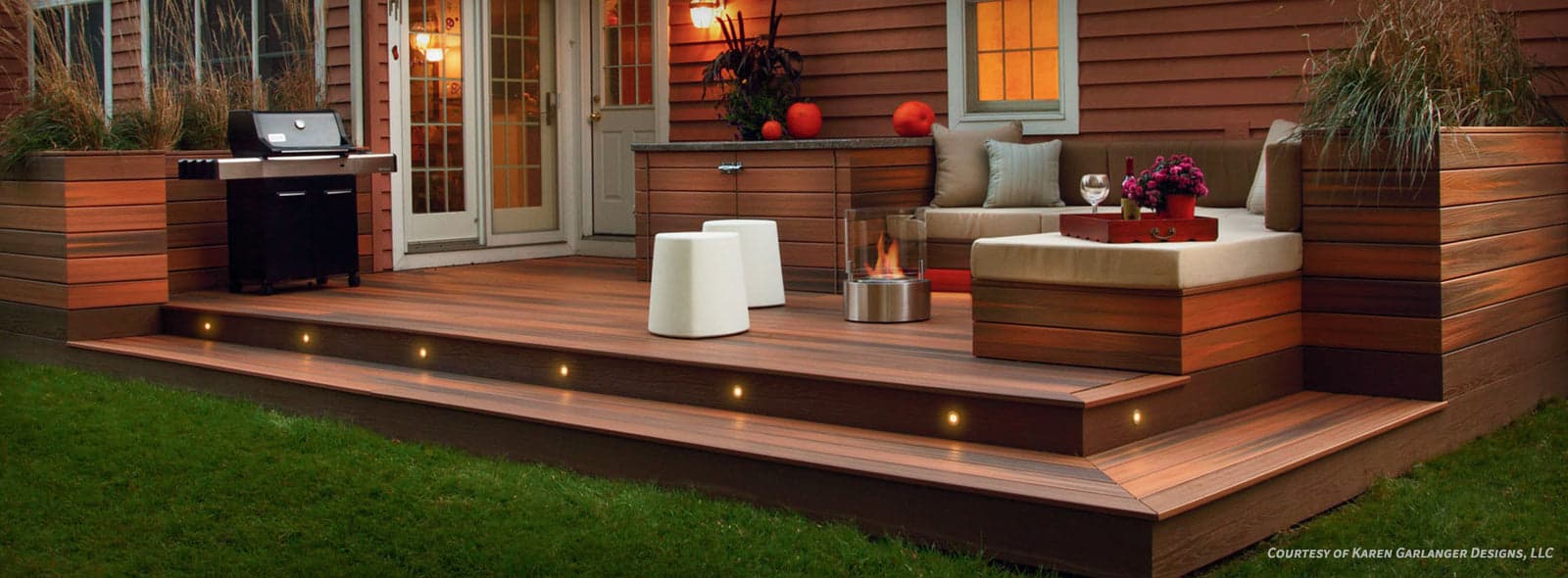
Understanding Your Covered Porch Environment
Covered porches present a distinct set of environmental factors compared to fully exposed decks. While the primary decking area benefits from overhead protection, edges, steps, and areas near railings may still experience direct sun, rain, or snow. This variability requires a decking material that can perform reliably across these different conditions.
Fiberon's capped composite construction is designed to address these challenges. The protective cap layer on Concordia (four-sided capped) and Sanctuary (three-sided capped) lines helps resist moisture absorption and UV damage, reducing the risk of discoloration or material degradation even in partially exposed zones. The Good Life line, while entry-level, also features a cap and carries a stain and fade warranty, making it a viable option for fully covered or minimally exposed porches. This consistent performance ensures your porch maintains a uniform look over time, avoiding noticeable differences between sheltered and exposed sections.
Choosing the Right Fiberon Line for Your Porch
Fiberon offers three main lines, each with distinct features suitable for different project needs and budgets. The choice depends on your desired aesthetics, expected traffic, and the specific exposure levels of your porch.
Fiberon Concordia is the flagship line, featuring four-sided capping and multi-tonal color blends. Its enhanced protection makes it suitable for porches with significant sun exposure on certain edges or where a premium, highly resistant surface is desired. The deep, rich colors of Concordia, such as Ipe or Graphite, can add a sophisticated touch.
Fiberon Sanctuary is a mid-range option with three-sided capping and warm, believable wood tones. It offers a balance of performance and aesthetics, making it a popular choice for many covered porch applications. Colors like Chestnut and Moringa provide a natural, inviting feel. Sanctuary is a solid choice when a custom look is desired without the highest price point.
Fiberon Good Life is the entry-level option, featuring a scalloped profile and honest colors like Cabin and Beach House.
All Fiberon lines are designed for low maintenance, requiring only an annual soap-and-water wash, which is particularly convenient for a porch that sees regular use.
Coordinating Thresholds and Entryways
A key design element for a covered porch is the seamless transition from your home's interior to the outdoor space. This involves careful planning of thresholds and entryways. Fiberon decking, available in both grooved-edge boards for hidden fasteners and square-edge boards for face fastening and trim, allows for clean finishes.
When planning, consider the height difference between your interior flooring and the porch deck. Aim for a smooth transition, typically with the deck surface slightly below the interior threshold to prevent water intrusion. Using square-edge Fiberon boards for the perimeter or as a picture frame can create a defined edge that complements your home's siding or trim. Matching fascia boards are also available to finish the sides of the porch deck, providing a cohesive look from all angles.
Careful measurement and consideration of board profiles (1" x 5.5") and lengths (12, 16, 20 ft) will help minimize cuts and create a professional finish at all transitions.
Planning for Furniture and Traffic
A covered porch is often a high-traffic area, frequently hosting outdoor furniture, planters, and gatherings. Fiberon decking is designed to withstand typical porch use, with a durable capped surface that resists stains from spills and marks from furniture.
When arranging furniture, consider its weight and the load distribution on the deck. While Fiberon decking is robust, heavy items should be placed with care. For areas with particularly heavy planters or furniture, using furniture pads can help prevent potential surface marks. The low-maintenance nature of Fiberon means you won't need to worry about staining or sealing around furniture, simplifying upkeep.
Worked Example: Designing a 10' x 16' Covered Porch
Let's consider a hypothetical 10-foot by 16-foot covered porch, with the 16-foot dimension running parallel to the house. We'll use Fiberon Sanctuary decking in Chestnut. The porch will have a picture-frame border along the three exposed sides and a main field laid perpendicular to the house.
First, determine the border: A 16-foot length will use a single 16-foot square-edge board. The two 10-foot sides will each use a 12-foot square-edge board, with 2 feet cut off and saved as offcuts. This uses three square-edge boards.
Next, calculate the field: The interior dimensions will be approximately 9 feet 5 inches by 15 feet 5 inches (accounting for the border width). Laying boards perpendicular to the house means using 10-foot grooved-edge boards. For the 15-foot 5-inch length, you'll need two 10-foot boards per run, end-joining them. This means each run uses 20 feet of material, with 4 feet 7 inches of offcut. Given the 9-foot 5-inch width, and Fiberon's 5.5-inch board width, you'll need approximately 20 boards (9'5" / 5.5" = ~20.5 boards, round up to 21 for cuts and waste). Therefore, 21 runs x 2 boards/run = 42 grooved-edge 10-foot boards.
For fascia, assume a 16-foot length and two 10-foot lengths will be needed around the perimeter. This would require one 16-foot fascia board and two 12-foot fascia boards (with offcuts).
This example illustrates how board lengths and profiles are selected to minimize waste and ensure a clean finish. Always confirm actual dimensions and consult product installation guides for precise spacing and fastening requirements.
Before you order
- Assess the exact exposure level of all porch sections (fully covered vs. partially exposed to sun/rain).
- Choose a Fiberon line (Concordia, Sanctuary, Good Life) based on desired aesthetics, durability, and budget.
- Plan for seamless transitions at all doorways and thresholds, considering finished deck height relative to interior floors.
- Account for matching fascia and riser boards for a complete, finished look.
- Consider the placement and weight of outdoor furniture and planters.
- Factor in ventilation needs under the deck, especially for covered areas.
- Review local building codes for any specific requirements for covered outdoor structures.
Confirm installation details, approved uses and warranty terms in the current instructions for the exact product and profile. Your installer should verify the substrate, structure and applicable project requirements.
Questions to help you decide
Will Fiberon decking fade differently in covered versus exposed sections of my porch?
Fiberon decking is designed with a protective cap layer that helps resist fading and staining. The goal is a uniform appearance, even where parts of the porch see more direct sunlight or weather.
Can I use hidden fasteners on a covered porch with Fiberon decking?
Yes, Fiberon offers grooved-edge boards that are compatible with hidden fastening systems. This allows for a clean, screw-free surface, which is often preferred for covered porches where aesthetics are paramount. Square-edge boards are also available for face-fastening, picture framing, and trim applications, providing flexibility for different design elements on your porch.
How do I maintain Fiberon decking on a covered porch?
Fiberon decking is a low-maintenance material. For a covered porch, annual cleaning with soap and water is typically sufficient to remove dirt, pollen, and any mildew that might accumulate in shaded areas. Unlike wood, Fiberon does not require staining, sealing, or sanding, simplifying the upkeep of your porch.
Ready to Plan Your Fiberon Covered Porch?
Request a material quote with your project dimensions, desired Fiberon profile, and ZIP code to confirm current availability and service options for your covered porch project. Explore Fiberon Concordia, Sanctuary, and Good Life lines to find the perfect fit.
Request a material quote →