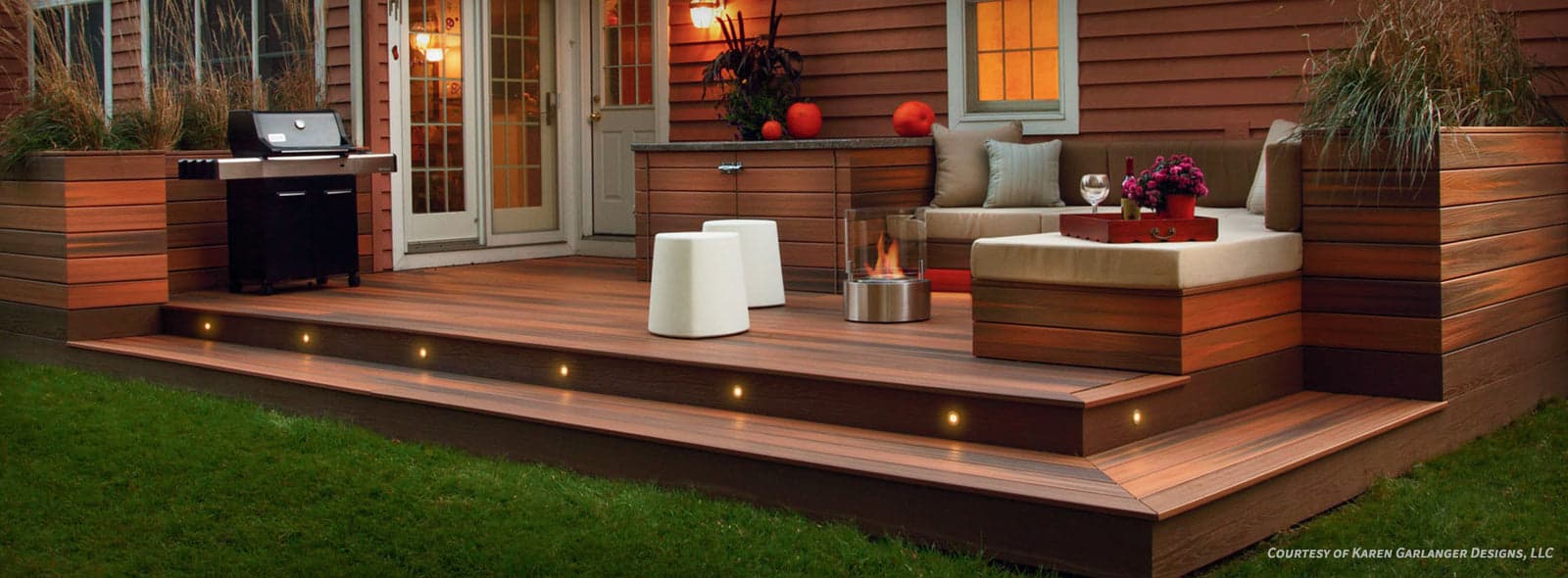
Understanding the Standard Fiberon Board Width
Fiberon composite decking boards are consistently manufactured with a nominal profile of 1 inch by 5.5 inches. This includes both grooved-edge boards, designed for hidden fastening systems, and square-edge boards, typically used for picture framing or stair treads. This uniformity across the Fiberon product lines simplifies the planning process, as you don't need to account for varying standard widths between different collections like Concordia, Sanctuary, or Good Life.
Always refer to the specific Fiberon installation guidelines for recommended gapping between boards, as this will affect your final coverage calculations and visual spacing.
Visual Rhythm and Scale: How Width Influences Design
The standard 5.5-inch width of Fiberon boards creates a classic, balanced look suitable for most deck sizes and architectural styles. This common dimension is familiar and works well for both expansive decks and more compact urban spaces.
For larger decks, the consistent 5.5-inch width provides a sense of continuity without overwhelming the space with excessively wide boards or creating a busy pattern with very narrow ones. For smaller areas, this width helps maintain a sense of scale, preventing the deck from feeling too fragmented.
The Role of Board Width in Deck Layouts
The 1-inch by 5.5-inch profile is versatile for various deck layouts. For traditional straight-lay patterns, the consistent width ensures a clean, linear appearance. When planning diagonal layouts, the standard width still applies, though the effective coverage per board will differ, requiring careful calculation.
For design elements like picture-frame borders, the square-edge boards of the same 5.5-inch width can be used to create a cohesive look around the perimeter of the deck. This allows for a uniform visual transition from the field boards to the border, maintaining the established rhythm.
Calculating Material Quantities with Standard Width Boards
To accurately estimate the number of Fiberon boards needed, you will primarily work with the nominal 5.5-inch width and the available board lengths (12, 16, and 20 feet).
Consider a hypothetical deck measuring 12 feet by 10 feet. If you plan to run the boards along the 12-foot length, you will need boards that are at least 12 feet long. The 10-foot width of the deck needs to be covered. Converting 10 feet to inches gives 120 inches. Dividing 120 inches by 5.625 inches yields approximately 21.33 board runs. Since you cannot purchase partial board runs, you would need 22 full board runs. If using 12-foot boards, this means 22 boards of 12-foot length.
Remember to account for waste due to cuts, especially for shorter sections, and factor in any boards needed for picture frames, stair treads, or fascia. Always add a percentage for cuts and unexpected needs, typically 5-10%, depending on the complexity of your deck design.
Complementary Products and Visual Harmony
Fiberon offers a full system of products, including matching fascia and riser boards, which are designed to complement the standard decking board widths. This ensures a consistent appearance across all visible elements of your deck. When selecting these complementary products, verify that their dimensions and profiles align with your design vision.
Explore options like composite decking for the main field, or consider different materials like ipe hardwood decking or other composite decking brands if you are blending materials in specific design zones, always checking for material compatibility and dimensional differences.
Before you order
- Confirm the exact installed width of Fiberon boards, including recommended gapping.
- Sketch your deck layout, indicating board direction and any special patterns (diagonal, picture frame).
- Calculate the number of full board runs needed for your deck's total width.
- Determine the optimal board lengths (12, 16, or 20 ft) to minimize waste for your project's dimensions.
- Account for additional boards for stairs, fascia, and any other trim elements.
- Add a waste factor (e.g., 5-10%) to your total board count.
- Verify compatibility with chosen fasteners (hidden clips or face screws) as they may influence spacing slightly.
Confirm installation details, approved uses and warranty terms in the current instructions for the exact product and profile. Your installer should verify the substrate, structure and applicable project requirements.
Questions to help you decide
Are all Fiberon decking lines available in the same board width?
Yes, Fiberon Concordia, Sanctuary, and Good Life lines all share the standard nominal board profile of 1 inch by 5.5 inches. This consistency simplifies planning regardless of the specific Fiberon collection you choose.
Does the board width affect the type of fasteners I can use?
The board width itself does not dictate the fastener type. Fiberon boards are available in both grooved-edge profiles, compatible with hidden fastening systems, and square-edge profiles, suitable for face-fastening or as border boards. The choice between grooved or square edge is what determines fastener compatibility.
How does board width impact joist spacing?
Adhering to these structural requirements is crucial for the performance and longevity of your deck, regardless of the board width.
Ready to Plan Your Fiberon Deck?
Request a material quote with your project dimensions, desired Fiberon profile, and ZIP code. We can help confirm current availability and service options for your project.
Request a material quote →