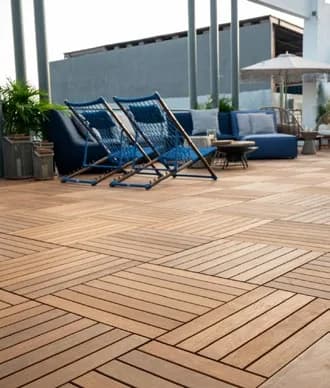
Why a Sample Board is Essential for Deck Tiles
Photographs and online renderings can offer inspiration, but they cannot fully replicate the tactile experience or the way light interacts with a material. Deck tiles, especially those made from natural hardwoods like Ipe, Garapa, or Cumaru, exhibit unique grain patterns and color variations that are best appreciated in person.
A sample board provides a portable, cohesive representation of your design choices. It allows you to observe how the tile's appearance changes throughout the day, how it contrasts with existing structures, and how it feels underfoot. This direct interaction is invaluable for making confident material selections.
Selecting Your Deck Tile Samples
Begin by acquiring samples of the specific deck tile species and sizes you are considering. Lumber Plus offers various options, including Ipe, known for its deep chocolate tones and exceptional hardness; Garapa, with warm golden tones; and Cumaru, featuring rich reddish-brown grain.
Consider the dimensions as well: 12 x 12 inch tiles offer a compact format for smaller areas or intricate layouts, while 24 x 24 inch tiles provide a larger surface area, reducing the number of seams for expansive terraces. Requesting multiple tiles of each option can help you see natural variations and how they might look when laid out.
Ensure your samples represent the exact profile and finish you intend to order. Differences in milling or surface treatment can significantly alter the final appearance and feel of the deck tiles.
Gathering Complementary Material Samples
A deck tile sample board should include more than just the tiles. Collect samples of any adjacent materials that will define your outdoor space. This might include paint swatches for exterior walls, samples of railing materials (metal, glass, or wood), stone or paver samples for transition areas, or even fabric swatches for outdoor cushions.
If you plan to incorporate specific planters, lighting fixtures, or decorative elements, consider including small examples or images of these items on your board. The goal is to create a mini-environment that reflects the overall design intent of your project.
Assembling Your Sample Board: A Practical Example
For a typical sample board, choose a sturdy, flat base material like a piece of plywood or rigid foam board, approximately 24 inches by 36 inches. This size allows for several deck tile samples and adjacent materials without being cumbersome.
Let's consider a hypothetical balcony project. You are deciding between 12 x 12 inch Garapa deck tiles and 12 x 12 inch Cumaru deck tiles. Your sample board might include:
1. **Two Garapa 12 x 12 inch deck tiles:** Place these side-by-side to observe color variation and grain.
2. **Two Cumaru 12 x 12 inch deck tiles:** Position these next to the Garapa for direct comparison.
3. **A paint swatch (4x6 inches) of the exterior wall color:** Adhere this near the tiles to see how the wood tones interact with the building facade.
4. **A small sample of the railing material (e.g., a piece of aluminum tubing or a wood stain sample):** Place this along one edge of the tile samples.
5. **A fabric swatch (6x6 inches) for outdoor cushions or an accent pillow:** Position this on the board to visualize the overall color palette.
Secure all samples to the board using adhesive, double-sided tape, or small screws for larger items. Label each item clearly to avoid confusion. This composite board can then be moved to different areas of your outdoor space and observed under varying light conditions.
Evaluating Your Sample Board in Different Conditions
The true value of a sample board emerges when you evaluate it in situ. Place your assembled board in the actual location where the deck tiles will be installed. Observe it at different times of day – morning, midday, and evening – to see how natural light affects the appearance of the materials.
Consider how the tiles look on a sunny day versus an overcast one. If your project is a rooftop terrace, observe the board from different angles and distances. For a ground-level patio, check how the colors and textures integrate with surrounding landscaping. This dynamic evaluation helps you make an informed choice that considers all environmental factors.
Remember to account for the eventual aging and weathering of natural wood deck tiles. Hardwoods like Ipe, Garapa, and Cumaru will gradually silver over time if left untreated. If you plan to apply a finish, consider requesting a small, pre-finished sample or applying a small amount of your chosen finish to a portion of a sample tile.
Before you order
- Have I obtained physical samples of all deck tile species and sizes under consideration?
- Do my deck tile samples represent the exact profile and finish I intend to order?
- Have I gathered samples of all adjacent materials (paint, railings, pavers, fabrics) for the sample board?
- Is my sample board sturdy and large enough to display all chosen elements effectively?
- Have I observed the sample board in the actual project location at different times of day?
- Have I considered how the deck tiles will appear under various weather conditions?
- Does the overall aesthetic of the sample board align with my vision for the outdoor space?
- Have I considered the long-term appearance of the deck tiles, including natural weathering or planned finishes?
- Have I shared the sample board with anyone else involved in the decision-making process for their input?
Confirm installation details, approved uses and warranty terms in the current instructions for the exact product and profile. Your installer should verify the substrate, structure and applicable project requirements.
Questions to help you decide
How many deck tile samples should I get?
It is recommended to obtain at least two tiles of each species and size you are considering. This allows you to see the natural variations in grain and color that are inherent in natural wood products like Ipe, Garapa, or Cumaru, and how they look when placed side-by-side.
What kind of base should I use for my sample board?
A sturdy, flat base material like a piece of plywood or rigid foam board is ideal. A size of approximately 24 inches by 36 inches is often sufficient to accommodate multiple deck tile samples and other material swatches without being too large to move and position easily.
Should I apply a finish to my deck tile samples?
If you plan to apply a specific finish or sealer to your installed deck tiles, it is highly recommended to apply that same finish to a portion of one of your samples. This will give you a realistic idea of how the finished product will look, as finishes can significantly alter the color and sheen of natural hardwoods.
Ready to Plan Your Deck Tile Project?
Request a material quote today. Provide your project dimensions, desired deck tile profile, and ZIP code to confirm current availability and service options for Ipe, Garapa, Cumaru, and other deck tile materials.
Request a material quote →