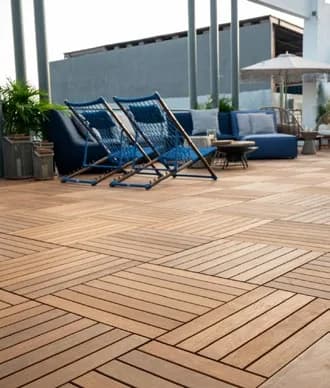
Understanding Deck Tile Material Costs
The primary component of your budget will be the deck tiles themselves. Lumber Plus offers deck tiles in various hardwood species and sizes. For example, Ipe deck tiles are known for their deep chocolate tones and exceptional hardness, while Garapa offers warm golden tones, and Cumaru provides a rich reddish-brown grain. These different species may have varying costs.
Deck tiles are available in standard dimensions such as 12 x 12 inches (1 square foot per tile) and 24 x 24 inches (4 square feet per tile). The choice of size can impact not only the aesthetic of your project but also the number of tiles needed and the potential for waste, which in turn affects your overall material budget. It is crucial to determine the exact area to be covered and then factor in a percentage for cuts and potential future replacements.
Essential Accessories and Their Impact on Budget
Beyond the deck tiles, several accessories are often required for a complete and functional installation. These can include pedestal systems for rooftop installations or leveling over uneven surfaces, edge trim pieces for a finished look, and fasteners or connectors specific to the chosen tile system. Do not overlook these items, as they are integral to the project's success and will add to the total cost.
For hardwood deck tiles, sealers or protective oils are often recommended to maintain their appearance and help protect the wood. While not always an immediate installation cost, budgeting for periodic maintenance products can extend the life and beauty of your deck tiles, making it a valuable long-term consideration.
Estimating Labor Costs for Installation
Unless you plan a DIY installation, labor costs will be a significant part of your budget. These costs can vary widely depending on the complexity of the installation, the local labor rates, and the experience of the contractor. Factors such as site preparation, existing surface conditions, and the need for custom cuts or intricate layouts can all influence the labor hours required.
When obtaining quotes from contractors, ensure that their estimate clearly outlines what is included: site preparation, tile installation, accessory installation, and clean-up. A detailed breakdown helps compare bids accurately and prevents misunderstandings later in the project.
The Importance of a Contingency Fund
No project budget is complete without a contingency fund. This is typically an additional 10-15% of the total estimated cost set aside to cover unforeseen expenses. Even with careful planning, unexpected issues can arise, such as needing additional materials due to errors in measurement, discovering hidden site conditions, or minor design adjustments.
Having a contingency fund provides financial flexibility and peace of mind, allowing you to address these issues without derailing your project or exceeding your planned spending. It is a prudent measure that helps ensure the project stays on track and within a realistic financial scope.
Worked Example: Budgeting for a 100-Square-Foot Terrace
Let's consider a hypothetical project: a 100-square-foot outdoor terrace using 24 x 24 inch Garapa deck tiles. This area measures 10 feet by 10 feet. Each 24 x 24 inch tile covers 4 square feet.
First, calculate the base quantity of tiles: 100 sq ft / 4 sq ft per tile = 25 tiles. However, for cuts and waste, it is advisable to add 10-15%. Let's add 10%, meaning 25 tiles * 1.10 = 27.5 tiles. You would need to purchase 28 tiles, assuming tiles are sold individually. If tiles come in packs, you would round up to the nearest full pack. For a 10 x 10 foot area, the 24-inch grid aligns well, minimizing significant edge cuts.
Next, estimate accessories. For a simple ground-level installation, you might need edge trim for two sides, totaling 20 linear feet.
Build this part of the estimate from the current supplier quote. Record the exact product, quoted unit, quantity, compatible accessories and delivery costs separately so assumptions do not become advertised prices.
Before you order
- Have you measured the exact dimensions of your project area?
- Which deck tile species (e.g., Ipe, Garapa, Cumaru) and size (12x12 or 24x24) have you chosen?
- Have you calculated the base quantity of tiles needed, plus an allowance for cuts and waste?
- What accessories are required (pedestals, edge trim, fasteners, sealers)?
- Have you obtained quotes for professional installation, if applicable?
- Have you included a contingency fund (10-15%) for unexpected costs?
- Have you considered long-term maintenance costs for your chosen deck tile material?
- Do you have a clear understanding of what is included in each quote you receive?
Confirm installation details, approved uses and warranty terms in the current instructions for the exact product and profile. Your installer should verify the substrate, structure and applicable project requirements.
Questions to help you decide
How much waste should I factor into my deck tile order?
For most deck tile projects, especially those with intricate layouts or many cuts, it is prudent to factor in 10-15% extra material for waste. For simple rectangular areas with well-aligned tile sizes, you might get by with 5-10%. Always consult your layout plan to determine potential cut waste.
Do I need pedestals for deck tiles?
Pedestals are typically used for rooftop terraces, installations over existing uneven concrete slabs, or any scenario where you need to create a level surface, allow for drainage underneath, or provide access to the substrate (like a waterproofing membrane). For simple ground-level applications on a prepared, level surface, pedestals may not be necessary. Always confirm the specific requirements for your installation type.
What is the difference between 12x12 and 24x24 deck tiles for budgeting?
While both cover a specific area, 12x12 inch tiles (1 sq ft each) generally result in more individual pieces and more seams compared to 24x24 inch tiles (4 sq ft each). For budgeting, 12x12 tiles might involve more labor for installation due to the higher number of pieces, and potentially more trim pieces for edges. 24x24 tiles can cover large areas more quickly, potentially reducing labor, but require careful planning for cuts, as larger offcuts might be less reusable than smaller ones.
Plan Your Deck Tile Project with Lumber Plus
Ready to build your budget? Request a material quote today by providing your project dimensions, desired deck tile profile, and ZIP code. We can help you confirm current availability and service options for your project. Explore our selection of Ipe, Garapa, and Cumaru deck tiles to find the perfect fit for your outdoor space.
Request a material quote →