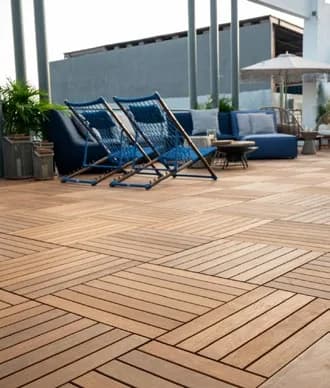
Understanding the Spa Terrace Environment
A spa terrace differs significantly from a typical deck or patio. The primary distinction is the constant presence of water, whether from splashes, condensation, or routine cleaning. This moisture necessitates materials that resist water damage, rot, and mold growth. Furthermore, the surface needs to be comfortable underfoot, even when wet, and capable of handling varying temperatures.
Beyond water exposure, a spa terrace often involves heavy equipment (the spa itself), potential chemical exposure (from spa treatments), and the need for easy access to the spa's mechanical components for maintenance. The chosen deck tile system must integrate seamlessly with these functional requirements.
Material Selection: Hardwood Deck Tiles for Wet Areas
When considering deck tiles for a spa terrace, tropical hardwoods are often a preferred choice due to their natural density and resistance to moisture and decay. Ipe, Garapa, and Cumaru are examples of hardwoods that can perform well in such environments.
Ipe, with its deep chocolate tones, offers exceptional hardness and natural resistance to decay, making it a durable option for wet conditions. Garapa features warm golden tones and is also known for its durability and resistance to rot. Cumaru provides a rich reddish-brown grain, combining strength with a distinctive appearance. Each of these species offers a natural, slip-resistant surface when properly maintained, which is crucial for safety around a spa.
It is important to understand that while these hardwoods are resistant, they are not impervious. Regular cleaning and appropriate maintenance are still necessary to preserve their appearance and prolong their lifespan in a spa environment.
Drainage and Substructure: Managing Water Flow
Effective drainage is paramount for a spa terrace. Deck tiles, particularly those installed on a pedestal system, facilitate water runoff by allowing it to flow through the gaps between tiles and beneath the surface. This prevents standing water, which can lead to slippery conditions, staining, and accelerate material degradation.
The underlying surface (e.g., concrete slab, waterproof membrane) must be sloped away from the spa and any adjacent structures to direct water towards drains. Pedestal systems, which elevate the deck tiles, create a cavity for water to drain freely. This also helps with air circulation, reducing moisture buildup under the tiles.
Access and Maintenance: Planning for the Future
A key advantage of deck tile systems, especially those using pedestals, is the ability to access the underlying surface. This is critical for a spa terrace, as spas often require periodic maintenance or repair of their plumbing, electrical, or filtration systems. Removable deck tiles allow for easy lifting and reinstallation, minimizing disruption.
Regular cleaning of the deck tile surface is essential to prevent the buildup of algae, mold, and spa chemicals. For hardwood tiles, this typically involves sweeping, rinsing with water, and occasional scrubbing with a mild cleaner. Periodic reapplication of a suitable finish may be recommended to protect the wood and maintain its appearance. Always refer to the specific manufacturer's guidelines for cleaning and maintenance of your chosen deck tile species and finish.
Worked Example: Designing a 10'x12' Spa Terrace
Let's consider a hypothetical 10-foot by 12-foot rectangular spa terrace. The spa itself measures 7 feet by 7 feet and will be centered on the 12-foot side, leaving a 2.5-foot walkway on either side of the spa's length and a 3-foot walkway at the ends.
For this example, we will use 24" x 24" (2-foot x 2-foot) Ipe deck tiles. The total area is 120 square feet. Each 24" x 24" tile covers 4 square feet. A simple area calculation suggests 30 tiles (120 sq ft / 4 sq ft per tile).
However, a grid layout is more accurate. The 10-foot width requires 5 tiles (10 feet / 2 feet per tile). The 12-foot length requires 6 tiles (12 feet / 2 feet per tile). This means a grid of 5 x 6 = 30 tiles. In this specific case, the dimensions align perfectly with the tile size, minimizing cuts and waste.
The layout would place the spa within the central 3.5 tile by 3.5 tile area (7 feet by 7 feet). The surrounding tiles would create a continuous walkway. No complex cuts are needed for the perimeter in this simplified example, though real-world projects often require cuts around fixed objects or for edge finishing. If the spa was not perfectly aligned with the grid, or if the terrace dimensions were not multiples of 2 feet, additional tiles would be needed for cuts, and a detailed cut plan would be critical.
For this 10' x 12' area, you would purchase 30 tiles of 24" x 24" Ipe deck tiles. This assumes no waste from cuts for the spa opening itself or for perimeter finishing, which is an ideal scenario. In practice, it's prudent to order a small percentage of extra tiles (e.g., 5-10%) to account for potential cuts, damage, or future repairs. This example also assumes a uniform depth pedestal system, with the underlying surface already sloped for drainage.
Before you order
- Verify the sub-surface is properly sloped for drainage away from the spa and structures.
- Confirm the load-bearing capacity of the underlying structure can support the spa, water, and deck tile system.
- Select a deck tile material suitable for constant moisture exposure (e.g., Ipe, Garapa, Cumaru).
- Choose a deck tile size (e.g., 12"x12", 24"x24") that minimizes cuts and complements the terrace dimensions.
- Plan for a pedestal system or other method to elevate tiles, allowing for water drainage and air circulation.
- Ensure the deck tile system allows for easy access to spa components for maintenance.
- Research and plan for the specific cleaning and maintenance requirements of the chosen deck tile material.
- Consider edge finishing options to create a polished and safe perimeter.
- Calculate the required number of deck tiles, including a percentage for waste or future replacement.
Confirm installation details, approved uses and warranty terms in the current instructions for the exact product and profile. Your installer should verify the substrate, structure and applicable project requirements.
Questions to help you decide
Are deck tiles slippery when wet around a spa?
Hardwood deck tiles, like Ipe, Garapa, and Cumaru, often have a naturally textured surface that can provide some slip resistance. However, any surface can become slippery when wet, especially with soap or chemical residue. Regular cleaning is crucial to maintain a safe surface. Some manufacturers may offer anti-slip treatments or textured finishes, which should be investigated if enhanced slip resistance is a primary concern. Proper drainage also helps prevent standing water that contributes to slipperiness.
How do I clean deck tiles around a spa?
Cleaning typically involves sweeping away debris, then rinsing with water. For stubborn grime or spa chemical residue, a mild soap and water solution with a soft brush can be used. Avoid harsh chemicals or high-pressure washers, which can damage the wood or its finish. Always follow the specific cleaning and maintenance recommendations from the deck tile manufacturer for your chosen wood species to ensure longevity and appearance.
Can I install deck tiles directly on an uneven concrete slab for a spa terrace?
Installing deck tiles directly on an uneven surface is generally not recommended, especially for a spa terrace. An uneven surface can lead to instability, poor drainage, and an unsightly finish. For optimal performance and safety, the underlying concrete slab should be relatively level and sloped for drainage. Pedestal systems can accommodate minor variations in the sub-surface and help create a level finished surface, but significant unevenness may require sub-surface preparation before tile installation.
Plan Your Spa Terrace with Lumber Plus Deck Tiles
Ready to enhance your spa terrace? Request a material quote today. Provide your project dimensions, desired deck tile profile (e.g., Ipe 24x24), and ZIP code. We'll help you confirm current availability and service options to bring your vision to life. Explore our selection of hardwood deck tiles, including Ipe, Garapa, and Cumaru, to find the perfect fit for your outdoor oasis. For more options, consider our full range of deck tiles: * [Ipe Deck Tiles](/deck-tiles/ipe) * [Garapa Deck Tiles](/deck-tiles/garapa) * [Cumaru Deck Tiles](/deck-tiles/cumaru) * [All Deck Tiles](/deck-tiles)
Request a material quote →