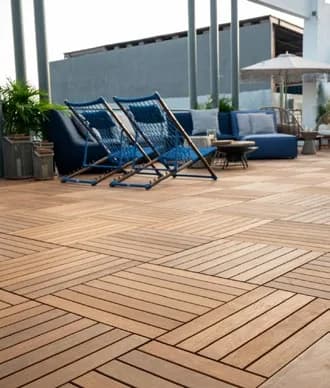
Understanding Your Small Terrace Dimensions
Before selecting deck tiles, accurately measure your terrace. Note not only the overall length and width but also the location of any fixed elements like columns, drains, door thresholds, or railings. These elements will influence your tile cuts and overall layout. Small variations in wall angles or existing paving can also impact how tiles fit, so it's important to measure in multiple spots.
Consider the usable area versus the total area. For instance, a terrace with an irregular shape or a large, immovable planter will have less effective space for furniture and circulation than a simple rectangle. Focus your design on the space you can truly inhabit.
Choosing the Right Deck Tile Size for Small Spaces
Deck tiles are available in various sizes, typically 12 x 12 inches and 24 x 24 inches. For small terraces, the choice between these sizes depends on your desired aesthetic and the dimensions of your space.
The 12 x 12 inch tile is a compact square format, often suitable for smaller areas or layouts that require more edges or transitions. This size can create a more detailed grid pattern. (S1)
The 24 x 24 inch tile offers a larger square format, which can make a small terrace feel more expansive due to fewer visible seams. This size works well for open surfaces and can simplify installation in certain layouts. (S1)
Consider how each tile size will interact with your terrace's specific dimensions. A larger tile might result in fewer cuts, while a smaller tile might offer more flexibility around irregular shapes.
Strategic Furniture Placement and Circulation
In a small space, furniture placement dictates how you will use the terrace. Before laying out tiles, sketch your desired furniture arrangement. This helps identify primary circulation paths and activity zones.
For example, if you plan for a bistro table and two chairs, ensure there's enough room to pull out chairs and walk around them comfortably. By defining these zones first, you can then plan the deck tile layout to minimize awkward cuts in high-traffic areas. Aim for full tiles in the most visible and used sections of your terrace.
Worked Example: A 6-foot by 10-foot Terrace Layout
Let's consider a hypothetical rectangular terrace measuring 6 feet (72 inches) by 10 feet (120 inches). We want to accommodate a small two-person dining area and a compact lounge chair.
Using 24 x 24 inch (2-foot x 2-foot) deck tiles:
Length (120 inches): 120 / 24 = 5 full tiles. This means no cuts are needed along the 10-foot dimension, which is ideal.
Width (72 inches): 72 / 24 = 3 full tiles. Again, no cuts are needed along the 6-foot dimension.
This layout would require 3 rows of 5 tiles, totaling 15 tiles. The advantage here is that the entire terrace can be covered with full tiles, resulting in a clean, seamless appearance and minimal waste. The furniture can then be placed directly on this full-tile grid.
Now, consider using 12 x 12 inch (1-foot x 1-foot) deck tiles for the same 6-foot by 10-foot terrace:
Length (120 inches): 120 / 12 = 10 full tiles.
Width (72 inches): 72 / 12 = 6 full tiles.
This layout would require 6 rows of 10 tiles, totaling 60 tiles. While also resulting in full tiles across the entire surface, the smaller module creates a busier visual pattern. The decision between 12x12 and 24x24 in this scenario becomes purely aesthetic, as both fit perfectly without cuts.
The critical takeaway is to select a tile size that minimizes cuts, especially narrow strips, in prominent areas. If your dimensions don't align perfectly, prioritize full tiles for the main functional zones and place necessary cuts along the perimeter or in less visible areas.
Material Selection: Appearance and Practicality
Beyond size, the material of your deck tiles contributes significantly to the look and feel of a small terrace. Hardwood deck tiles, such as Ipe, Garapa, or Cumaru, offer distinct appearances.
Ipe provides deep chocolate tones and is known for its hardness. Garapa offers warm golden tones, brightening a space. Cumaru presents rich reddish-brown grains. (S1)
When choosing, consider how the material's color and texture will interact with your building's facade, existing planters, or other outdoor elements. Lighter woods like Garapa can make a small space feel more open, while darker woods like Ipe can add a sense of sophistication and grounding. Always obtain samples to see how they look in your specific light conditions.
Finishing Edges and Access Considerations
For small terraces, how you finish the edges of your deck tile installation is important. While some systems allow for clean, exposed edges, others may benefit from trim pieces or a border to create a finished look, especially if cuts are visible.
Also, consider access to the surface beneath the tiles. If your terrace has a roof membrane or drains that require periodic inspection or maintenance, plan your tile layout to allow for easy removal of specific modules without disturbing the entire installation.
Before you order
- Accurately measure overall terrace dimensions and note fixed obstacles.
- Sketch a furniture plan to define circulation and activity zones.
- Choose between 12x12 or 24x24 inch deck tiles based on aesthetic and fit.
- Prioritize full tiles in primary functional areas to minimize cuts.
- Select a hardwood species (Ipe, Garapa, Cumaru) that complements your design.
- Plan for edge finishes and ensure access to the surface beneath if needed.
Confirm installation details, approved uses and warranty terms in the current instructions for the exact product and profile. Your installer should verify the substrate, structure and applicable project requirements.
Questions to help you decide
Can I mix different sizes of deck tiles on a small terrace?
Mixing different sizes, such as 12x12 and 24x24 inch tiles, is possible but requires careful planning to maintain a cohesive look. It's often easier to achieve a unified aesthetic in small spaces by sticking to one tile size, especially if you want to create the illusion of a larger area. If you do mix, ensure the layout is intentional and clearly defined into zones.
What kind of base do deck tiles need on a small terrace?
Deck tiles typically require a stable, level, and well-drained substrate. For a small terrace, this often means a concrete slab, an existing patio, or a properly prepared rooftop surface. Always confirm the specific installation requirements for your chosen deck tile system, as some may be interlocking while others might require a pedestal system. Ensure adequate drainage to prevent water accumulation beneath the tiles.
How do I account for the door threshold on a small balcony?
Measure the height difference between your interior floor and the top of the door threshold. Your deck tile system, including any support structure beneath it, must fit below this threshold to allow the door to open freely. If the clearance is very low, you may need specific low-profile deck tiles or an installation method that minimizes height. Sometimes, a small ramp or transition piece is used at the threshold if the height difference is unavoidable.
Ready to Transform Your Small Terrace?
Request a material quote today. Provide your project dimensions, desired deck tile profile, and ZIP code to confirm current availability and service options. Our team can assist you in selecting the best deck tiles for your small space.
Request a material quote →