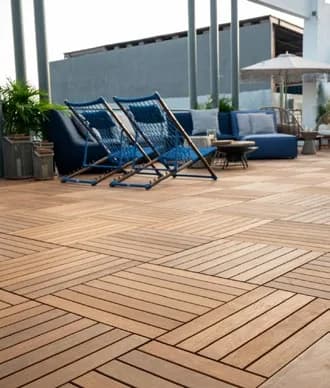
Why Exact Matching is Crucial (and Challenging)
Deck tiles are manufactured in batches, and even within the same species, there can be subtle variations in color, grain pattern, and even dimensions between production runs. Natural wood products, like Ipe, Garapa, and Cumaru deck tiles, will also naturally weather and change color over time. A new tile, even if it's the same species and size, might initially stand out against weathered, installed tiles.
Furthermore, manufacturers may update product specifications, introduce new finishes, or discontinue certain profiles. Without precise information from your original order, you might find yourself choosing between a visually mismatched replacement or replacing a larger section of your deck tiles to achieve uniformity.
Essential Records to Keep for Each Deck Tile Purchase
Consider creating a dedicated project folder, either physical or digital, for your deck tile installation. This folder should contain all relevant documentation from your purchase. The more detail you retain, the better prepared you will be for future replacements.
Key documents include: original purchase invoices or receipts, product specification sheets, installation guides, and any warranty information. If you worked with a contractor, ask for copies of their material orders.
Detailed Product Information to Document
Beyond the basic species, record the following specific attributes:
**Species:** Clearly note the wood species, such as Ipe, Garapa, or Cumaru. Each offers distinct characteristics and appearances. For example, Ipe is known for its deep chocolate tones, Garapa for warm golden hues, and Cumaru for rich reddish-brown grain. (S1)
**Dimensions:** Record the exact dimensions of your deck tiles. Common sizes include 12 x 12 inches (1 square foot per tile) and 24 x 24 inches (4 square feet per tile). (S1) Even a slight difference in length or width can impact the fit and appearance.
**Finish:** Did your deck tiles come pre-finished, or did you apply a finish after installation? If pre-finished, note the brand, product name, and color of the finish. If you applied it yourself, record the specific oil, sealer, or stain used, including the manufacturer and product code. This is critical for matching the appearance of a new tile to the existing, weathered ones.
**Batch or Lot Number:** This is one of the most important pieces of information. Manufacturers often stamp or label packaging with batch or lot numbers. These numbers allow them to trace specific production runs, which can be crucial for color and quality consistency. Take photos of the product packaging before disposal, specifically focusing on any identifying labels.
**Support System:** Note the type of support system used beneath your deck tiles. Is it a plastic grid backing, a pedestal system, or another method? While the tile itself is the focus, the support system can sometimes influence the availability or compatibility of certain replacement modules. For example, some tiles are designed for specific interlocking systems, while others are compatible with adjustable pedestals.
**Supplier Information:** Record the name of the supplier or retailer where you purchased the deck tiles. Keep their contact information readily available.
A Hypothetical Worked Example: Documenting an Ipe Deck Tile Project
Let's imagine you installed Ipe deck tiles on a 10-foot by 12-foot rooftop terrace two years ago. To prepare for potential future replacements, you would record the following:
**Project Name:** Rooftop Terrace, Apartment 4B
**Date of Purchase/Installation:** May 15, 2022
**Product:** Deck Tiles
**Wood Species:** Ipe (S1)
**Dimensions:** 24 x 24 inches (S1)
**Finish:** Pre-finished with 'Tropical Hardwood Oil - Natural Tone' (Brand: XYZ Sealants, Product Code: THO-NT-2022). (Hypothetical detail)
**Batch/Lot Number:** LPI-24x24-IPE-052022-A (Found on box label). (Hypothetical detail)
**Support System:** Interlocking plastic grid base.
**Supplier:** Lumber Plus (Invoice #LP-2022-0515-001).
You might also take a photo of an installed tile and a close-up of the underside, if accessible, to show the grid system. This detailed record significantly improves your chances of finding a suitable match or understanding why an exact match may not be possible.
What to Do When a Tile is Damaged
If a deck tile becomes damaged, consult your records first. Gather all the information you documented. When contacting a supplier, provide as much detail as possible, including the species, dimensions, finish, and especially the batch number. Also, be prepared to describe the nature of the damage and provide photos of the damaged tile and the surrounding installation. This helps the supplier understand the context and suggest the best course of action.
Understand that even with perfect records, a new tile may not perfectly match the weathered appearance of your existing deck. Natural wood ages, and a newly installed tile will need time to weather and blend in. Applying the same finish used previously can help accelerate this blending process.
Before you order
- Did I record the exact wood species (e.g., Ipe, Garapa, Cumaru)?
- Have I noted the precise dimensions of my deck tiles (e.g., 12x12 or 24x24 inches)?
- Is the specific finish (brand, product name, color, code) documented?
- Do I have the batch or lot number from the original packaging?
- Is the type of support system (e.g., interlocking grid, pedestal) recorded?
- Do I have the original purchase invoice and supplier contact information?
- Have I taken photos of the product packaging and the installed tiles?
Confirm installation details, approved uses and warranty terms in the current instructions for the exact product and profile. Your installer should verify the substrate, structure and applicable project requirements.
Questions to help you decide
Can I replace just one deck tile, or do I need to replace a larger section?
You can often replace a single deck tile, especially if it's an interlocking system or if the damage is isolated. However, if the new tile's appearance (color, weathering) is significantly different from the surrounding tiles, you might consider replacing a small contiguous section to minimize the visual contrast. This is a design decision based on your preference for uniformity.
My deck tiles have weathered and changed color. How will a new replacement tile look?
New deck tiles, especially natural wood like Ipe or Cumaru, will likely have a different color than your existing weathered tiles. Over time, all outdoor wood weathers to a silver-gray patina if left untreated. If your existing tiles have been maintained with a specific oil, a new tile will need to be similarly treated and then allowed time to weather and blend with the surrounding area. An exact immediate match is generally not possible with natural materials.
What if my original deck tiles are no longer available?
If your exact deck tile product has been discontinued, you may need to consider alternative options. This could involve finding a similar species and size that can be modified to fit your existing support system, or in some cases, deciding to replace a larger area or even the entire deck tile installation with a new, currently available product. This is where your detailed records become even more valuable, as they help you communicate your original product's specifications to potential new suppliers.
Ready to Plan Your Deck Tile Project or Find a Replacement?
For new projects or to discuss replacement options, request a material quote with your project dimensions, desired profile, and ZIP code. Confirm current availability and service options with our team.
Request a material quote →