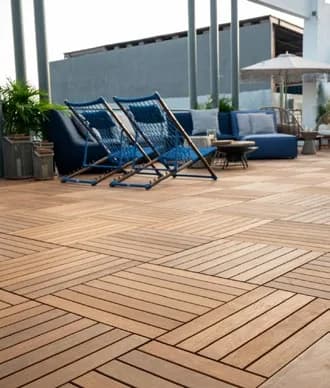
Material Selection for Poolside Deck Tiles
The constant presence of water, chlorine, and sunlight around a pool means material durability is paramount. Hardwood deck tiles are a popular choice due to their natural resistance to moisture and their ability to withstand outdoor conditions. Different species offer varying aesthetics and characteristics.
Ipe deck tiles, for instance, feature deep chocolate tones and are known for their exceptional hardness. Garapa deck tiles offer warm golden tones, which can brighten a poolside area. Cumaru deck tiles present a rich reddish-brown grain, providing a distinct character. Each of these species offers a natural, slip-resistant texture when left unfinished, but specific slip resistance should always be verified for your project's conditions.
Consider how the chosen material will interact with pool chemicals and direct sunlight. While hardwoods are resilient, consistent exposure to standing water or strong chemicals without proper maintenance can affect their appearance over time. Plan for regular cleaning and potential reapplication of finishes as part of your long-term maintenance strategy.
Ensuring Proper Drainage Around the Pool
Effective drainage is critical for any poolside surface. Deck tiles, by their nature, create a raised surface that allows water to pass through and drain underneath. This is a significant advantage in a poolside setting, as it prevents standing water on the walking surface.
When planning your poolside terrace, ensure the underlying substrate has an adequate slope to direct water away from the pool structure and any adjacent buildings. The gaps between individual deck tiles facilitate water runoff, but the sub-surface must be prepared to handle this flow. Consider installing a drainage system beneath the tiles, such as gravel beds or a sloped concrete slab, to ensure efficient water evacuation.
Regularly inspect and clear any debris from the gaps between tiles and the drainage paths underneath to prevent blockages. Stagnant water can lead to algae growth or damage to the underlying structure, which is particularly important around a pool.
Finishing Exposed Edges for Safety and Aesthetics
A poolside terrace often has exposed edges, especially where it meets the pool coping or other landscaping features. How these edges are finished impacts both the appearance and the safety of the installation.
For a seamless look, consider using trim pieces or transition strips that match your deck tiles. These can cap the exposed sides of the tiles, creating a finished edge that is less prone to tripping hazards. Alternatively, some designs may integrate the deck tiles directly with the pool coping, requiring precise measurements and cuts.
If the deck tiles are installed on a raised pedestal system, the exposed edges will reveal the pedestals and the underside of the tiles. In such cases, specialized fascia boards or perimeter trim can be used to conceal the support structure, creating a clean, finished look from all angles. Ensure any edge treatment is securely fastened and can withstand the wet environment.
Choosing Deck Tile Sizes for Your Poolside Project
Deck tiles are available in various sizes, which can influence the visual scale and installation complexity of your poolside terrace. Common sizes include 12 x 12 inch and 24 x 24 inch modules.
The 12 x 12 inch format offers a compact square, often suitable for smaller areas or layouts that incorporate more curves, transitions, or intricate patterns around pool features. This size can create a more detailed grid appearance. The 24 x 24 inch format provides a larger square, ideal for more expansive terraces and open surfaces, resulting in fewer seams and a more streamlined look. Each 24 x 24 inch tile covers 4 square feet.
Consider the overall dimensions of your poolside area and how the tile size will impact the number of cuts needed. Larger tiles may require fewer cuts for large, open areas, while smaller tiles might be more forgiving for irregular shapes or detailed work around pool equipment or landscaping. Always verify the exact dimensions and area coverage of the specific tiles you plan to use.
Hypothetical Project Example: Poolside Terrace in Garapa
Let's consider a hypothetical poolside terrace measuring 16 feet long by 10 feet wide, to be surfaced with 24 x 24 inch Garapa deck tiles. The terrace is adjacent to the pool on one long side and a lawn on the other, with a house on one short side and an open path on the other.
First, calculate the total area: 16 feet * 10 feet = 160 square feet. Each 24 x 24 inch (2 ft x 2 ft) Garapa deck tile covers 4 square feet. To cover the area, you would theoretically need 160 sq ft / 4 sq ft per tile = 40 tiles.
However, practical installation requires considering cuts. Along the 16-foot length, you would need 16 ft / 2 ft per tile = 8 tiles. Along the 10-foot width, you would need 10 ft / 2 ft per tile = 5 tiles. This results in a perfect grid of 8 x 5 = 40 tiles, assuming no waste from cuts for this perfectly rectangular area. However, it is always prudent to order an additional 5-10% for cuts, potential damage, and future replacements. So, for this project, 42-44 tiles would be a more practical purchase quantity.
For the exposed edges along the lawn and open path, consider using matching Garapa trim pieces to create a finished look. The side adjacent to the pool would ideally meet the coping with minimal gap, allowing water to drain through the tile gaps onto the sloped sub-surface beneath.
The warm golden tones of Garapa would complement the water, and its natural properties make it suitable for a wet environment, provided the underlying drainage is well-designed.
Before you order
- Verify the existing sub-surface slope and drainage for water runoff away from the pool.
- Select a deck tile material suitable for constant moisture and sun exposure (e.g., Ipe, Garapa, Cumaru).
- Determine the optimal deck tile size (12x12 or 24x24) based on terrace dimensions and desired aesthetic.
- Plan for edge finishing around the pool coping, lawn, and other exposed areas.
- Calculate the required number of tiles, accounting for cuts and a waste factor.
- Consider the long-term maintenance requirements for your chosen deck tile species in a poolside setting.
- Confirm access for any future maintenance or repair of the underlying drainage system.
Confirm installation details, approved uses and warranty terms in the current instructions for the exact product and profile. Your installer should verify the substrate, structure and applicable project requirements.
Questions to help you decide
Can deck tiles be installed directly on an existing concrete poolside patio?
Yes, deck tiles can often be installed directly on a concrete patio, provided the concrete is structurally sound and has a proper slope for drainage. It's crucial that water can flow away from the pool and not pool underneath the tiles. If the patio is uneven, you may need to level it or use adjustable pedestals, though the latter requires careful consideration of the overall height.
How do I maintain deck tiles around a pool?
Maintenance for poolside deck tiles typically involves regular cleaning to remove dirt, debris, and any pool chemical residue. Sweeping or light washing with water and a mild, pH-neutral cleaner is often sufficient. Hardwood deck tiles may benefit from periodic reapplication of a protective finish to help preserve their color and enhance their natural resistance to moisture and UV. Always follow the specific care instructions for your chosen tile material.
Are specific deck tile species better for poolside use?
Hardwood species like Ipe, Garapa, and Cumaru are generally well-suited for poolside use due to their natural density and resistance to moisture. Ipe is exceptionally hard, while Garapa offers bright golden tones, and Cumaru provides rich reddish-brown hues. While these materials are robust, their performance relies on proper installation, drainage, and regular maintenance to withstand the specific conditions of a poolside environment.
Plan Your Poolside Deck Tile Project
Ready to transform your poolside area? Request a material quote for your project. Provide your project dimensions, desired deck tile profile (e.g., Ipe, Garapa, Cumaru, 12x12 or 24x24), and your ZIP code to confirm current availability and service options.
Request a material quote →