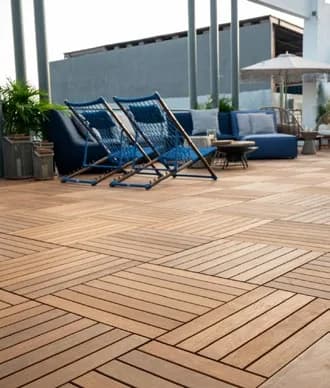
Visual Appeal: Ipe's Deep Chocolate vs. Cumaru's Reddish-Brown
The most immediate difference between Ipe and Cumaru deck tiles is their natural color. Ipe is often described as having deep chocolate tones, which can range from olive-brown to a darker, almost blackish-brown. This rich, consistent coloring tends to create a sophisticated and grounding aesthetic, making it a classic choice for many outdoor designs.
Cumaru, on the other hand, typically features a rich reddish-brown grain. Its coloration can vary from light reddish-brown to a more pronounced, warm red-brown, often with subtle variations that add character. This warmer palette can bring a vibrant and inviting feel to a terrace or balcony. When making your choice, consider how these natural hues will complement your existing outdoor furniture, building facade, or surrounding landscape.
Both woods will naturally weather to a silver-gray patina over time if left untreated. If you prefer to maintain their original color, regular application of a UV-inhibiting oil finish is recommended.
Hardness and Density: Implications for Durability
Both Ipe and Cumaru are exceptionally dense and hard tropical hardwoods, which contributes to their reputation for outdoor durability. This difference, though notable, means both woods offer significant resistance to impacts, scratches, and general wear and tear from foot traffic and outdoor elements.
For most residential and light commercial applications, either Ipe or Cumaru will provide excellent long-term performance. The high density of these woods also contributes to their natural resistance to decay and insect damage. While Ipe is marginally harder, the practical difference in everyday outdoor use is often minimal, with both materials standing up well to typical outdoor conditions.
Available Tile Sizes and Layout Flexibility
Deck tiles are typically available in common sizes, such as 12 x 12 inches and 24 x 24 inches. The choice of tile size can significantly impact the visual rhythm and perceived scale of your outdoor space.
A 12 x 12 inch tile provides 1 square foot of coverage per tile. This smaller format can be advantageous for tighter spaces, intricate layouts, or areas with more edges and transitions, as it allows for greater flexibility in design and potentially less waste from cuts. For example, on a narrow balcony, smaller tiles might create a more proportional look.
A 24 x 24 inch tile offers 4 square feet of coverage per tile. This larger format is often preferred for more expansive terraces and open surfaces, as it results in fewer tile seams and a broader, more continuous appearance. It can make a large area feel more grand and less visually busy. When planning, consider how the tile size will interact with the overall dimensions of your project area.
Both Ipe and Cumaru are available in these standard sizes, allowing you to choose the aesthetic and layout that best suits your design regardless of your chosen wood species.
Installation Considerations for Deck Tiles
Deck tiles, whether Ipe or Cumaru, are designed for straightforward installation over a suitable sub-surface. They can be installed directly over existing concrete patios, rooftops with proper waterproofing, or on specialized pedestal systems. Pedestal systems are particularly useful for creating a level surface over sloped substrates, accommodating drainage, and allowing access to the membrane below.
When installing, ensure the substrate is clean, stable, and has adequate drainage. It is crucial to follow the manufacturer's specific instructions for the chosen tile system, especially regarding spacing between tiles to allow for natural wood movement and water runoff. While Ipe and Cumaru share similar installation methods due to their inherent stability, always confirm the exact assembly requirements for your chosen tiles and support system.
For projects on rooftops or over occupied spaces, verify that the chosen system is compatible with the waterproofing membrane and meets any structural or wind uplift requirements.
Maintenance and Longevity
Both Ipe and Cumaru are low-maintenance hardwoods. To preserve their original color, an application of a UV-inhibiting oil finish is typically recommended every 12-18 months, depending on exposure to sun and weather. If left untreated, both species will gradually fade to a silvery-gray patina, a natural process that does not compromise their structural integrity.
Regular cleaning with a broom or hose to remove debris is generally sufficient. For deeper cleaning, a mild soap and water solution can be used. Avoid harsh chemicals or pressure washers, which can damage the wood fibers.
Due to their natural density and resistance to rot and insects, both Ipe and Cumaru offer excellent longevity in outdoor environments. Your choice between them will likely come down to preferred aesthetics rather than significant differences in maintenance burden or expected lifespan under similar conditions.
Worked Example: A 100 Square Foot Terrace
Consider a hypothetical residential terrace measuring 10 feet by 10 feet, resulting in a total area of 100 square feet. The owner desires a durable, attractive surface that can withstand varying weather.
**Option 1: Ipe 24 x 24 inch Deck Tiles**
If the owner chooses Ipe 24 x 24 inch tiles, each tile covers 4 square feet. To cover 100 square feet, a minimum of 25 tiles would be needed (100 sq ft / 4 sq ft per tile). Given the 10-foot dimensions, this translates to 5 tiles along each 10-foot side (10 feet / 2 feet per tile). This straightforward grid would require no cuts if the dimensions were exact multiples of 2 feet. However, always account for a small percentage of waste, typically 5-10%, for cuts around obstacles or edges, bringing the purchase quantity to approximately 27-28 tiles.
**Option 2: Cumaru 12 x 12 inch Deck Tiles**
If the owner opts for Cumaru 12 x 12 inch tiles, each tile covers 1 square foot. For the same 100 square foot area, a minimum of 100 tiles would be required (100 sq ft / 1 sq ft per tile). This would mean 10 tiles along each 10-foot side (10 feet / 1 foot per tile). The smaller tile size would create a more detailed grid pattern. Again, adding a 5-10% waste factor suggests purchasing around 105-110 tiles.
**Decision Factors:** The choice here would hinge on the desired visual scale and color. Ipe would offer a darker, more expansive feel with fewer seams, while Cumaru would provide a warmer, richer red-brown tone with a finer-grained pattern. Both would deliver high durability.
Before you order
- What is your preferred natural wood color: Ipe's deep chocolate or Cumaru's reddish-brown?
- Do you prefer the expansive look of larger 24x24 inch tiles or the detailed pattern of 12x12 inch tiles?
- Will the deck tiles be installed on a flat concrete slab, a rooftop, or a pedestal system?
- Have you confirmed the compatibility of your chosen deck tiles with your sub-surface and any existing waterproofing?
- Are you prepared for periodic oiling to maintain the original wood color, or do you prefer the silver-gray patina?
- What is the total square footage of your project area, including any irregular shapes or transitions?
- Have you factored in a waste percentage (typically 5-10%) for cuts and potential future replacements?
- Are there any building codes or condominium association rules that might influence your material choice or installation method?
Confirm installation details, approved uses and warranty terms in the current instructions for the exact product and profile. Your installer should verify the substrate, structure and applicable project requirements.
Questions to help you decide
Can I mix Ipe and Cumaru deck tiles in one project?
While technically possible, mixing Ipe and Cumaru deck tiles is generally not recommended if you aim for a consistent appearance. Their distinct natural colors – Ipe's deep chocolate and Cumaru's reddish-brown – will create a noticeable contrast. If you desire a multi-tonal design, it's often more effective to use one species and vary the finish or layout pattern, or to consider other complementary materials.
Do Ipe and Cumaru deck tiles require any special tools for installation?
Standard woodworking tools are typically sufficient for cutting and fitting Ipe and Cumaru deck tiles. However, due to their extreme density, using sharp, high-quality saw blades designed for hardwoods is essential. Diamond-tipped blades can be particularly effective. Always follow safety precautions and wear appropriate personal protective equipment when cutting any hardwood.
How do I calculate the number of deck tiles I need?
First, measure the total square footage of your project area. For 12 x 12 inch tiles (1 sq ft per tile), the number of tiles needed is roughly equal to the square footage. For 24 x 24 inch tiles (4 sq ft per tile), divide your total square footage by four. Always add a waste factor of 5-10% to your calculation to account for cuts, potential errors, or future repairs. For example, a 100 sq ft area would need about 105-110 of the 12x12 inch tiles, or 27-28 of the 24x24 inch tiles.
Ready to Transform Your Outdoor Space?
Request a material quote for Ipe or Cumaru deck tiles. Provide your project dimensions, desired tile profile (e.g., 12x12 or 24x24), and your ZIP code to confirm current availability and service options. Explore our full range of deck tiles, including Ipe, Garapa, and Cumaru, to find the perfect fit for your design.
Request a material quote →