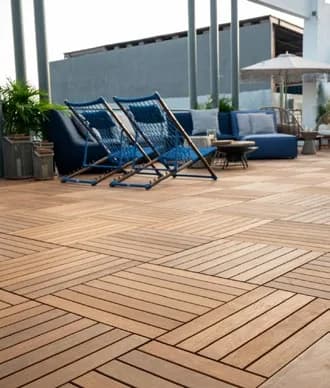
Understanding Garapa Deck Tiles
Garapa deck tiles are known for their warm, golden color, which can brighten an outdoor space. The wood typically exhibits a fine, consistent grain pattern. Over time, if left untreated, Garapa will naturally weather to a silvery-gray patina. Regular application of a UV-inhibiting oil can help maintain its original golden hue.
Garapa is a durable hardwood, suitable for various outdoor applications. Its lighter color can make smaller spaces feel more expansive and open. It pairs well with contemporary designs and lighter outdoor furniture, creating a fresh and airy ambiance. Garapa deck tiles are available in standard sizes such as 12" x 12" and 24" x 24".
Consider Garapa for projects where you want to maximize natural light or complement light-colored building facades. Its appearance can soften the look of concrete or metal elements, adding warmth to an otherwise stark environment.
Exploring Cumaru Deck Tiles
Cumaru deck tiles feature a rich reddish-brown color with an attractive grain, offering a more traditional and earthy aesthetic. This deeper tone can create a sense of grounded elegance and warmth in an outdoor setting. Like Garapa, Cumaru will also weather to a silvery-gray if not regularly treated with a UV-inhibiting oil.
Cumaru is recognized for its substantial hardness and density, making it a robust choice for outdoor flooring. Its inherent color can provide a strong contrast against lighter building materials or blend seamlessly with darker architectural elements. Cumaru deck tiles are commonly offered in sizes like 12" x 12" and 24" x 24".
Choose Cumaru when aiming for a sophisticated, established look. It works well with darker furniture, lush greenery, and designs that benefit from a richer, more profound color palette. This wood can anchor a space, making it feel more substantial and inviting.
Appearance and Color Palette
The primary distinction between Garapa and Cumaru lies in their color. Garapa's golden tones range from light honey to a medium amber, offering a bright and cheerful foundation. This can be particularly effective in shaded areas or on north-facing balconies to enhance light.
Cumaru, in contrast, presents a palette of reddish-browns, often with variations that include hints of orange or purple. This depth of color can create a luxurious and warm atmosphere, suitable for spaces intended for evening entertaining or a more intimate feel.
When making your selection, consider how each wood's natural color will interact with your existing architecture, furniture, and landscaping. Obtaining physical samples of both Garapa and Cumaru deck tiles can be invaluable. Observe them in different lighting conditions throughout the day to see how their colors shift.
Project Example: A 12-foot by 8-foot Balcony
Let's revisit our 12-foot by 8-foot urban balcony. The total area is 96 square feet. We will consider using 24" x 24" (2-foot by 2-foot) deck tiles, each covering 4 square feet. To cover the area, you would theoretically need 96 / 4 = 24 tiles. However, this is an area-equivalent calculation, not a purchase quantity.
For a 12-foot (6 tile modules) by 8-foot (4 tile modules) space, the dimensions align perfectly with the 24" x 24" tiles, meaning no cuts are needed for the main field. You would purchase 6 tiles along the 12-foot length and 4 tiles along the 8-foot width, totaling 6 x 4 = 24 tiles. This assumes no obstructions or complex perimeter cuts.
If you choose Garapa, the balcony would feel expansive and bright, reflecting sunlight and creating a cheerful space. If you opt for Cumaru, the balcony would exude a richer, more intimate ambiance, perfect for cozy evenings. The choice dictates the mood.
For a project like this, consider the furniture and accessories. Light-colored, minimalist furniture might complement Garapa, while darker, more substantial pieces could enhance Cumaru. Both options offer durability, so the decision primarily rests on the desired aesthetic.
Maintenance and Weathering Characteristics
Both Garapa and Cumaru are natural hardwoods that will undergo a weathering process when exposed to the elements. If left untreated, both species will gradually fade to a soft, silvery-gray patina. This natural graying is a common characteristic of tropical hardwoods and does not necessarily indicate a loss of durability.
To preserve the original golden hue of Garapa or the reddish-brown tones of Cumaru, regular application of a UV-inhibiting deck oil is recommended. The frequency of application depends on local climate conditions and sun exposure. This treatment helps to nourish the wood and protect its color.
General maintenance for both includes regular cleaning to remove dirt, leaves, and debris. This helps prevent moisture buildup and keeps the surface looking its best. Always follow the specific care instructions for the chosen finish or treatment product.
Complementary Products and Design Considerations
When planning your deck tile project, consider how Garapa or Cumaru will integrate with other elements of your outdoor space. For Garapa's golden tones, consider pairing with light-colored planters, glass railings, or light-toned privacy screens to enhance the bright and airy feel. <a href="/deck-tiles/ipe">Ipe deck tiles</a> offer a darker alternative if a deeper, more uniform brown is preferred.
For Cumaru's rich reddish-brown, consider darker metal accents, terracotta planters, or privacy screens made from darker woods or composites. <a href="/deck-tiles/garapa">Garapa deck tiles</a> can be used in adjacent zones for contrast if a multi-tone design is desired. You might also explore <a href="/deck-tiles/cumaru">Cumaru deck tiles</a> for a consistent look.
Pedestal systems are often used with deck tiles to create a level surface over sloped or uneven substrates, allowing for drainage and access to the membrane below. Ensure that any chosen pedestal system is compatible with the specific deck tile module and supports the intended loads. Always verify the assembly details with the manufacturer or a qualified professional.
Before you order
- Desired Color Palette: Do you prefer bright golden (Garapa) or rich reddish-brown (Cumaru)?
- Existing Architecture: How will the tile color complement your building's facade and trim?
- Lighting Conditions: Is the space sunny or shaded? How will the color appear throughout the day?
- Maintenance Preference: Are you committed to oiling to maintain original color, or comfortable with natural graying?
- Furniture and Accessories: What colors and styles of outdoor furniture will you use?
- Overall Mood: Do you want an airy, expansive feel (Garapa) or a grounded, intimate atmosphere (Cumaru)?
- Physical Samples: Have you viewed physical samples of both Garapa and Cumaru in your project space?
Confirm installation details, approved uses and warranty terms in the current instructions for the exact product and profile. Your installer should verify the substrate, structure and applicable project requirements.
Questions to help you decide
Do Garapa and Cumaru deck tiles require special installation?
Garapa and Cumaru deck tiles typically install similarly to other hardwood deck tiles. They are often installed over a prepared, level substrate using a grid system, or on adjustable pedestals to accommodate slopes for drainage. The exact installation method depends on the specific product and project conditions. Always refer to manufacturer guidelines for the chosen tile system.
Can I mix Garapa and Cumaru deck tiles in one project?
Yes, you can mix Garapa and Cumaru deck tiles to create a varied pattern or to define different zones within a larger outdoor space. For example, you might use Garapa for a dining area and Cumaru for a lounge area. When mixing, ensure the tile dimensions and connection systems are compatible. Consider how the different wood tones will interact both initially and as they naturally weather.
How do Garapa and Cumaru deck tiles handle different climates?
Both Garapa and Cumaru are dense tropical hardwoods known for their durability in outdoor environments. They are resistant to decay and insects. In coastal areas, proper drainage and ventilation are important to manage moisture. In areas with significant seasonal changes, wood will naturally expand and contract with humidity fluctuations; this is generally managed by the tile system's design. Regular maintenance, including cleaning and optional oiling, helps protect the wood in any climate.
Request a Material Quote for Your Deck Tile Project
Ready to transform your outdoor space? Request a material quote for Garapa or Cumaru deck tiles. Provide your project dimensions, desired tile profile (e.g., 12" x 12" or 24" x 24"), and your ZIP code to confirm current availability and service options.
Request a material quote →