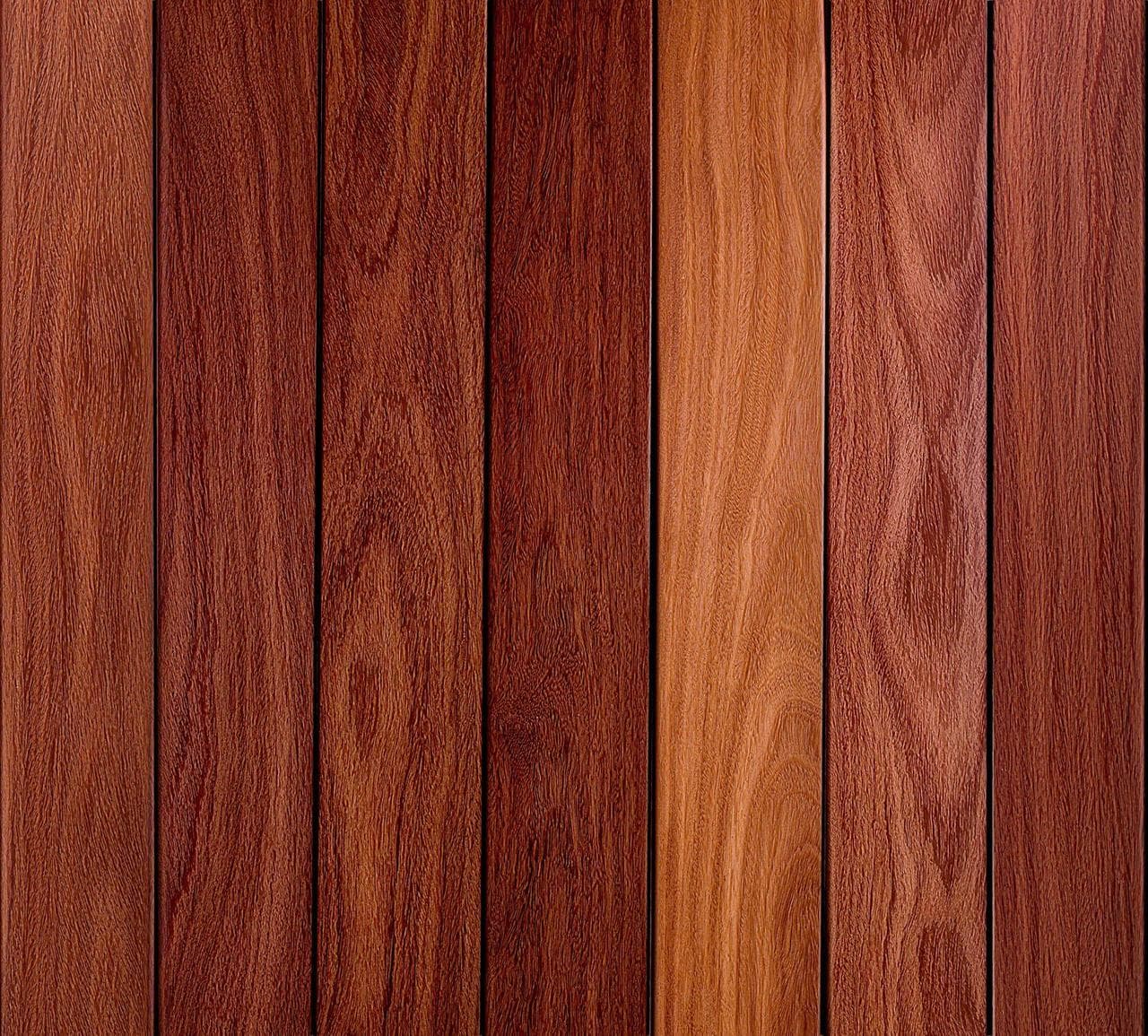
Why Cumaru Suits Urban Backyards
Cumaru is a very durable tropical hardwood, naturally resistant to termites and weather changes, making it a robust choice for any outdoor application. In an urban setting, where outdoor spaces might experience varied conditions and frequent use, Cumaru's inherent strength is a significant advantage. This resilience means it can withstand heavy foot traffic and the demands of outdoor furniture without showing premature wear.
Beyond its durability, Cumaru offers a distinct aesthetic. Its bold grain and warm tones can add character to a small space, creating a focal point rather than fading into the background. When worked, Cumaru gives off a scent of cinnamon and vanilla, a subtle but pleasant characteristic.
Cumaru also carries a Class A fire resistance rating, an important consideration for urban environments where proximity to other structures is common.
Maximizing Space with Deck Layouts and Board Profiles
In a compact urban backyard, every inch counts. The layout of your Cumaru deck can significantly influence how spacious the area feels and how effectively it serves its purpose. For small spaces, consider a single-level deck design to maintain an open flow, avoiding steps that can break up the visual field and reduce usable area. A simple rectangular or square footprint often works best, aligning with common urban property lines.
When selecting Cumaru board profiles, common options include 1"x6" (actual 3/4" x 5.5") and 5/4"x6" (actual 1" x 5.5"). The choice of width can subtly alter the perception of space. Wider boards might make a small deck appear larger by reducing the number of visible seams. However, a very narrow space might benefit from narrower boards to avoid making the deck feel disproportionately wide. Running boards parallel to the longest dimension of your yard can also visually extend the space.
Consider a picture-frame border for a clean, finished look that defines the deck's edge without adding visual clutter. This can also help frame the deck as a distinct 'room' within the backyard.
Integrating Furniture and Circulation
The primary goal for a small urban backyard deck is often to provide a functional area for relaxation or dining. Before finalizing your Cumaru decking plan, map out your intended furniture placement and essential circulation paths. For example, if you envision a small dining set, ensure there's enough space around the table for chairs to be pulled out comfortably and for people to walk past.
In a 10-foot by 12-foot backyard, for instance, a 6-foot by 8-foot Cumaru deck could accommodate a small bistro table and two chairs, leaving adequate room for movement on one side. If a lounge area is preferred, a compact sectional or a pair of Adirondack chairs might fit, but always measure the furniture to ensure it doesn't overwhelm the deck. Built-in benches made from Cumaru can be an efficient way to provide seating without consuming floor space that portable furniture would. These can also serve as storage with clever design.
Maintain clear pathways, ideally at least 3 feet wide, to allow easy access to all parts of the deck and any adjacent garden areas. Avoid designs that create bottlenecks or force awkward movement around furniture.
Hypothetical Project: A 10'x15' Urban Patio
Let's consider a compact urban backyard measuring 10 feet wide by 15 feet deep. The goal is to create a primary seating area with Cumaru decking that feels open and connected to the small garden space. We'll design a rectangular deck measuring 8 feet by 12 feet, positioned against the back wall, leaving a 2-foot border on one side for a narrow planting bed and a 3-foot border on the other for circulation.
Using 5/4"x6" Cumaru decking boards (actual 1" x 5.5"), we'll lay them parallel to the 12-foot dimension to visually lengthen the space. For an 8-foot width, this means approximately 8 feet / (5.5 inches / 12 inches/foot) = 17.45 boards. We'll need 18 boards for the width, with some slight adjustment or trimming. For the 12-foot length, we would use full 12-foot boards. The total area is 96 square feet.
To calculate the number of 12-foot boards needed for an 8-foot wide deck: 8 feet (width) / (5.5 inches / 12 inches per foot) = 17.45 boards. We would purchase 18 boards, each 12 feet long. This gives us 18 boards * 12 feet/board = 216 linear feet. This layout provides a defined area for a small outdoor sofa and a compact coffee table, with enough room to walk around, and the remaining 3-foot strip can be used for a narrow walkway or additional planters. The total purchased linear footage would be 18 boards x 12 feet = 216 linear feet. Since boards are available in 3-24 ft lengths, purchasing 12-foot lengths would minimize cuts for this specific dimension.
Maintenance and Longevity in a Small Space
Cumaru's natural durability means it requires less intensive maintenance than some other decking materials, which is beneficial in a small urban backyard where access for maintenance might be limited. Cumaru is naturally resistant to insects, rot, and fungi. To maintain its rich color, Cumaru can be oiled periodically. Without oiling, it will naturally weather to a silver-grey patina over time, a look many find appealing. This weathering process does not diminish its structural integrity.
Regular cleaning with a broom or hose to remove debris is generally sufficient to keep the deck looking good. In a smaller space, this task is often quicker and easier. Ensure proper drainage underneath the deck to prevent moisture accumulation, which can be more critical in confined areas with less airflow. Good ventilation helps prevent issues and contributes to the deck's long-term performance.
Before you order
- Measure your exact backyard dimensions and draw a scaled plan.
- Sketch out potential deck footprints, considering existing features and desired activity zones.
- Measure your intended outdoor furniture to ensure it fits comfortably on the proposed deck, allowing for circulation.
- Decide on a Cumaru board profile (1"x6" or 5/4"x6") and consider how board direction will impact the visual flow.
- Plan for a single-level deck to maximize openness in a small space.
- Consider incorporating built-in seating or planters to save floor space.
- Account for adequate drainage and ventilation beneath the deck, especially in confined areas.
- Determine your preferred finish: oiled to retain color, or allow it to weather to silver-grey.
- Verify local building codes and permits for deck construction, particularly in urban areas.
Confirm installation details, approved uses and warranty terms in the current instructions for the exact product and profile. Your installer should verify the substrate, structure and applicable project requirements.
Questions to help you decide
How hard is Cumaru, and is it suitable for high-traffic urban decks?
This makes it a dependable choice for high-traffic areas, including urban decks that see frequent use, as it resists dents and wear effectively.
Can Cumaru decking be installed directly on concrete in a small urban yard?
For optimal performance, Cumaru decking, like most hardwoods, requires proper ventilation and drainage underneath. It should not be installed directly on concrete. A subframe or sleeper system is typically used to elevate the decking boards, allowing for airflow and preventing moisture traps. This is crucial for the longevity of the deck, especially in confined urban spaces.
Does Cumaru require special tools to work with in a small space?
Cumaru is a dense and hard wood. It can dull tools, so using sharp, carbide-tipped blades and bits is recommended. While not 'special' in the sense of unique machinery, having robust, good-quality power tools will make cutting and fastening easier. Its high oil content can also complicate gluing if that is part of the assembly.
Plan Your Cumaru Urban Backyard Deck
Ready to enhance your compact outdoor space? Request a material quote for Cumaru decking. Provide your project dimensions, desired board profile, and ZIP code to confirm current availability and service options.
Request a material quote →