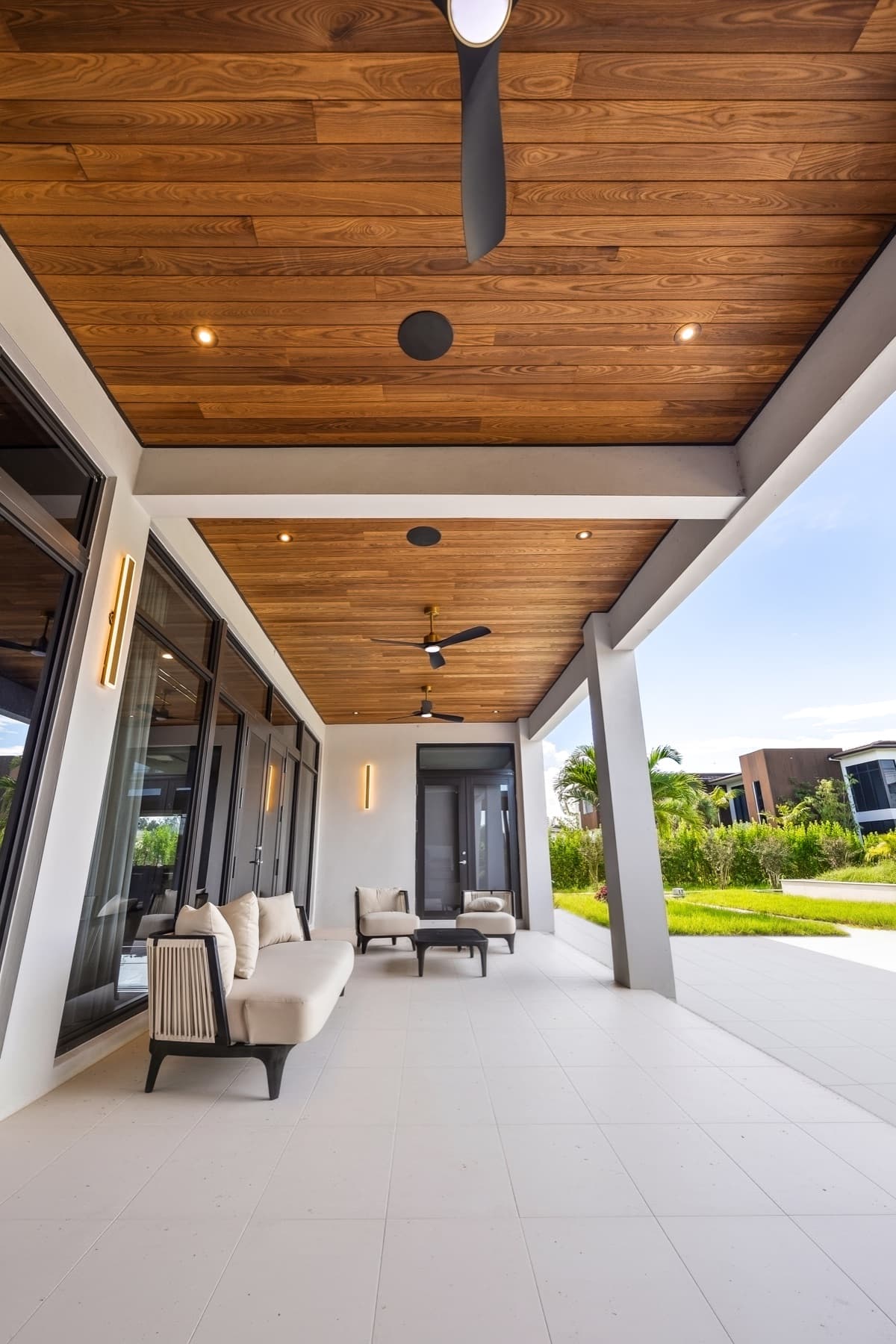
The Appeal of Natural Wood Grain
Natural wood grain offers an authentic, organic aesthetic that manufactured products aim to replicate. Each board of real wood presents a unique pattern of growth rings, knots, and color variations, ensuring no two installations are exactly alike. This variability contributes to a sense of warmth and bespoke craftsmanship that can be highly desirable for both interior and exterior applications.
For areas like porches, lanais, and eaves, real wood soffit and ceiling boards integrate harmoniously with natural surroundings. The visual depth and texture of wood can enhance architectural features and create a welcoming atmosphere. Options include thermally modified wood, Brazilian hardwoods, and Maximo Accoya, each offering distinct grain characteristics and color palettes. (S1)
Understanding Thermally Modified Wood
Thermally modified wood undergoes a high-temperature treatment process that alters its cellular structure. This process enhances stability and can deepen the wood's natural color, often resulting in rich, consistent tones. While the modification process changes the wood's properties, it preserves the inherent grain patterns, allowing the natural character to shine through.
Examples like Scandinavian thermally modified wood (Ayous, Ash) offer clean grain patterns suitable for contemporary designs, while still retaining the natural variations that distinguish real wood. This material is often chosen for its balance of natural beauty and enhanced performance, making it a versatile option for various ceiling and soffit applications. (S1)
Exploring Brazilian Hardwoods for Ceilings and Soffits
Brazilian hardwoods such as Ipe, Cumaru, Garapa, Angelim, Jatoba, and Tigerwood are known for their density, durability, and striking natural beauty. Their grain patterns can range from fine and subtle to bold and exotic, often accompanied by a rich spectrum of natural colors.
These hardwoods can create a luxurious and robust look for ceilings and soffits, particularly in areas where a deeper, more pronounced wood character is desired. The natural color variations and intricate grain patterns contribute to a sophisticated finish that can become a focal point of a design. (S1)
Maximo Accoya: Acetylated Wood with Natural Appeal
Maximo Accoya is an acetylated wood product, distinct from thermally modified wood. Acetylation is a process that modifies the wood at a molecular level, improving its dimensional stability and durability. Like thermally modified wood, Accoya retains its natural wood grain, providing an authentic appearance while offering enhanced performance characteristics. (S1)
Accoya's stable nature makes it suitable for demanding applications, and its natural grain allows it to fit seamlessly into designs that prioritize a genuine wood aesthetic. It can be a good choice where both natural character and advanced material properties are important considerations.
Manufactured Alternatives: Norx Composite and PVC
For projects where natural wood may not be the primary choice, manufactured alternatives like Norx composite and PVC products offer consistent aesthetics and specific performance benefits. These materials are engineered to mimic the look of wood, often featuring embossed or printed grain patterns. (S1)
Norx composite ceiling and soffit boards, for example, provide a uniform appearance with pre-defined wood-look textures. While they aim to replicate natural grain, they offer a predictable pattern and color consistency that can be advantageous for large-scale projects or those requiring a specific, repeatable aesthetic. PVC products, such as those from Versatex, also provide durable, low-maintenance options with wood-like finishes, but the grain is a manufactured impression rather than a natural characteristic. (/brands/versatex)
Worked Example: Selecting Boards for a Covered Patio Ceiling
Consider a covered patio ceiling measuring 10 feet by 16 feet, requiring ceiling boards with a natural wood grain. The design aesthetic calls for a warm, medium-brown tone with visible but not overly pronounced grain. Boards are typically available in various lengths and widths, such as 1x6 (nominal) profiles.
If you choose Thermally Modified Ash, known for its clean grain and consistent medium-brown color, you would calculate the area: 10 ft * 16 ft = 160 square feet. Assuming 1x6 boards (actual coverage approximately 5.5 inches wide), each linear foot covers roughly 0.458 square feet. Therefore, 160 sq ft / 0.458 sq ft/linear ft = approximately 349 linear feet of material.
Factoring in cuts, waste, and alignment, it is prudent to add a waste factor, typically 10-15%. For this example, adding 15% waste: 349 linear feet * 1.15 = 401.35 linear feet. If boards are commonly available in 12-foot lengths, you would need to purchase approximately 34 individual 12-foot boards (401.35 / 12 = 33.45 rounded up). This ensures sufficient material to achieve the desired natural grain pattern across the entire ceiling, allowing for careful selection and placement of boards to highlight their unique characteristics. Offcuts from longer boards can often be utilized for shorter sections, minimizing waste when planned carefully.
Before you order
- Determine if an authentic, unique natural wood grain is essential for your project's aesthetic.
- Consider the desired color palette: deep browns (Ipe, Cumaru), golden tones (Garapa), or lighter, cleaner grains (Thermally Modified Ayous, Ash).
- Evaluate the level of grain visibility and character preferred: subtle and consistent or bold and varied.
- Assess the project's exposure to elements: natural wood options like Thermally Modified Wood or Accoya offer enhanced stability.
- Review available profiles and dimensions to ensure they align with your design and installation requirements.
- Factor in the maintenance commitment associated with natural wood versus manufactured alternatives.
- Request physical samples to observe the natural grain variations and finishes firsthand.
Confirm installation details, approved uses and warranty terms in the current instructions for the exact product and profile. Your installer should verify the substrate, structure and applicable project requirements.
Questions to help you decide
What is the primary difference between natural wood grain and a manufactured wood look?
Natural wood grain refers to the unique, organic patterns found in real wood, formed by growth rings, knots, and natural variations. Each piece is distinct. A manufactured wood look, such as that found in composite or PVC products, is an engineered pattern designed to mimic wood, offering consistency but lacking the unique variability of natural timber.
Do thermally modified wood products retain their natural grain?
Yes, thermally modified wood retains its natural grain patterns. The thermal modification process alters the wood's cellular structure to enhance stability and durability, and can affect its color, but it does not remove or obscure the inherent grain. This allows you to achieve the benefits of modified wood while still enjoying the authentic aesthetic of natural timber.
Can I achieve a consistent color with natural wood ceiling and soffit materials?
While natural wood will always have some inherent color variation, certain species and treatments can offer greater consistency. Thermally modified woods often have a more uniform color post-treatment. For Brazilian hardwoods, you can select boards within a desired color range, but expect slight natural differences. For absolute color consistency, manufactured wood-look products would be a more suitable choice.
Ready to Plan Your Ceiling or Soffit Project?
Request a material quote with your project dimensions, desired profile, and ZIP code to confirm current availability and service options. Explore our full range of ceiling and soffit materials, including Thermally Modified Wood and Brazilian Hardwoods, or consider Versatex and Norx for engineered solutions. Visit our main product page at /ceiling-and-soffit or related brands at /brands/versatex and /thermally-modified-wood.
Request a material quote →