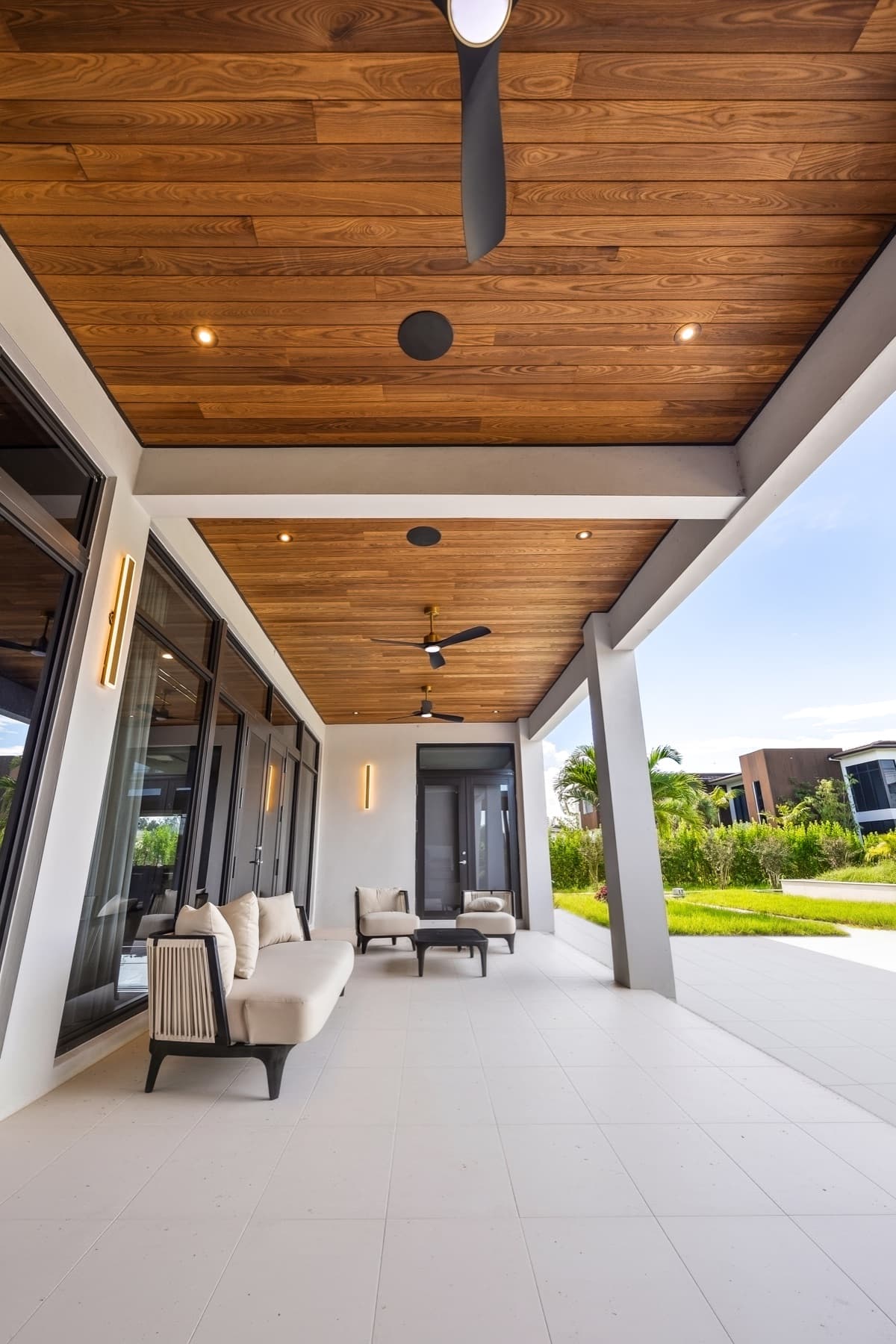
Understanding the Coastal Environment for Soffits
Coastal areas are characterized by several environmental factors that impact building materials. Salt-laden air can be corrosive, leading to rust on incompatible fasteners and finishes. High humidity promotes moisture absorption in some wood products, potentially causing warping or decay if not properly managed. Strong winds can exert significant pressure on soffit panels, requiring robust attachment methods.
These conditions mean that materials suitable for inland applications may not perform adequately in a coastal setting without specific adaptations or enhanced protection. The goal is to choose materials and installation techniques that resist these environmental stressors.
Material Options for Coastal Soffits
When planning a coastal soffit, several material categories offer different advantages:
Thermally Modified Wood: This wood undergoes a heat treatment process that alters its cellular structure, enhancing its stability and resistance to moisture absorption and decay. Species like thermally modified Ayous or Ash can be suitable for coastal soffits, offering a natural wood aesthetic without the same susceptibility to warping or insect damage as untreated wood. They can be installed as ceiling boards for porches, lanais, and eaves. Visit the Thermally Modified Wood collection for more information.
Accoya: This acetylated wood is known for its dimensional stability and durability, making it a strong contender for coastal applications. The acetylation process makes the wood less prone to swelling, shrinking, and rot, even in humid and wet conditions. Accoya offers a natural wood appearance with enhanced performance.
Brazilian Hardwoods: Species such as Ipe, Cumaru, Garapa, Angelim, and Jatoba are naturally dense and resistant to decay and insects. Their inherent properties make them a durable choice for outdoor applications, including soffits in coastal zones. These hardwoods often feature deep, rich colors that can complement a variety of architectural styles. They are available as straight, stable, soffit-ready stock.
Composite Materials (e.g., Norx): Composite ceiling and soffit boards, such as those from the Norx collection, are engineered from a blend of wood fibers and plastics. This composition provides resistance to moisture, insects, and rot, and they often require less maintenance than natural wood. They are available in various colors and finishes, including options like Oxford Gray, and are designed for both ceiling and soffit applications. Explore Norx composite ceiling and soffit options.
Fastener Selection for Coastal Environments
The choice of fasteners is as critical as the material itself in a coastal environment. Standard steel fasteners are susceptible to rust and corrosion when exposed to salt spray and high humidity. This can lead to unsightly stains on the soffit material, compromised structural integrity, and premature failure.
Grade 316 stainless steel offers even greater resistance to saltwater corrosion and is often preferred for direct exposure to marine conditions. Ensure that screws, nails, and any other hardware used are made from compatible, corrosion-resistant materials to prevent galvanic corrosion between dissimilar metals.
Installation Best Practices for Coastal Soffits
Proper installation is crucial for the longevity of coastal soffits. Adequate ventilation behind the soffit material can help mitigate moisture buildup, especially with wood products. Ensure that any gaps or seams are appropriately sealed or designed to allow for drainage, preventing water from pooling.
Follow manufacturer guidelines for spacing and support. In high-wind areas, additional fastening may be necessary to secure panels against uplift forces. Consider using a blind fastening system where possible to minimize exposed fasteners and enhance aesthetic appeal while also reducing points of potential corrosion. Always allow for thermal expansion and contraction, especially with composite materials, by following recommended gap requirements.
Worked Example: Designing a Coastal Soffit for a 12' x 20' Porch
Consider a covered porch measuring 12 feet by 20 feet, requiring a durable soffit material for a coastal home. The homeowner desires a natural wood look with enhanced durability.
Material Choice: Thermally modified Ayous ceiling boards, 1x6 (0.75" x 5.5" actual) profile. This material offers good stability and resistance to decay in humid conditions.
Coverage Calculation: The total area is 12 ft * 20 ft = 240 square feet. Each 1x6 board has a nominal coverage width of 5.5 inches (0.458 feet). To cover a 12-foot width, you would need 12 ft / 0.458 ft/board = 26.2 boards. For the 20-foot length, you would need 20 ft / 12 ft/board = 1.67 boards. Therefore, for each 12-foot run across the 20-foot length, you'd need 26.2 boards. If we run the boards parallel to the 20-foot length, we would need 20 ft / 0.458 ft/board = 43.6 boards. Given a 12-foot width, we would choose board lengths that are 12 feet long. So, we'd need 44 boards of 12-foot length.
Total Linear Footage: 44 boards * 12 linear feet/board = 528 linear feet.
It's always advisable to purchase extra for waste and unexpected needs.
Ventilation: Plan for continuous soffit vents along the perimeter to ensure adequate airflow within the attic space, preventing moisture buildup behind the wood.
This example illustrates how to combine material selection, quantity estimation, and appropriate hardware for a successful coastal soffit project. Always verify local building codes and manufacturer specifications.
Before you order
- Assess direct exposure to salt spray and wind.
- Consider material's inherent resistance to moisture and decay (e.g., thermally modified wood, Accoya, hardwoods, composites).
- Plan for adequate ventilation to prevent moisture buildup.
- Ensure proper support spacing and robust fastening methods for high-wind areas.
- Account for thermal expansion and contraction when designing gaps and joints.
- Review manufacturer's installation guidelines specific to coastal applications.
- Determine required linear footage and fastener count based on project dimensions and material profile.
Confirm installation details, approved uses and warranty terms in the current instructions for the exact product and profile. Your installer should verify the substrate, structure and applicable project requirements.
Questions to help you decide
Do I need to treat wood soffits specifically for coastal use?
While some woods, like thermally modified wood or hardwoods, offer enhanced natural resistance, applying a high-quality, marine-grade finish can provide an additional layer of protection against UV radiation, salt, and moisture. Always check the finish manufacturer's compatibility with your chosen wood species.
Can I use standard galvanized fasteners for coastal soffits?
Standard galvanized fasteners are generally not recommended for direct coastal exposure. The zinc coating can be compromised by salt spray, leading to rust and corrosion.
How often should coastal soffits be inspected and maintained?
Regular inspection is advisable, typically annually, to check for any signs of wear, fastener corrosion, or material degradation. Maintenance schedules will vary by material; natural wood may benefit from periodic cleaning and reapplication of protective finishes, while composite materials might only require occasional cleaning.
Plan Your Coastal Soffit Project
Ready to select the right materials for your coastal soffit? Request a material quote with your project dimensions, exact profile, and ZIP code. Confirm current availability and service options to get started.
Request a material quote →