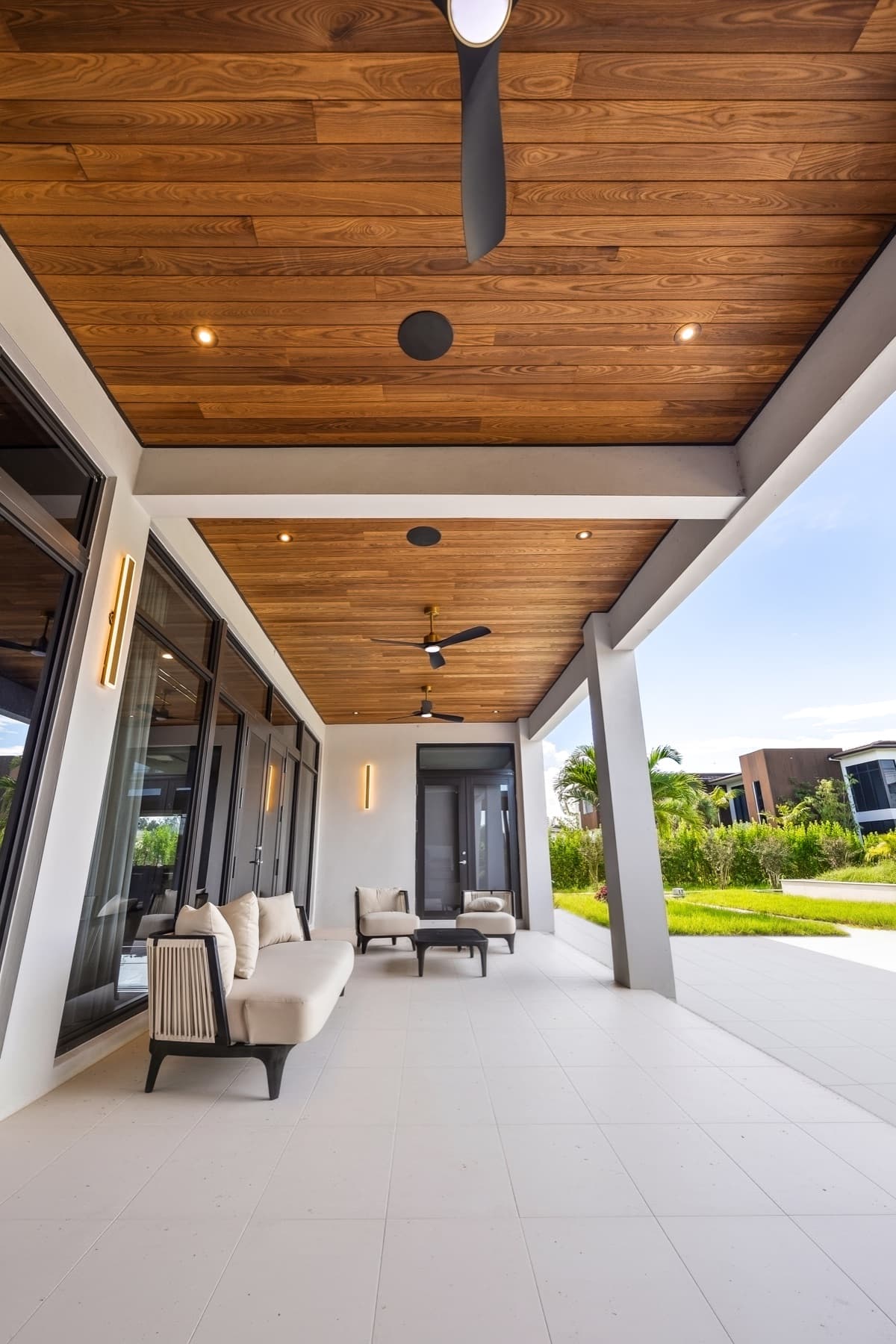
Understanding Board Lengths and Profiles
Ceiling and soffit boards are typically available in a range of standard lengths. These lengths can vary significantly depending on the material type and manufacturer. For example, thermally modified wood products, Maximo Accoya, Brazilian hardwoods, and Norx collections each have their own typical length offerings.
Knowing the available lengths for your chosen material is the first step in planning. Longer boards can reduce the number of seams, potentially creating a more expansive and continuous appearance. However, longer boards can also be more challenging to handle and may generate more waste if not cut efficiently.
Consider the profile of the boards as well. Tongue-and-groove profiles, common in many ceiling and soffit materials, allow for a clean, interlocking fit that can help conceal minor variations at the seam. The specific dimensions of the board's face width will also impact the visual rhythm when boards are laid out.
Strategies for Seam Placement
The placement of seams can significantly impact the visual flow of your ceiling or soffit. There are several common strategies:
**Random Seams:** This approach staggers seams irregularly, creating a more natural, less formal look often seen with solid wood flooring. While it can minimize the appearance of a distinct seam line, careful planning is still needed to avoid small offcuts and ensure no two seams align too closely.
**Stacked Seams:** In some designs, seams are intentionally aligned across the width of the installation. This creates a more structured, panelized look. This method requires precise cutting and careful support planning at each seam.
**Patterned Seams:** For larger areas, you might create a repeating pattern with your seams, such as a 1/3-offset or 1/2-offset (brick pattern). This provides a sense of order and can be visually appealing.
Always consider the direction of the boards relative to the main viewing angle. Seams running perpendicular to the primary line of sight may be more noticeable than those running parallel.
Structural Support and Seams
Every seam in your ceiling or soffit material must be adequately supported. This typically means ensuring that a joist, blocking, or furring strip is present directly beneath each board end where a seam occurs.
Insufficient support at seams can lead to deflection, gaps, or even structural failure over time. When planning your layout, identify the location of all structural framing members. This will help you determine where seams can realistically be placed and if additional blocking is required.
Worked Example: Porch Ceiling Layout
Let's consider a hypothetical covered porch ceiling measuring 10 feet wide by 18 feet long. We plan to use thermally modified Ayous ceiling boards, available in 8-foot, 12-foot, and 16-foot lengths, with a nominal face width of 5.5 inches. We want to run the boards parallel to the 18-foot length to emphasize the depth of the porch.
**Step 1: Determine Board Direction and Seam Orientation.** Running boards parallel to the 18-foot length means seams will occur along the 18-foot dimension. The 10-foot width will be covered by approximately 22 boards (10 feet / 5.5 inches per board = 120 inches / 5.5 inches A 21.8, so 22 boards).
* Using 8-foot boards: Each 18-foot run would require two 8-foot boards (16 feet total) and one 2-foot board. This would result in two seams per run and significant waste from the third board.
* Using 12-foot boards: Each 18-foot run would require one 12-foot board and one 6-foot board. This results in one seam per run. This is more efficient than the 8-foot option.
* Using 16-foot boards: Each 18-foot run would require one 16-foot board and one 2-foot board. This also results in one seam per run, but the 2-foot offcut might be less useful than a 6-foot offcut.
With 12-foot boards and 6-foot cuts, the seam will fall at the 12-foot mark along the 18-foot length. This aligns perfectly with a joist if the starting point is carefully managed.
**Step 4: Optimize Cuts and Staggering.** To avoid a single, noticeable line of seams across the entire ceiling, we can stagger the 12-foot and 6-foot sections. For instance, the first row could start with a 12-foot board followed by a 6-foot board. The next row could start with a 6-foot board, followed by a 12-foot board, then another 6-foot board (using a portion of the second 12-foot board). This creates a visually appealing staggered pattern and minimizes waste by using the 6-foot offcuts.
This example demonstrates how selecting appropriate board lengths and deliberately staggering cuts can create a cohesive look while managing material efficiency.
Material Specifics and Limitations
Different materials possess unique characteristics that influence seam planning:
**Thermally Modified Wood (e.g., Ayous, Ash):** Known for stability, these boards can often be run in longer spans. Their consistent grain and color can make well-executed seams less noticeable. Available lengths vary by species and supplier.
**Brazilian Hardwoods (e.g., Ipe, Cumaru, Garapa):** These dense woods offer natural durability and rich colors. Their inherent strength may allow for longer spans between supports, but their weight requires robust fastening and support at seams. Lengths are often diverse.
**Norx Composite:** Composite materials like Norx can offer consistent lengths and profiles, simplifying planning. Their manufacturing process often allows for fewer natural imperfections, which can contribute to a more uniform appearance when seams are present. Check specific product documentation for available lengths and recommended support spacing.
Always review the manufacturer's specifications for maximum unsupported spans and required fastening at board ends to ensure proper installation and longevity of your ceiling or soffit.
Minimizing Waste and Ordering Considerations
Efficient planning of seams and lengths directly impacts material waste. By sketching out your layout and calculating cuts, you can determine the optimal combination of board lengths to purchase.
Consider ordering a small percentage (e.g., 5-10%) extra material to account for miscuts, unforeseen damage, or slight variations in board quality. This buffer can prevent project delays caused by needing to order additional material.
When requesting a quote, provide your project dimensions and your preferred layout plan. This allows the supplier to help you select the most appropriate board lengths and calculate the quantity needed, potentially identifying opportunities to reduce waste.
Before you order
- Identify the exact dimensions of your ceiling or soffit area.
- Determine the direction you want the boards to run.
- Locate all existing structural supports (joists, rafters, blocking).
- Research the available standard lengths for your chosen ceiling/soffit material (e.g., Thermally Modified Wood, Brazilian Hardwood, Norx).
- Sketch out potential board layouts, considering different length combinations.
- Choose a seam placement strategy (random, stacked, patterned).
- Ensure every board end at a seam will be fully supported.
- Calculate the number of boards of each length needed, accounting for cuts and potential waste.
- Add a waste factor (e.g., 5-10%) to your total material estimate.
- Confirm fastening requirements and compatible accessories for your chosen material.
Confirm installation details, approved uses and warranty terms in the current instructions for the exact product and profile. Your installer should verify the substrate, structure and applicable project requirements.
Questions to help you decide
How do I choose the best board length for my project?
The best board length minimizes the number of seams while also minimizing waste. Measure your project area and consider how different standard lengths (e.g., 8-foot, 12-foot, 16-foot) can be cut to fit. Longer boards can reduce seams but might lead to more waste if cuts are inefficient. Sketching a layout can help visualize the most efficient use of material.
Do seams need to be supported by framing?
This prevents sagging, movement, and potential damage to the boards over time. Ensure your seam placement aligns with your existing or planned support structure.
Can I use different board lengths on the same ceiling?
Yes, using a combination of board lengths is common, especially when implementing a random or patterned seam strategy. This can help distribute seams more evenly and reduce the appearance of a continuous seam line across the entire surface. Just ensure all cuts are precise and seams are properly supported.
Ready to Plan Your Ceiling or Soffit Project?
Request a material quote with your project dimensions, desired profile, and ZIP code. Our team can help confirm current availability and service options for all your ceiling and soffit material needs, including Thermally Modified Wood, Brazilian Hardwoods, and Norx collections.
Request a material quote →