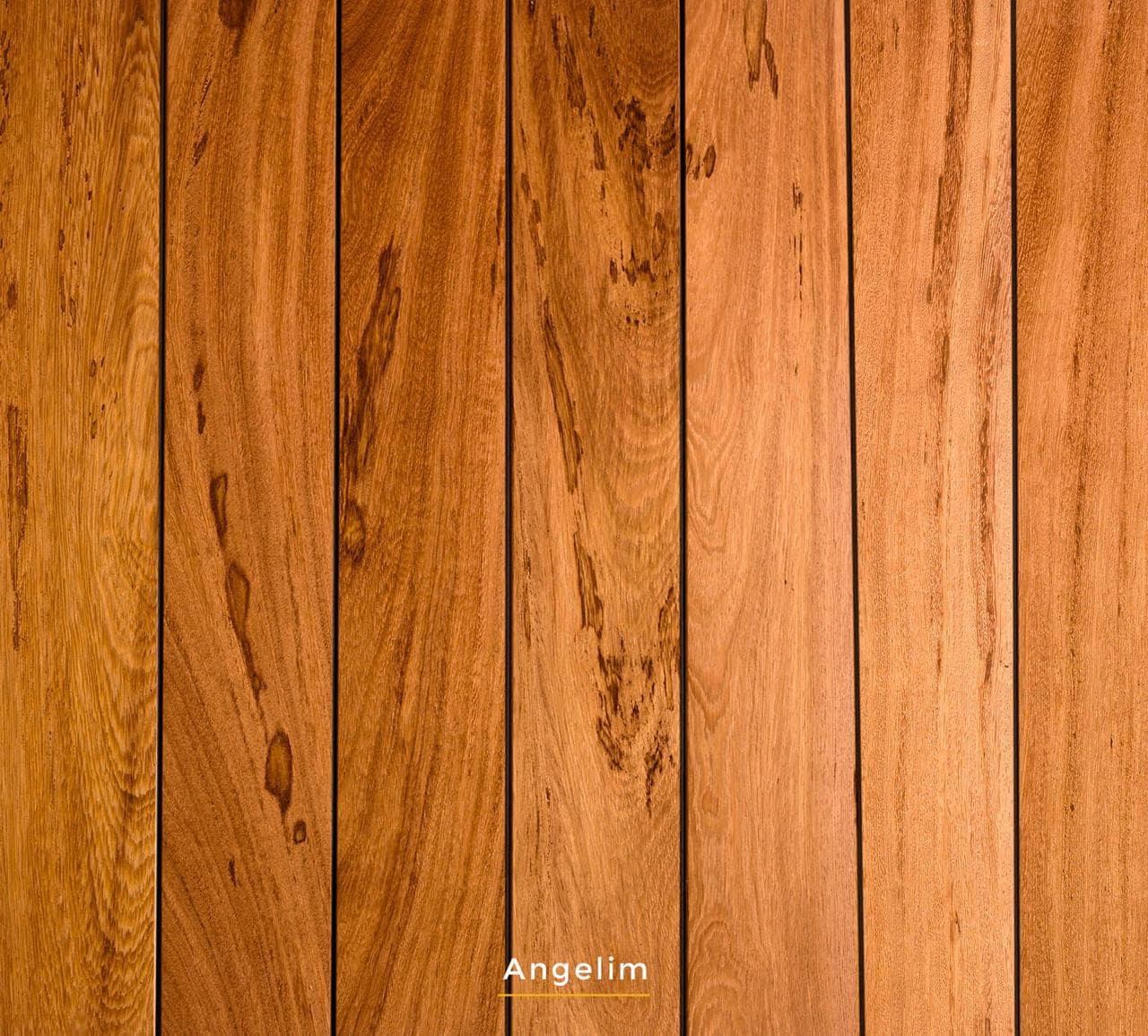
Understanding Angelim Decking for Urban Spaces
Angelim decking, also known as Angelim Pedra, is a hardwood sourced from Brazil. It is valued for its natural durability and resistance to insects, rot, and fungi, which are important considerations for any outdoor decking, especially in urban environments where moisture and pests can be concerns. Its density and stability make it a reliable material for decking applications.
The heartwood of Angelim ranges from yellowish-beige to a pinkish-brown as it ages, providing a warm and natural look. The sapwood is generally white to greyish. It is absorptive, which allows for easy finishing with stains and oils if you choose to maintain a specific color or enhance its natural tones. For a small space, the material's inherent qualities contribute to a low-maintenance, long-lasting surface.
Angelim is considered easy to install, though pre-drilling is recommended due to its density. This characteristic is important for ensuring a smooth installation process, particularly when working with intricate layouts or custom cuts often required in compact urban backyards. The material's strength means it can withstand heavy use, which is beneficial for areas that might experience concentrated foot traffic or the weight of outdoor furniture.
Maximizing Space with Board Widths and Layouts
In a compact urban backyard, the choice of Angelim board width and layout can significantly impact the perceived size and functionality of your deck. While Angelim is available in profiles ranging from 1x4 through 6x6, standard decking boards typically come in narrower widths like 1x4 or 1x6. Using narrower boards can sometimes make a small space feel larger by creating more lines of perspective, drawing the eye across the area.
Consider laying boards parallel to the longest dimension of your backyard or diagonally. A diagonal layout can create an illusion of greater width or depth, making the space feel less confined. However, diagonal layouts typically require more cuts and can result in more material waste, which is a factor to consider for any project. Straight layouts, while more traditional, can still be effective if combined with thoughtful furniture placement and landscaping.
Avoid overly complex patterns or multiple changes in board direction within a very small footprint. Simple, clean lines tend to work best in compact areas, preventing the space from feeling cluttered. The goal is to create a cohesive surface that complements the surrounding elements without overwhelming the eye.
Strategic Layout for Circulation and Furniture
The primary challenge in a small urban backyard is balancing usable deck area with essential circulation paths and sufficient space for furniture. Before finalizing your Angelim decking plan, map out your intended furniture arrangement and high-traffic routes. Will you have a small bistro set, a lounge chair, or perhaps a compact outdoor kitchen component? Ensure there's enough clearance around these items for comfortable movement.
Consider creating distinct zones within your small deck. Even a 10x12 foot deck can have a dining zone and a separate lounging zone if designed thoughtfully. Use the decking pattern or even subtle changes in board direction to delineate these areas, or integrate built-in benches along one edge to save floor space. Built-in elements can free up valuable square footage that would otherwise be taken by freestanding furniture, enhancing both functionality and perceived spaciousness.
For example, if you have a 10-foot by 12-foot backyard space, dedicating a 6-foot by 8-foot section to a dining area allows for a compact table and chairs, leaving a 4-foot by 10-foot strip for a narrow planter or a small bench. The remaining 2-foot strip along the 12-foot length can serve as a circulation path to other areas of the yard or a gate. This kind of careful dimensioning ensures that every square foot is utilized effectively without compromising flow.
Worked Example: Designing a 10x12-foot Urban Deck with Angelim
Let's consider a hypothetical urban backyard measuring 10 feet wide by 12 feet deep. The goal is to create a multi-functional deck using Angelim decking, maximizing both dining and lounge areas while maintaining clear pathways.
We'll use standard nominal 1x6 Angelim decking boards, which are approximately 5.5 inches wide. For a 10-foot width, laying boards parallel to the 10-foot dimension (i.e., running the 12-foot length) would require approximately 22 boards (10 feet * 12 inches/foot / 5.5 inches/board = 21.8 boards). Since boards are typically available in lengths up to 20 feet, 12-foot boards would be suitable for this layout, minimizing waste.
To create zones, we can define a dining area in the first 6 feet of the 12-foot depth, creating a 10x6-foot space. This allows for a small dining table and two to four chairs. The remaining 6 feet of depth (10x6-foot area) can be designated as a lounge space. Within this lounge area, a built-in bench along one 10-foot side, approximately 18 inches deep, would provide seating without obstructing the remaining floor space. This leaves a 10-foot by 4.5-foot open area for a small coffee table or planters. A 3-foot wide pathway along one 12-foot side could lead to a gate or other yard features, ensuring clear access. This strategic layout uses the natural strength and beauty of Angelim while making the most of a compact footprint.
For the dining area (10 ft x 6 ft = 60 sq ft) and lounge area (10 ft x 6 ft = 60 sq ft), the total deck surface is 120 sq ft. Using 1x6 (5.5 inch actual width) boards, each 12 feet long, each board covers (5.5/12) ft * 12 ft = 5.5 sq ft. Therefore, you would need approximately 120 / 5.5 = 21.8 boards. Rounding up, you would purchase 22 boards of 12-foot length. This calculation does not account for cutting waste or specific installation gaps, which should be factored into your final order.
Complementary Materials and Features
Beyond the Angelim decking itself, consider how other materials and features can enhance your compact urban backyard. Planters with vertical gardening can add greenery without consuming valuable floor space. Compact, multi-functional outdoor furniture that can be folded or stacked is ideal. Lighting, such as string lights or subtle ground-level fixtures, can extend the usability of the deck into the evening and create a cozy atmosphere.
Consider integrating other natural materials like stone pavers or gravel for adjacent pathways or planting beds to create visual interest and break up the expanse of decking. This can also help with drainage in a small space. For railings, if required, choose designs that are open and allow light to pass through, such as cable railings or slender pickets, to avoid making the space feel enclosed. Matching fascia boards in Angelim can provide a clean, finished edge to the deck.
Explore complementary products such as other hardwood decking options like Ipe, which offers a similar durability profile with a different color palette, or composite and PVC decking for alternative maintenance characteristics. These options can be useful for contrasting accents or if specific performance attributes are prioritized for certain areas of your outdoor space.
Before you order
- Measure your urban backyard's exact dimensions and create a scaled drawing.
- Map out intended furniture placement and essential circulation paths.
- Determine if a straight or diagonal Angelim board layout best suits your space and aesthetic goals.
- Consider built-in seating or multi-functional furniture to maximize usable area.
- Plan for vertical elements like planters or screens to add greenery without consuming floor space.
- Select appropriate Angelim board widths (e.g., 1x4 or 1x6) to influence the perceived size of the deck.
- Factor in lighting and other complementary materials to enhance the overall design.
- Estimate material quantities, accounting for cuts and potential waste, especially with diagonal layouts.
- Review local building codes for deck height, railings, and attachment methods.
Confirm installation details, approved uses and warranty terms in the current instructions for the exact product and profile. Your installer should verify the substrate, structure and applicable project requirements.
Questions to help you decide
Is Angelim decking suitable for all climates?
Angelim is a very durable hardwood, resistant to termites and moisture, making it suitable for a wide range of outdoor conditions. Its natural resistance to rot and fungi contributes to its longevity in various climates. However, like all natural wood products, regular maintenance, such as cleaning and oiling, will help preserve its appearance and extend its lifespan, especially in areas with significant weather fluctuations.
How do I calculate the amount of Angelim decking needed for a small project?
First, calculate the total square footage of your deck area. Then, determine the square footage covered by a single Angelim board based on its nominal width and length (e.g., a 1x6 board, which is approximately 5.5 inches wide and 12 feet long, covers 5.5 square feet). Divide your total deck area by the area per board to get an approximate number of boards. Always add an extra 10-15% for cuts, waste, and future repairs, especially for complex layouts or if you are doing the installation yourself. For precise calculations, provide your project dimensions to a material supplier.
What maintenance does Angelim decking require?
Angelim decking is naturally durable and resistant to many outdoor elements. To maintain its original yellowish-beige to pinkish-brown color, it is recommended to apply a UV-inhibiting oil or stain periodically. If left untreated, Angelim will naturally weather to a silver-gray patina. Regular cleaning to remove dirt, leaves, and debris is also important to prevent mildew growth and keep the surface safe and attractive. Its absorptive nature makes it easy to finish with stains and oils.
Ready to Plan Your Angelim Urban Deck?
Request a material quote with your project dimensions, desired Angelim profile, and ZIP code to confirm current availability and service options for your urban backyard project.
Request a material quote →