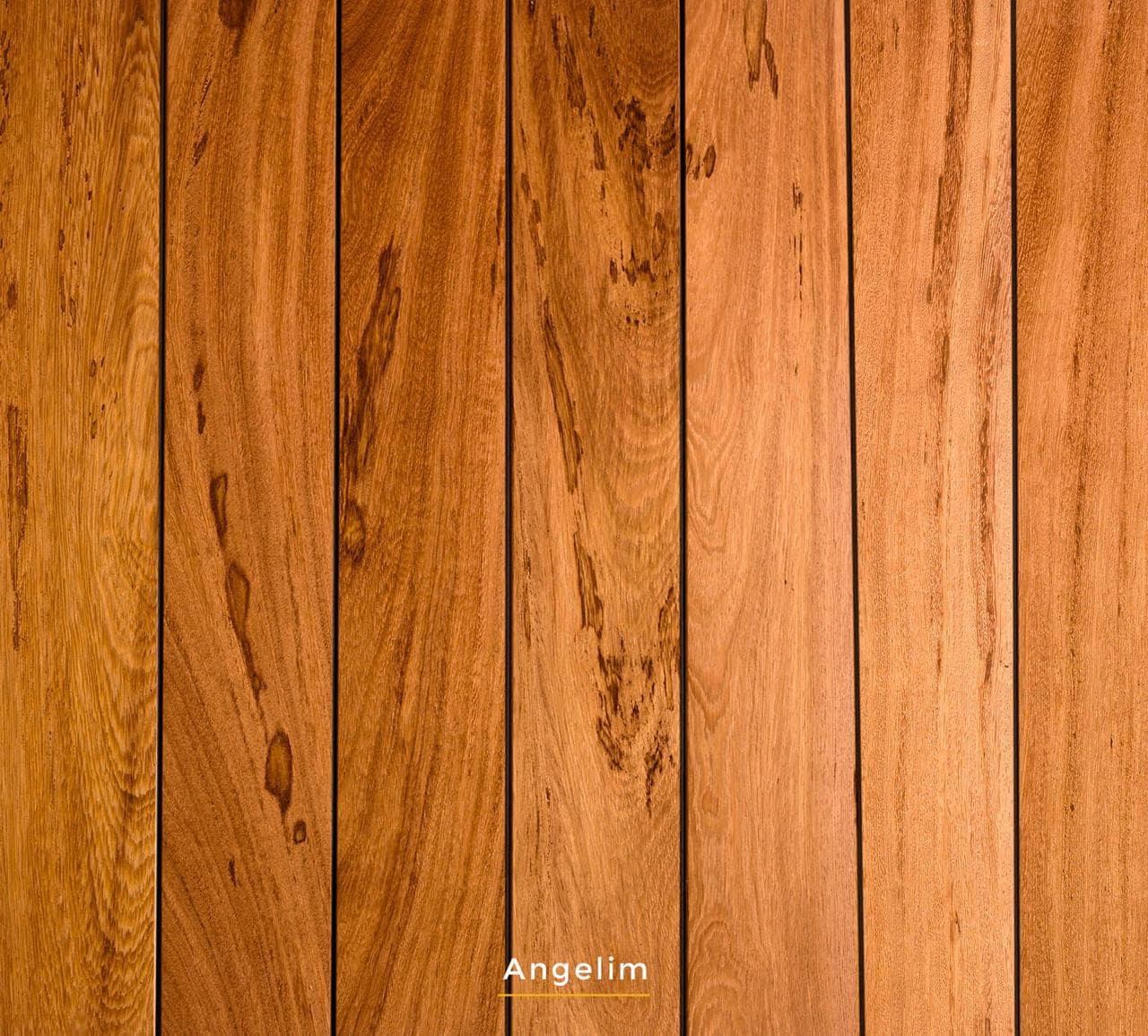
Understanding Angelim Decking Profiles
Angelim decking is available in a range of profiles, which refer to the shape and dimensions of the individual boards. Common profiles include standard decking boards suitable for surface installation. The profile you choose impacts the visual style, installation method, and structural integrity of your deck.
Angelim is typically offered in dimensions from 1x4 through 6x6. These numbers represent nominal sizes, with actual dimensions being slightly smaller after milling. For example, a nominal 1x4 board will have actual dimensions closer to 3/4 inch thick by 3 1/2 inches wide. Confirming the actual, not just nominal, dimensions is important for accurate project planning and material takeoffs.
The choice of profile also influences the span capabilities and the type of fastening system that can be used. Thicker boards generally allow for wider joist spacing, while thinner boards may require closer support. Always consult the specific product documentation for recommended installation guidelines based on the profile selected.
Considering Board Lengths and Drying Methods
Angelim decking boards are available in various lengths, typically ranging from 4 to 20 feet, depending on the specific profile. Project planning should account for these available lengths to minimize waste from cuts. Longer boards can reduce the number of seams in your deck surface, potentially creating a more continuous appearance, but they may also be more challenging to transport and handle.
The drying method of Angelim decking, whether Air Dried (AD) or Kiln Dried (KD), is another specification to consider. Kiln-dried wood has been processed in a controlled environment to reduce its moisture content to a specific level, which can result in more stable boards upon delivery. Air-dried wood is dried naturally, allowing it to acclimate to ambient conditions over time. The choice between AD and KD can affect how the wood behaves during installation and its initial stability.
For decking applications, stability is key to preventing excessive movement, warping, or checking after installation. Understanding the drying method will help you anticipate how the material might respond to the climate in your project location and inform any necessary acclimation period before installation.
Angelim's Natural Properties and Applications
Angelim is classified as a very durable hardwood, attributed to its density and natural resistance characteristics. It has an air dry density of 5.58 lbs/bf and a specific gravity of 0.79. These properties contribute to its suitability for demanding applications.
The material exhibits resistance to termites and moisture, as well as insects, rot, and fungi. These natural protections make Angelim a viable option for outdoor uses such as decking and cladding. It is also suitable for interior carpentry, including joinery, paneling, furniture, molding, and stairs, as well as heavy carpentry and industrial flooring.
While Angelim is known for its durability, it's also noted for being absorptive, which makes it receptive to finishes like stains and oils. This characteristic allows for customization of its appearance and can help maintain its aesthetic over time. Pre-drilling is recommended during installation, a common practice for dense hardwoods to prevent splitting.
Worked Example: Planning Angelim Decking for a 10x12 Foot Deck
Let's consider a hypothetical 10-foot by 12-foot deck project using nominal 1x6 Angelim decking boards. For this example, we'll assume the actual dimensions are 3/4 inch thick by 5.5 inches wide. The deck will be laid with boards running parallel to the 10-foot dimension, meaning each board will be 10 feet long.
To cover the 12-foot width of the deck, we need to determine how many 5.5-inch wide boards are required. 12 feet is 144 inches. Dividing 144 inches by 5.5 inches per board gives approximately 26.18 boards. Since you cannot purchase a fraction of a board, you would need to round up to 27 boards to cover the width. Each board is 10 feet long.
Therefore, for a 10x12 foot deck, you would need to purchase 27 boards, each 10 feet in length, of the nominal 1x6 Angelim decking. This calculation does not account for waste due to cuts, miscuts, or potential board defects, so it is generally advisable to add a percentage (e.g., 5-10%) for waste factor, especially for complex layouts. For this simple example, we'd initially calculate 270 linear feet of 1x6 material.
Comparing Angelim with Other Hardwood Decking Options
When considering Angelim decking, it can be helpful to compare its characteristics with other hardwood options, such as Ipe. Both are dense, durable hardwoods suitable for outdoor use. Angelim's heartwood color ranges from yellowish beige to pinkish brown, offering a distinct aesthetic.
Ipe, by comparison, is known for its olive brown to reddish-brown tones. While both woods are resistant to insects and moisture, their specific densities, hardness ratings (Janka hardness), and typical grain patterns can differ.
The choice between Angelim and other hardwoods often comes down to specific project requirements, aesthetic preferences, and budget considerations. Each wood offers a unique combination of appearance, performance, and maintenance characteristics that should be weighed during the selection process.
Explore other options like Ipe decking to compare their properties and see which best fits your project needs. You can find more information on various decking materials, including composite and PVC options, at our main decking page: Decking, Hardwood Decking, Ipe Decking, Composite Decking, PVC Decking.
Before you order
- Confirm the actual dimensions (thickness and width) of the Angelim decking boards.
- Verify the available board lengths and plan your layout to minimize waste.
- Understand the drying method (AD or KD) and consider any acclimation requirements.
- Review the recommended fastening methods for the chosen profile.
- Consider the natural color variation and how it will complement your design.
- Factor in the waste percentage for cuts and potential board defects.
- Confirm compatibility with any planned stains or oils for finishing.
- Check the need for pre-drilling during installation due to wood density.
Confirm installation details, approved uses and warranty terms in the current instructions for the exact product and profile. Your installer should verify the substrate, structure and applicable project requirements.
Questions to help you decide
What are the common dimensions for Angelim decking?
Angelim decking is typically available in nominal dimensions ranging from 1x4 through 6x6. Actual dimensions will be slightly less due to milling. For example, a nominal 1x4 board might measure approximately 3/4 inch by 3 1/2 inches.
Does Angelim decking require special fastening?
Due to its density, pre-drilling is generally recommended when installing Angelim decking to prevent splitting. The specific fastening method (e.g., face-fastening or hidden fasteners) will depend on the chosen profile and project requirements.
How does Angelim's color change over time?
Angelim heartwood starts as a yellowish beige and tends to darken to a pinkish-brown hue with exposure. The sapwood is typically white to grayish. Applying UV-inhibiting finishes can help maintain its initial color longer, or you can allow it to naturally silver over time.
Request a Quote for Angelim Decking
Ready to move forward with your decking project? Request a material quote for Angelim decking. Provide your project dimensions, desired profile, and ZIP code to confirm current availability and service options. Our team can assist you in selecting the right specifications for your needs.
Request a material quote →