Why Board Spacing Matters for Angelim Decking
Proper board spacing for Angelim decking serves multiple functional and aesthetic purposes. Functionally, adequate gaps allow rainwater to drain quickly, preventing water from pooling on the deck surface and potentially accelerating wear. These gaps also facilitate air circulation beneath the deck, which is crucial for preventing moisture buildup that can lead to mold, mildew, and potential long-term structural issues for the deck frame. Good ventilation helps the wood dry evenly after rain or cleaning.
Aesthetically, consistent spacing contributes to a uniform and professional appearance. Uneven gaps can detract from the deck's overall look. Furthermore, proper spacing accounts for the natural movement of Angelim. As a natural hardwood, Angelim will absorb and release moisture, causing it to expand and contract. The gaps provide the necessary room for this movement without causing boards to cup, warp, or buckle, which can occur if they are installed too close together.
Key Factors Influencing Angelim Decking Spacing
The ideal spacing for Angelim decking boards is not static; it depends on several project-specific factors. These include the moisture content of the boards at the time of installation, the width of the boards, and the typical climate conditions of the installation location.
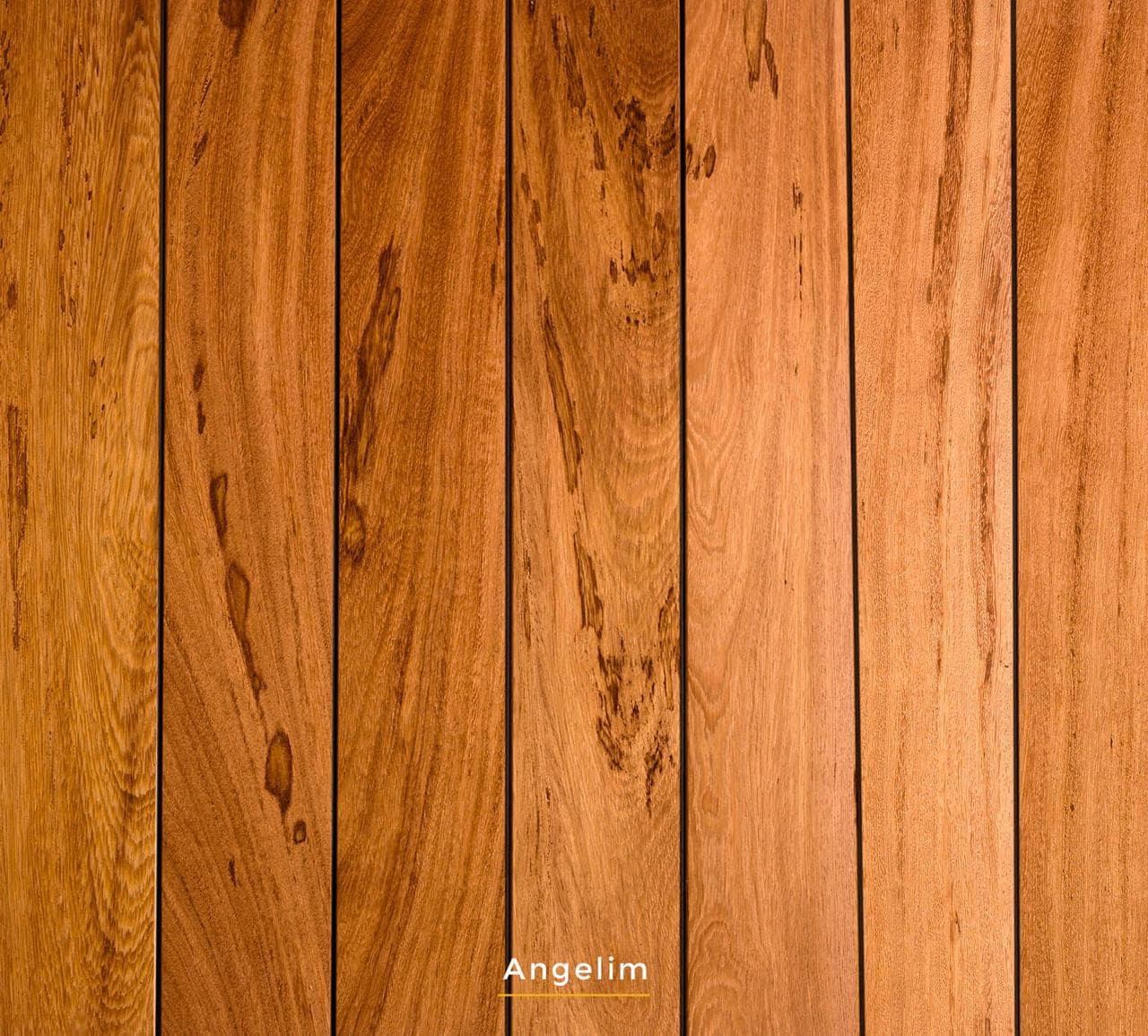
Angelim heartwood is yellowish beige, darkening to pinkish brown, and is available in profiles such as 1x4 through 6x6. Wider boards generally require slightly larger gaps than narrower boards to accommodate their greater potential for expansion and contraction across their width. Always refer to the specific product documentation for recommended ranges.
The climate's humidity levels are particularly important. In consistently humid environments, boards are likely to contain more moisture, so they should be installed with smaller gaps to allow for future drying and contraction. In drier climates, or if boards are installed during a dry season, slightly wider gaps might be necessary to accommodate future expansion when humidity rises.
Understanding Moisture Content and its Impact
Angelim decking boards are typically sold as either Air Dried (AD) or Kiln Dried (KD). The moisture content at the time of purchase and installation significantly impacts the required spacing. Air Dried Angelim may have a higher moisture content, closer to ambient humidity, and will likely shrink as it acclimates to a drier environment. Kiln Dried material has a lower, more stable moisture content, but will still react to the local climate.
It is crucial to measure the moisture content of your Angelim boards upon delivery and compare it to the expected average moisture content for your region. If boards are installed when their moisture content is high, smaller gaps should be used to account for subsequent shrinkage. If installed when moisture content is low, larger gaps are generally recommended to allow for expansion. Using a moisture meter is recommended to get an accurate reading.
Worked Example: Calculating Spacing for 1x6 Angelim Decking
Let's consider a hypothetical scenario: You are installing a 10-foot wide Angelim deck using 1x6 (nominal size, actual dimension closer to 5.5 inches) boards.
First, determine the actual width of the Angelim boards. For a nominal 1x6 board, the actual width is typically around 5.5 inches (5-1/2").
Next, calculate the number of boards needed for the 10-foot (120-inch) width. This is an iterative process. Let's assume you'll use 21 boards.
Total width taken by boards: 21 boards * 5.5 inches/board = 115.5 inches.
Total estimated width: 115.5 inches + 1.875 inches = 117.375 inches.
This leaves a remaining space of 120 inches - 117.375 inches = 2.625 inches. This remaining space can be distributed among the gaps or used for a slightly wider border board if desired, or you may adjust the number of boards and recalculate.
The critical takeaway is to use the manufacturer's recommended gap for your specific board dimensions and installation conditions. Always perform a test layout with a few boards to verify the chosen spacing before fastening the entire deck. The goal is to achieve a consistent appearance while providing functional space for movement.
Installation Tools and Best Practices
Achieving consistent board spacing requires specific tools and careful technique. Decking spacers are invaluable for maintaining uniform gaps. These come in various thicknesses, allowing you to select the precise gap size recommended for your Angelim boards.
When installing, lay out several boards dry to assess the fit and confirm your chosen spacing. Use a straightedge or string line to ensure boards are running true and not drifting. Hardwoods like Angelim are dense, so pre-drilling is recommended for fasteners to prevent splitting. Ensure your fasteners are compatible with hardwood and designed for outdoor use.
It's also important to consider the overall deck design. If you are incorporating a picture frame border or other design elements, these may require different spacing considerations at the edges. Always work systematically, checking spacing and alignment as you proceed to ensure a professional finish. Good ventilation beneath the deck is also important, which proper spacing contributes to.
Long-Term Considerations and Maintenance
Once your Angelim deck is installed with proper spacing, ongoing maintenance will help preserve its appearance and structural integrity. However, regular cleaning to remove debris from between the boards is important to maintain proper drainage and airflow.
Over time, the natural color of Angelim will mellow. The heartwood is yellowish beige, darkening to pinkish brown. If you choose to apply a stain or oil, ensure it is suitable for hardwoods and follow the manufacturer's instructions. These finishes can help protect the wood and maintain its appearance. Periodically inspect the gaps to ensure they remain clear and free of obstructions that could impede drainage or cause boards to bind.
Before you order
- Verify the actual width of your Angelim decking boards.
- Measure the moisture content of your Angelim boards upon arrival.
- Consult the manufacturer's installation guide for recommended spacing based on board width and moisture content.
- Consider your local climate's average humidity and temperature swings.
- Factor in the installation season (dry vs. humid).
- Choose appropriate decking spacers to ensure consistent gaps.
- Plan for good under-deck ventilation.
- Account for any special design elements, like picture frame borders, that might affect edge spacing.
- Confirm the compatibility of fasteners with Angelim hardwood.
- Plan for pre-drilling holes for fasteners.
Confirm installation details, approved uses and warranty terms in the current instructions for the exact product and profile. Your installer should verify the substrate, structure and applicable project requirements.
Questions to help you decide
What happens if Angelim deck boards are installed without enough spacing?
If Angelim deck boards are installed too tightly, they may expand when they absorb moisture, leading to buckling, cupping, or warping. This can create an uneven surface and compromise the deck's structural integrity and appearance.
Does Angelim decking expand and contract like other hardwoods?
Yes, Angelim, like all natural hardwoods, will expand and contract in response to changes in ambient humidity and temperature. This natural movement is why proper board spacing is essential for a durable and stable deck.
Can I use the same spacing for all Angelim board widths?
Generally, wider Angelim boards may require slightly larger gaps than narrower boards to accommodate their greater potential for expansion and contraction across their width. Always consult the specific product documentation for recommendations based on board dimensions.
Ready to Plan Your Angelim Decking Project?
Request a material quote with your project dimensions, exact profile, and ZIP code to confirm current availability and service options for Angelim decking. Our team can help you select the right materials for your project.
Request a material quote →