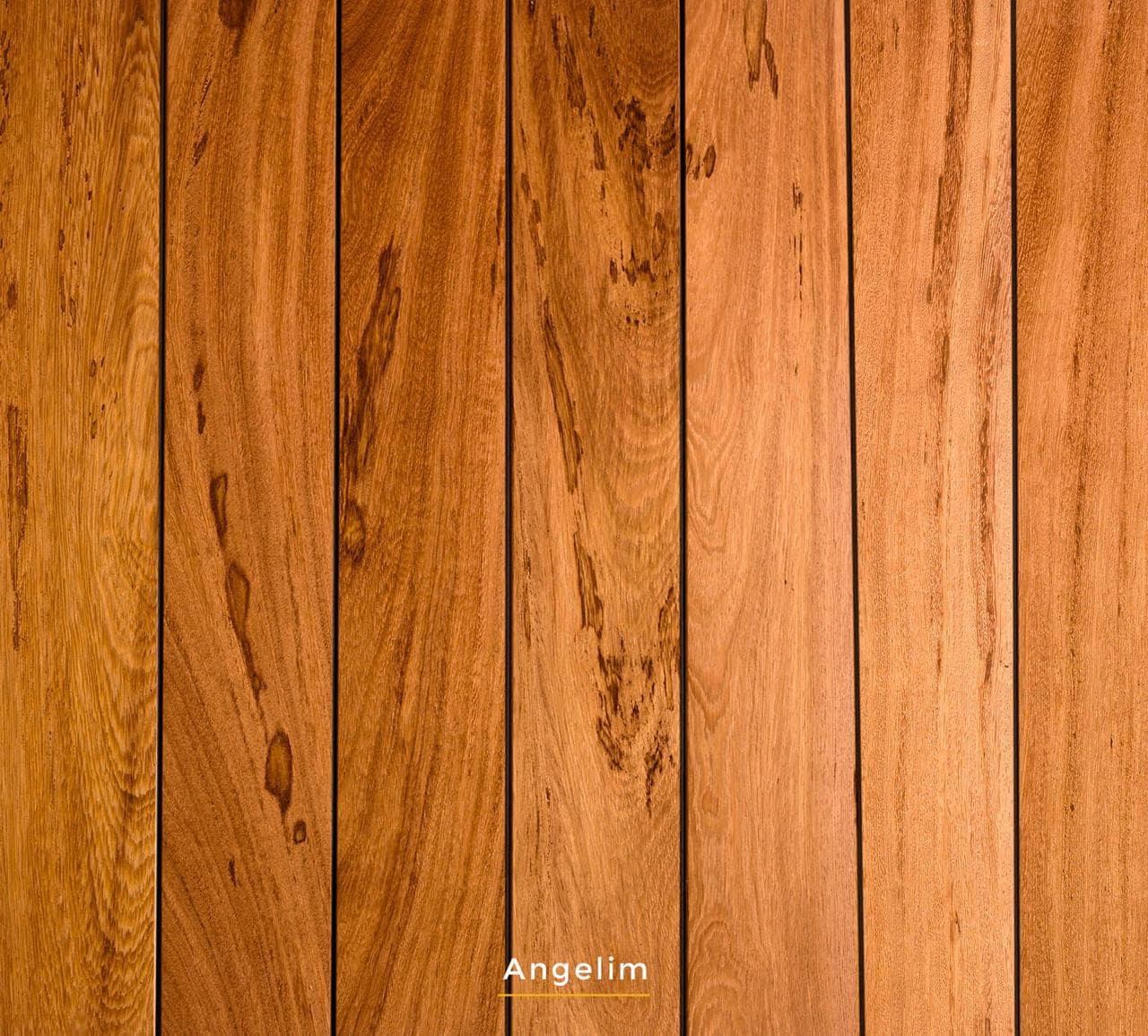
Angelim Decking: A Foundation for Design
Angelim is a hardwood known for its durability and reliability, making it a suitable choice for exterior applications like decking. The wood's density and stability also make it appropriate for various carpentry uses, including decking and cladding.
The distinctive coloration of Angelim, with heartwood ranging from yellowish beige to pinkish brown, offers a warm and inviting aesthetic that can be highlighted by a diagonal pattern. This material is also absorptive, which allows for easy finishing with stains and oils if you choose to alter its natural appearance or enhance its color.
Increased Material Needs for Diagonal Layouts
A diagonal decking layout, typically at a 45-degree angle, inherently generates more waste compared to a straight layout. This is because boards must be cut at angles to fit the perimeter of the deck, resulting in triangular offcuts that are often too small or irregularly shaped for reuse. For rectangular decks, the effective length of each board segment is longer along the diagonal, and boards often need to span across more joists.
As a general rule, plan for an additional 15-20% material waste compared to a straight layout. This percentage can vary based on the exact dimensions of your deck, the length of the Angelim boards you purchase (available in 4-20 ft, depending on profile), and the complexity of the deck's perimeter. It is always better to over-order slightly to account for cuts, potential mistakes, and future repairs. Consider using a decking calculator that specifically accounts for diagonal layouts, or manually lay out your cuts on a scaled drawing.
Reviewing Your Deck's Structural Support
Diagonal decking boards distribute weight differently across the substructure than boards laid parallel or perpendicular to joists. While Angelim is a dense and stable wood, the primary concern for a diagonal layout is ensuring adequate support from the deck's joists. Depending on the angle and board span, a diagonal layout may require closer joist spacing than a straight layout.
This can lead to more flex or bounce in the decking if the joists are spaced too far apart. Consult with a structural engineer or your contractor to confirm that your existing or planned joist spacing is sufficient for a diagonal Angelim decking installation. This step is crucial for the long-term stability and performance of your deck.
Manufacturer-Recommended Board Spacing
Regardless of the layout pattern, adhering to the manufacturer's recommended board spacing for Angelim decking is essential. Hardwood decking, including Angelim, expands and contracts with changes in moisture and temperature. Proper spacing allows for this movement, preventing cupping, warping, and buckling.
Always refer to the specific installation instructions provided with your Angelim decking order. If using hidden fasteners, these often automatically set the appropriate gap. Incorrect spacing can compromise the deck's appearance and longevity, even for a durable material like Angelim.
Worked Example: Diagonal Layout Material Calculation
Consider a hypothetical rectangular deck measuring 10 feet by 12 feet (120 square feet). We plan to use 1x6 Angelim decking boards. So, 120 sq ft / 0.479 sq ft/linear ft = approximately 250.5 linear feet.
For a diagonal layout, we must factor in increased waste. Let's estimate an additional 18% waste. This brings our linear footage requirement to 250.5 linear feet * 1.18 = approximately 295.6 linear feet. If boards are available in 16-foot lengths, you would need to purchase 295.6 / 16 = 18.47 boards. Rounding up, you would need 19 boards of 16-foot length.
This calculation is a simplified example. Always verify actual board dimensions, account for specific waste percentages based on your deck's geometry, and consider purchasing a few extra boards for cuts and potential future repairs. Longer boards often reduce the number of end joints, which can be aesthetically pleasing in a diagonal layout.
Before you order
- Confirm your deck's dimensions and perimeter shape.
- Estimate material waste for diagonal cuts (add 15-20% to area-based linear footage).
- Verify joist spacing is adequate for diagonal load distribution; consult a professional if unsure.
- Obtain specific Angelim decking board spacing recommendations from the manufacturer.
- Plan for a cutting strategy that minimizes waste, especially for perimeter boards.
- Consider the aesthetic impact of board length and end joints on the diagonal pattern.
- Account for any picture-frame borders or edge treatments that interact with the diagonal field.
Confirm installation details, approved uses and warranty terms in the current instructions for the exact product and profile. Your installer should verify the substrate, structure and applicable project requirements.
Questions to help you decide
Why does a diagonal decking layout create more waste?
A diagonal layout requires boards to be cut at an angle to fit the deck's perimeter. These angled cuts produce triangular offcuts that are often unusable, leading to a higher percentage of material waste compared to a straight layout where cuts are typically perpendicular to the board length.
Do I need to change my deck's joist spacing for a diagonal layout?
Possibly. A diagonal layout increases the effective span of the decking boards between joists, which can lead to more flex. It is recommended to consult with a structural engineer or experienced contractor to ensure your joist spacing is adequate for the increased demands of a diagonal installation, especially for heavier hardwoods like Angelim.
Is Angelim decking suitable for a diagonal layout?
Yes, Angelim's density, stability, and natural resistance to insects and moisture make it a durable choice for any decking layout, including diagonal. The key is to properly plan for increased material waste, ensure adequate structural support, and adhere to manufacturer-specified board spacing.
Ready to Plan Your Angelim Deck?
Request a material quote with your project dimensions, desired Angelim profile, and ZIP code to confirm current availability and service options for your diagonal decking project. Explore our full range of Angelim decking and complementary products today.
Request a material quote →