Why Angelim for a Covered Porch?
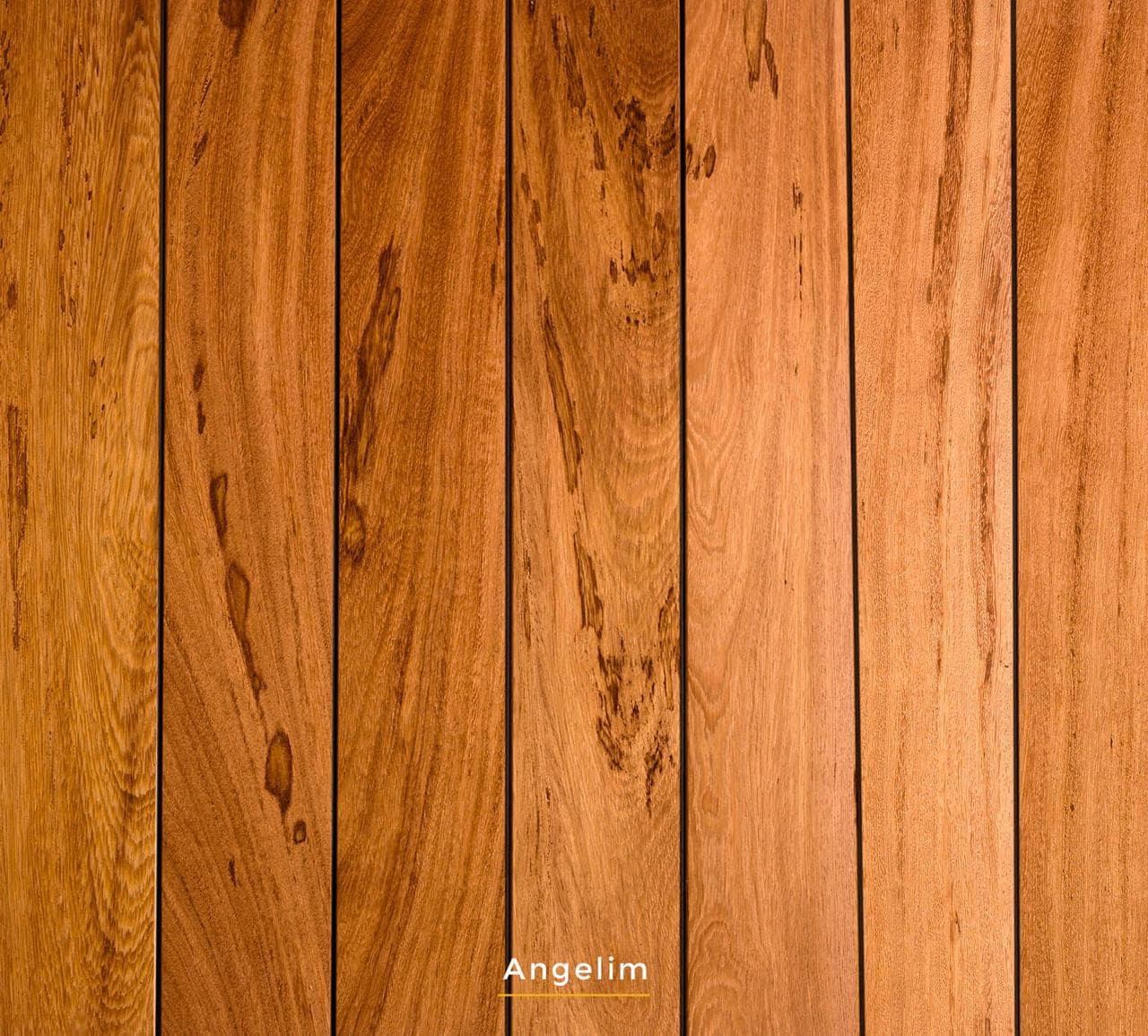
Angelim (Hymenolobium spp.), also known as Angelim Pedra, is a hardwood sourced from Brazil, recognized for its strength and reliability. Its natural resistance to termites and moisture makes it a suitable choice for outdoor applications, including covered porches where humidity and occasional splashes may still be present. The wood's heartwood displays a yellowish-beige tone that deepens to a pinkish-brown over time, offering a distinctive color profile.
Its density and stability contribute to a solid feel underfoot, an important quality for a main entry or outdoor living space. While a covered porch offers some protection, selecting a material like Angelim that is naturally resistant to insects, rot, and fungi provides an additional layer of assurance.
Angelim is also described as absorptive, which makes it receptive to stains and oils. This characteristic allows for customization of the finished look, whether you prefer to enhance its natural color or apply a protective finish that complements your home's exterior.
Considering Board Profiles and Dimensions
Angelim decking is available in various profiles, typically ranging from 1x4 to 6x6, with lengths from 4 to 20 feet, depending on the specific profile and availability. For a covered porch, common decking board sizes like 1x4 or 5/4x6 are often selected. The choice of board width can influence the visual scale of your porch. Wider boards might make a smaller porch feel more expansive, while narrower boards can create a more intricate pattern.
When planning your layout, consider the direction of the boards. Running them parallel to the house can elongate the space, while perpendicular placement can visually widen it. Diagonal layouts are also an option, adding a unique design element, though they may result in more material waste due to angled cuts.
Coordinating with Thresholds and Adjacent Spaces
The transition from your interior living space to the covered porch is a critical design point. Ensure the finished height of your Angelim decking aligns appropriately with the interior floor level, allowing for smooth passage through doorways. This often involves careful planning of the subframe structure and joist height.
If your covered porch connects to an uncovered deck or patio, consider how the Angelim decking will transition to that material. For instance, a picture-frame border using Angelim boards can create a clean visual separation and finish the edges neatly. You might also consider using matching Angelim for fascia boards or stair treads if your porch includes steps, ensuring a cohesive look.
Planning for Furniture and Usage
A covered porch often serves as an extension of indoor living, frequently housing furniture, planters, and other decorative elements. Angelim's density and stability make it well-suited to bear the weight of porch swings, dining sets, or heavier planters without concern for excessive deflection or damage. Its resistance to moisture also means that incidental spills or dampness from plant watering are less likely to impact the material.
When arranging furniture, consider the layout to ensure clear pathways and comfortable spacing. If you plan to use rugs, ensure they are suitable for outdoor use and allow for proper ventilation beneath to prevent moisture buildup on the decking surface.
Worked Example: A 10x12 Foot Covered Porch
Let's consider a hypothetical 10-foot by 12-foot covered porch that will use Angelim 1x4 (nominal 3/4 inch by 3 1/2 inch actual) decking boards, installed perpendicular to the house. The goal is a uniform appearance with minimal visible seams.
First, calculate the total area: 10 ft * 12 ft = 120 square feet.
The number of boards needed across the 12-foot length is 12 feet / (3.75 inches / 12 inches/foot) = 12 / 0.3125 = 38.4 boards. Since we can't buy partial boards, we'd round up to 39 boards. To account for cuts and waste, it's prudent to add 10-15%, so let's aim for 43-45 boards.
If Angelim is available in 10-foot lengths, this would be a straightforward purchase. If only 12-foot or 14-foot lengths are available, you'd need to consider how to optimize cuts to minimize waste. For example, if using 12-foot boards, you could get one 10-foot board and a 2-foot offcut from each. This small offcut might not be reusable for decking but could be used for blocking or other small details.
For a project this size, 39 to 45 boards of Angelim 1x4 at 10 feet each would be approximately 390 to 450 linear feet. This example demonstrates the importance of considering actual board dimensions and factoring in waste for precise material ordering.
Before you order
- Confirm the exact dimensions of your covered porch, including any steps or irregular shapes.
- Decide on the desired board profile (e.g., 1x4, 5/4x6) and length availability for Angelim decking.
- Plan the orientation of the decking boards (parallel, perpendicular, or diagonal) to optimize visual flow and minimize cuts.
- Evaluate the existing subframe and joist system to ensure it can support Angelim decking and allows for proper finished height alignment with interior thresholds.
- Consider the aesthetic transition to adjacent outdoor spaces or hardscaping.
- Account for any special features like built-in seating, planters, or railing posts that will integrate with the decking.
- Research compatible fasteners (e.g., hidden fasteners, face screws) and ensure they are appropriate for Angelim hardwood.
- Determine your preferred finish (stain or oil) and plan for its application to enhance and protect the Angelim.
- Factor in potential waste for cuts and unforeseen issues, typically adding 10-15% to your linear footage calculation.
Confirm installation details, approved uses and warranty terms in the current instructions for the exact product and profile. Your installer should verify the substrate, structure and applicable project requirements.
Questions to help you decide
Does Angelim decking require special installation for a covered porch?
While Angelim is generally easy to install, pre-drilling is recommended due to its density. For a covered porch, ensure proper ventilation underneath the deck to prevent moisture buildup, even though the area is sheltered. Follow manufacturer guidelines for board spacing to allow for natural expansion and contraction.
How does Angelim's color change in a covered environment?
Angelim heartwood is yellowish beige and darkens to a pinkish brown over time. In a covered environment, this natural color change, often referred to as 'silvering' or 'weathering,' may occur more slowly or unevenly compared to areas exposed to full sun. Applying a UV-inhibiting oil or stain can help maintain its initial color longer, if desired, and provide additional protection.
What maintenance is needed for Angelim decking on a covered porch?
Angelim is absorptive, making it easy to finish with stains and oils. For a covered porch, regular cleaning to remove debris, leaves, and dirt is important to prevent mold or mildew growth in sheltered, potentially humid conditions. Periodic reapplication of a suitable finish, as recommended by the finish manufacturer, will help maintain its appearance and offer protection. Check for any areas where water might pool and address drainage as needed.
Ready to Plan Your Angelim Covered Porch?
Request a material quote with your project dimensions, desired Angelim profile, and ZIP code. We can confirm current availability and service options for your project.
Request a material quote →