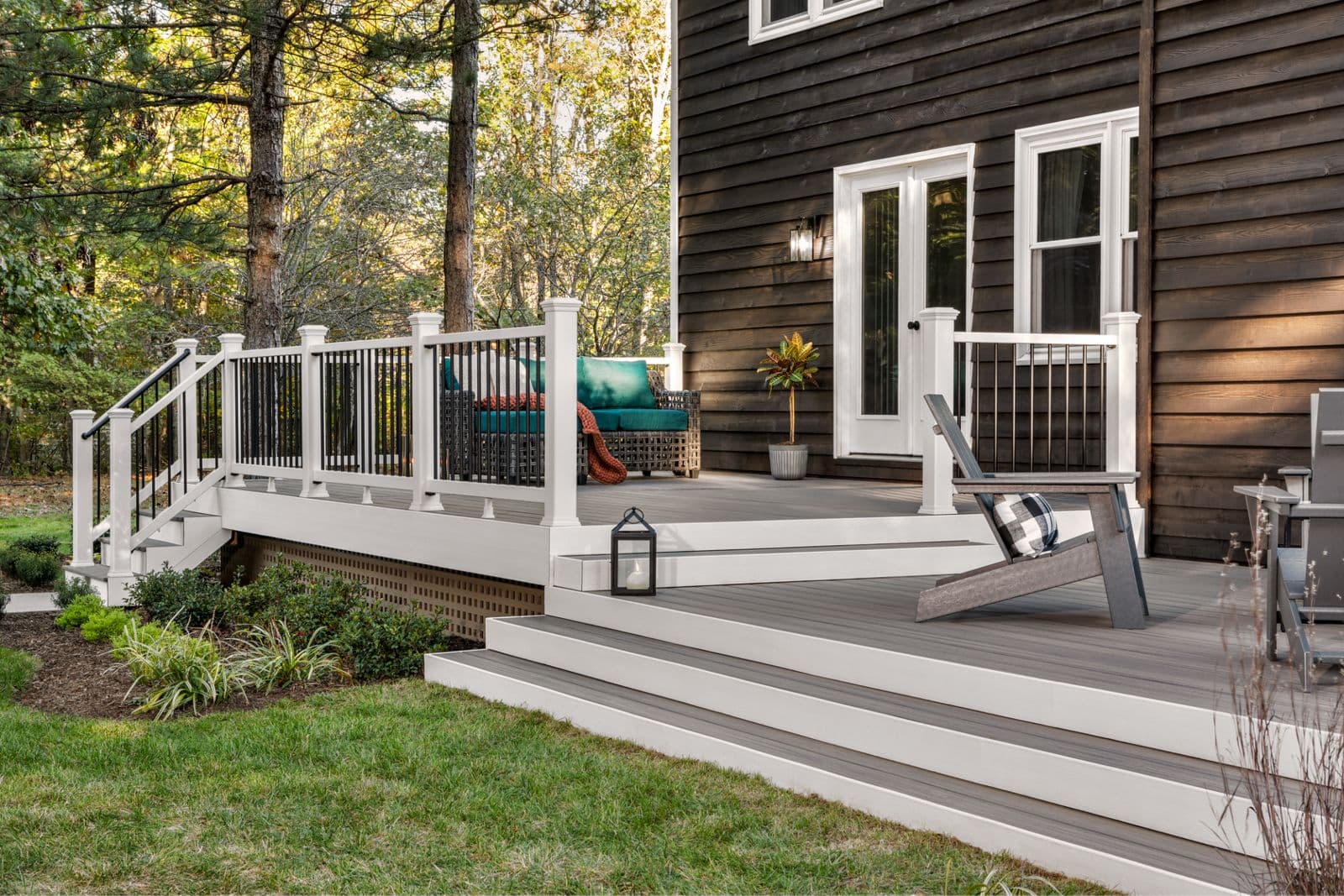
Understanding Trex Decking Collections
Trex composite decking is made from 95% recycled materials, combining reclaimed wood fiber and recycled plastic film. This composition results in a material that resists common issues like splinters, rot, and insect damage, which can be concerns with traditional wood decking. Trex offers several collections, each with distinct finishes and color palettes, but all share a capped surface for protection.
The Trex Enhance® collection, including Basics and Naturals, provides an entry point with traditional and multi-tonal colors. Enhance Basics features colors like Clam Shell, Beach Dune, and Saddle. Enhance Naturals offers an authentic wood-grain appearance with options such as Foggy Wharf, Rocky Harbor, Toasted Sand, and Coastal Bluff. Both Enhance lines are capped on three sides.
For a mid-range option, Trex Select® Earth Tones offers high-performance shell technology with colors like Pebble Grey, Winchester Grey, Woodland Brown, and Madeira. The flagship Trex Transcend® collection, available in Earth Tones and Tropical, provides a premium aesthetic and the highest level of performance. Transcend Earth Tones includes Gravel Path, Rope Swing, and Vintage Lantern, while Transcend Tropical features vibrant multi-tonal colors such as Havana Gold, Island Mist, Tiki Torch, Spiced Rum, and Lava Rock. All Trex lines are designed for low maintenance, typically requiring only a soap-and-water wash.
Lengths typically come in 12, 16, and 20 feet.
Planning Your Deck's Dimensions and Layout
Before selecting a Trex collection, defining the dimensions and layout of your backyard gathering space is crucial. Consider how many people you anticipate hosting, what activities will take place (dining, lounging, grilling), and how the deck will integrate with existing landscaping or structures.
A common recommendation for a comfortable dining area is at least 10x12 feet, while a separate lounging area might require similar space. If you plan for an outdoor kitchen or grill station, ensure adequate clearance and a non-combustible surface beneath the grill. Sketching out your desired layout helps visualize zones and determine the overall footprint.
When planning board lengths, consider the available Trex lengths (12, 16, 20 feet) to minimize waste and visible seams. For a seamless look on longer decks, boards can be butt-jointed over joists, or you might consider a picture-frame border to define the perimeter and hide end grains. Discuss board orientation (parallel, perpendicular, or diagonal to the house) with your installer, as this impacts both aesthetics and material quantity.
Coordinating Fascia and Edge Finishes
The finished edge of your deck significantly contributes to its overall appearance. Trex offers matching fascia boards for each collection, which are thinner, non-structural boards used to cover the rim joists of the deck frame. This creates a clean, uniform look around the deck's perimeter.
When ordering, ensure you specify the correct quantity and color of fascia boards to match your chosen decking. Square-edge boards are typically used for the perimeter of the deck where they meet the fascia, providing a finished look without exposed grooved edges. For stairs, you'll need to coordinate both the tread boards and risers with your chosen Trex collection and color.
Fastening Systems for Trex Decking
Trex decking can be installed using either hidden fasteners or face screws. Hidden fasteners, often clips that fit into the grooved edges of the boards, create a smooth, fastener-free surface. This method is popular for its clean aesthetic and barefoot-friendly finish. These clips typically provide consistent spacing between boards, which is important for drainage and ventilation.
Alternatively, face screws can be used, particularly for square-edge boards or when a more visible, traditional fastening method is preferred. When face-fastening, it's important to use screws specifically designed for composite decking to prevent mushrooming or cracking. Pre-drilling may be necessary depending on the screw type and board. Always refer to the manufacturer's specific installation guidelines for chosen fasteners to ensure proper spacing and structural integrity.
Worked Example: A 12x16-foot Gathering Deck
Let's consider a hypothetical 12-foot by 16-foot deck in Burlington, VT, designed for a small gathering space, using Trex Select® Earth Tones in 'Pebble Grey'. The deck will feature a straight layout, with boards running perpendicular to the house, and a single picture-frame border.
For the main decking, we'll need boards to cover 12 feet in width and 16 feet in length. If we run 16-foot boards parallel to the 12-foot house side, we'd need approximately 26 boards (12 feet / 5.5 inches board width = 26.18, rounded up to 27 boards if no cuts, or 26 boards if we can use offcuts). Assuming 16-foot grooved boards for the main deck. For a picture-frame border around the 12x16-foot perimeter, we'd need square-edge boards. This would require two 16-foot boards and two 12-foot boards for the outer frame. Depending on the exact framing, additional square-edge boards might be needed for the innermost part of the picture frame or for stairs.
Hidden fasteners would be used for the grooved boards, while the square-edge border boards and fascia would be face-fastened with color-matched screws. This example highlights the need to account for specific board types (grooved vs. square-edge), lengths, and accessories like fascia and fasteners when calculating material quantities.
Maintenance and Longevity in Burlington's Climate
Trex decking is engineered for low maintenance, a significant advantage in a climate like Burlington's with varying seasonal conditions. Unlike wood, Trex does not require sanding, staining, or sealing. The protective capping on Trex boards is designed to resist fading and staining.
Routine maintenance typically involves a simple soap-and-water wash to remove dirt, pollen, and other debris. Promptly cleaning spills helps prevent potential stains. Ensuring proper ventilation beneath the deck is also important to prevent moisture buildup, especially with Burlington's winters and humid summers. Following Trex's specific cleaning recommendations will help maintain the deck's appearance and support its longevity.
Before you order
- Determine the primary function and desired size of your gathering space.
- Select a Trex collection (Enhance, Select, or Transcend) based on desired aesthetics and performance.
- Choose a color that complements your home and landscape.
- Decide on board orientation (e.g., perpendicular, diagonal) and plan for seams or borders.
- Specify grooved boards for hidden fasteners and square-edge boards for perimeters and fascia.
- Calculate the quantity of decking boards, fascia boards, and appropriate fasteners.
- Consider any stairs, railings, or other accessories to complete the project.
- Review installation guidelines for proper board spacing and ventilation.
- Confirm the availability of physical samples to verify color and texture.
Confirm installation details, approved uses and warranty terms in the current instructions for the exact product and profile. Your installer should verify the substrate, structure and applicable project requirements.
This is a planning guide for projects in Burlington, VT. Ask our team to confirm availability, delivery to your ZIP code and which branch can support your order.
Questions to help you decide
What are the primary differences between Trex collections?
The main differences lie in the finish depth, color range, and aesthetic. Enhance is an entry-level option with traditional and multi-tonal colors. Select offers a mid-range performance and color selection. Transcend is the flagship line, providing elevated aesthetics and the highest level of performance with a wider range of tropical and earth-tone colors. All lines share a recycled core and low-maintenance capped shell.
Can Trex decking be installed over an existing wood frame?
In many cases, Trex decking can be installed over an existing, structurally sound wood frame. However, it's crucial to have the existing frame inspected by a qualified professional to ensure it meets current building codes and can adequately support the new decking. Joist spacing, ledger board attachment, and overall structural integrity must be verified before proceeding.
How do I clean Trex decking?
Trex decking is designed for low maintenance. Typically, a simple cleaning with soap and water, along with a soft-bristle brush, is sufficient to remove dirt, debris, and pollen. For tougher stains, Trex provides specific cleaning recommendations. Avoid pressure washers set at high pressures or harsh chemicals, as these can potentially damage the surface. Always refer to the official Trex cleaning guidelines for your specific product line.
Ready to Plan Your Trex Deck in Burlington, VT?
Request a material quote with your project dimensions, desired Trex profile, and ZIP code. We can confirm current availability and service options for your backyard gathering space.
Request a material quote →