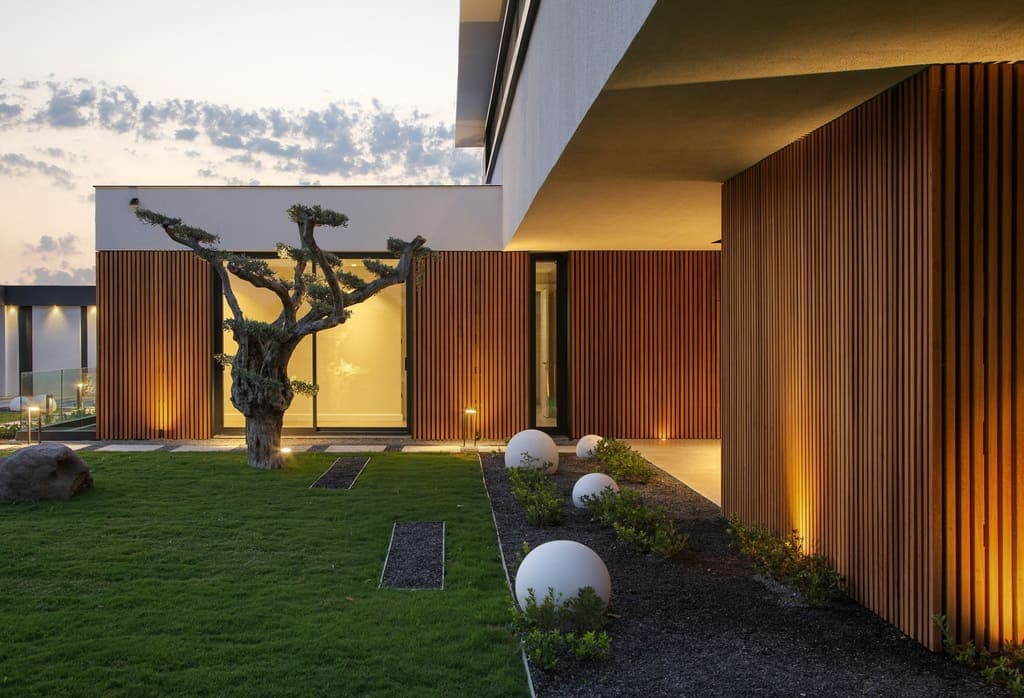
Understanding Thermally Modified Wood for Wall Applications
Thermally modified wood undergoes a high-temperature heat treatment process that changes its physical properties. This process reduces the wood's ability to absorb moisture, leading to increased dimensional stability and enhanced resistance to biological decay. For covered patio walls, where the material is sheltered but still exposed to ambient humidity and indirect weather, these characteristics are particularly beneficial.
The modification process also imparts a distinct, rich brown tone to the wood, which can be maintained with UV-protective finishes or allowed to weather naturally to a silver-gray patina. Different wood species can be thermally modified, each offering unique grain patterns and characteristics suitable for various design preferences. Common species include ash, pine, and spruce, available in diverse profiles.
Selecting the Right Profile and Species
The profile of the thermally modified wood planks will define the visual texture and shadow lines of your covered patio walls. Options range from traditional tongue-and-groove (T&G) for a seamless appearance, to shiplap or board-and-batten styles that create distinct lines and depth. For covered applications, a T&G profile can offer a clean, finished look, while shiplap can provide subtle shadow lines.
Consider the overall architectural style of your home and patio. A modern design might favor a sleek, narrow board with minimal visible fasteners, while a more rustic or transitional aesthetic could benefit from wider boards or a profile with a more pronounced reveal. Species like thermally modified ash offer a strong, distinctive grain, while thermally modified pine or spruce can provide a more uniform appearance. Always verify that the chosen profile and species are approved for vertical wall applications.
Finishing Options and Maintenance for West Palm Beach Conditions
Thermally modified wood can be left unfinished to weather naturally, developing a silver-gray patina over time. If you prefer to retain the initial rich brown color, a UV-protective finish is recommended. In West Palm Beach's climate, with its strong sun and humidity, a high-quality exterior finish designed for wood cladding is crucial. These finishes help protect against UV degradation and offer some moisture resistance.
Regular cleaning and reapplication of finish (if desired) will be necessary to maintain the appearance. Even without a finish, periodic cleaning to remove dust, pollen, and mildew is advisable. The frequency of maintenance will depend on the specific finish used, the degree of exposure on your covered patio, and local environmental factors. Always follow the finish manufacturer's instructions for application and reapplication intervals.
Substructure and Attachment Considerations
Proper substructure is essential for any wall cladding. For covered patio walls, the thermally modified wood planks typically attach to a system of furring strips or battens, creating an air gap behind the cladding. This air gap is important for ventilation and to help manage any moisture that might penetrate the wall assembly, which is particularly relevant in humid environments. The furring strips should be securely fastened to the structural framing of the patio.
Fasteners should be corrosion-resistant, such as stainless steel, to prevent staining of the wood and ensure long-term integrity, especially in a coastal climate. Hidden fastening systems can provide a cleaner aesthetic, while face-fastening might be chosen for certain profiles or for ease of installation. Always ensure fasteners are appropriate for the specific wood species and profile, and that they allow for any minor wood movement.
Worked Example: Covered Patio Wall for a 10-Foot Section
Let's consider a hypothetical covered patio wall section in West Palm Beach, measuring 10 feet wide by 8 feet tall. We'll specify a thermally modified ash shiplap profile, 5.5 inches wide with a 0.5-inch overlap, and available in 10-foot lengths. This profile is designed for horizontal installation.
First, calculate the total wall area: 10 ft (width) * 8 ft (height) = 80 square feet. The effective coverage width of each shiplap board is 5.5 inches - 0.5 inches (overlap) = 5 inches, or approximately 0.417 feet. To cover the 8-foot height, you would need 8 ft / 0.417 ft/board = 19.18 boards. Since you can't use a fraction of a board for a full run, you'd need 20 boards for the height. Each board is 10 feet long, so for a 10-foot wide section, each board would run the full width. Therefore, you would need 20 boards, each 10 feet long.
This calculation assumes no waste for cuts around windows or doors, and perfect alignment. In practice, it's advisable to add 10-15% for waste, cuts, and potential future repairs. For this example, 20 boards * 1.15 (15% waste) = 23 boards. Therefore, you would order 23 pieces of 10-foot long, 5.5-inch wide thermally modified ash shiplap. This example uses a single profile for illustrative purposes; always confirm specific product dimensions and coverage before ordering. The substructure (furring strips) and fasteners would be calculated separately based on spacing requirements.
Before you order
- Verify local building codes and HOA requirements for exterior wall materials.
- Confirm the specific thermally modified wood species (e.g., ash, pine) and profile (e.g., T&G, shiplap) suitable for vertical wall applications.
- Decide on a finish (or no finish) and understand the long-term appearance and maintenance implications for West Palm Beach's climate.
- Plan the substructure, including furring strip material, spacing, and attachment to the existing patio framing.
- Select appropriate corrosion-resistant fasteners (e.g., stainless steel) for the chosen wood species and profile.
- Calculate material quantities, including an allowance for waste, based on detailed project dimensions.
- Consider how corners, edges, and any penetrations (e.g., light fixtures) will be detailed.
Confirm installation details, approved uses and warranty terms in the current instructions for the exact product and profile. Your installer should verify the substrate, structure and applicable project requirements.
This is a planning guide for projects in West Palm Beach, FL. Ask our team to confirm availability, delivery to your ZIP code and which branch can support your order.
Questions to help you decide
Can thermally modified wood be painted?
While it's possible to paint thermally modified wood, many users choose stains or clear finishes to highlight its natural grain and enhanced color. If painting, ensure the paint is suitable for exterior wood, and that the wood is properly prepared and primed according to the paint manufacturer's instructions. Painting may require more frequent maintenance than some other finishing options.
How does West Palm Beach's humidity affect thermally modified wood?
Thermally modified wood exhibits improved dimensional stability compared to untreated wood, meaning it is less prone to swelling and shrinking in response to changes in humidity. This characteristic makes it a suitable choice for humid environments like West Palm Beach, as it helps reduce the risk of warping, cupping, or checking on your covered patio walls. However, proper installation with an air gap and appropriate fasteners is still important for optimal performance.
Is thermally modified wood heavy for wall installation?
The thermal modification process typically reduces the wood's density and weight. While the exact weight varies by species, thermally modified wood is generally lighter than its untreated counterpart. This can be an advantage during installation, making it easier to handle and reducing the overall load on the patio's structure. Always ensure your framing can support the combined weight of the cladding and any other applied loads.
Request a Material Quote for Your Covered Patio Walls
Ready to enhance your West Palm Beach covered patio with thermally modified wood? Provide your project dimensions, desired profile, and ZIP code to request a material quote. We can help confirm current availability and service options for your project. Visit our product page for more details: /thermally-modified-wood
Request a material quote →