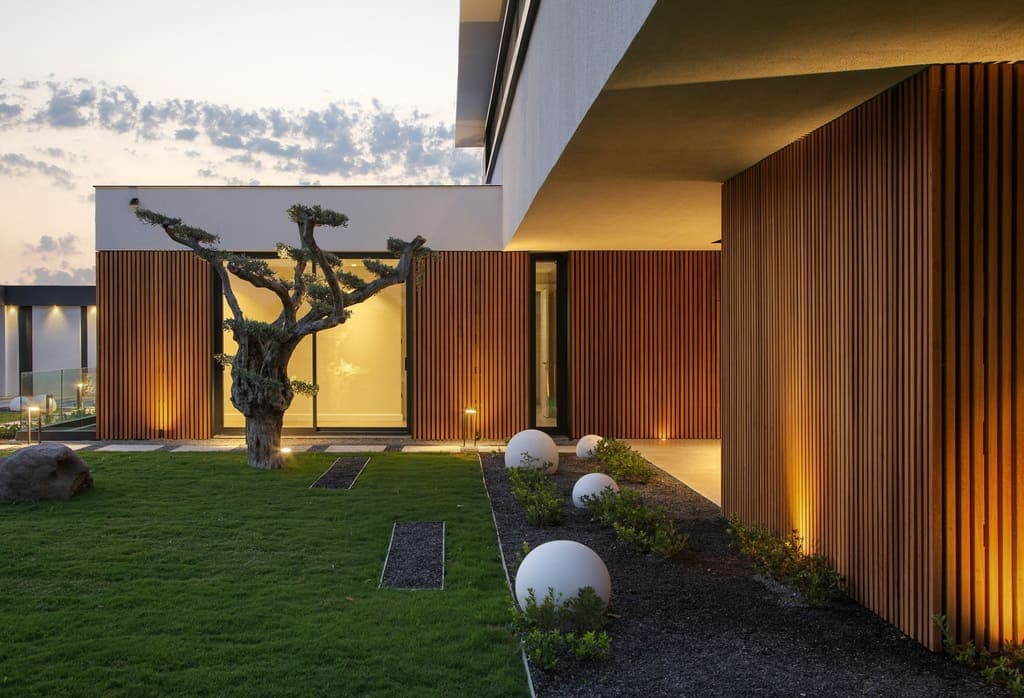
Understanding Thermally Modified Wood for Wall Applications
Thermally modified wood undergoes a high-temperature heat treatment process, which alters its cellular structure. This process enhances the wood's dimensional stability and resistance to decay and insects, making it a robust material for various exterior and semi-exterior applications. For covered patio walls, these properties are beneficial because the wood will still experience changes in humidity and temperature, even if protected from direct rain and sun.
The modification process typically results in a darker, more uniform color throughout the wood, which can deepen further with finishes. While the primary benefit is performance, the aesthetic qualities of thermally modified wood, such as its rich tones and visible grain, contribute to its appeal for architectural features like covered patio walls. It offers a natural wood look with improved longevity compared to untreated wood in many outdoor scenarios.
Selecting Profiles and Species for Covered Patio Walls
When planning a covered patio wall, the profile of the thermally modified wood plays a significant role in both aesthetics and installation. Common profiles include tongue-and-groove, shiplap, and square-edge boards. Tongue-and-groove and shiplap profiles offer a cleaner, more finished look by concealing fasteners and creating defined shadow lines. Square-edge boards can be installed with intentional gaps for a more open, contemporary feel, or tightly butting for a solid surface.
NORX offers thermally modified spruce with a variety of profiles suitable for cladding applications. The precise dimensions and profiles available can influence the overall appearance and ease of installation. Consider how the chosen profile will align with existing architectural elements and the desired visual texture of your patio space. For instance, a wider shiplap profile can create a modern, expansive look, while narrower tongue-and-groove boards might offer a more traditional or intricate pattern.
While many species can be thermally modified, the specific properties of the base wood, such as grain pattern and density, will still be present. For example, NORX thermally modified spruce provides a consistent appearance with good workability, making it a versatile choice for wall cladding.
Finishing and Appearance Considerations
Thermally modified wood can be left unfinished to weather naturally, or it can be finished with stains, oils, or sealers to maintain its color or achieve a specific aesthetic. If left unfinished, the wood will gradually silver over time, a process accelerated by UV exposure. Even on a covered patio wall, some ambient UV light will reach the surface.
To preserve the initial color or introduce a new hue, a penetrating oil or stain is often recommended. These finishes can enhance the wood's natural grain and provide additional protection against moisture and UV degradation, extending the vibrancy of the color. Maximo Accoya, while a different product, illustrates the range of aesthetic possibilities for wood in outdoor applications, from natural tones to more vibrant, color-enhanced finishes.
When selecting a finish, consider the level of maintenance you are willing to undertake. Finishes will require periodic reapplication to maintain their appearance and protective qualities. Always follow the manufacturer's recommendations for application and recoating intervals.
Attachment Methods and Substructure
Proper attachment is crucial for the long-term performance of thermally modified wood on covered patio walls. Common attachment methods include face fastening and hidden fastening systems. Face fastening involves driving fasteners directly through the face of the board into the substructure. This method is generally straightforward but leaves visible fastener heads, which may be camouflaged with color-matched screws or by selecting a profile that minimizes their visibility.
Hidden fastening systems, often used with tongue-and-groove or shiplap profiles, involve fasteners that are driven through the tongue or groove, leaving the face of the board unmarred. This creates a cleaner, more seamless appearance. Regardless of the method, stainless steel fasteners are recommended to prevent staining of the wood and ensure long-term corrosion resistance, especially in humid environments.
The substructure behind the thermally modified wood should be sound and provide adequate ventilation. Even in a covered area, air circulation behind the cladding helps prevent moisture buildup. A rainscreen assembly, which creates an air gap between the cladding and the wall sheathing, is often a best practice for exterior walls, including covered patio walls, to manage moisture effectively. This typically involves vertical furring strips attached to the structural wall, to which the thermally modified wood is then fastened. For more detailed guidance, resources on siding and cladding installation can offer further insights.
Ensure the substructure is level and plumb to facilitate a straight and consistent installation of the thermally modified wood. Any irregularities in the substructure will be reflected in the final appearance of the wall.
Worked Example: Covered Patio Wall in Syracuse
Consider a covered patio in Syracuse, NY, with a wall section measuring 10 feet wide by 8 feet high that the homeowner wishes to clad with thermally modified wood. They choose a NORX thermally modified spruce shiplap profile, 5.5 inches wide with a 0.5-inch overlap, and a nominal length of 12 feet. The desired aesthetic is a horizontal installation with a natural, unstained finish that will silver over time.
First, calculate the total area: 10 feet * 8 feet = 80 square feet. The effective coverage width of each shiplap board is 5.5 inches - 0.5 inch (overlap) = 5 inches, or approximately 0.417 feet. For horizontal installation, the number of courses needed is 8 feet / 0.417 feet/course = 19.18 courses. Round up to 20 courses to ensure full coverage.
Each course will require a 10-foot length. Since the boards are 12 feet long, each board can yield one 10-foot length with a 2-foot offcut. For 20 courses, 20 boards will be needed. The 2-foot offcuts may be useful for smaller sections or trim, but for primary coverage, 20 full boards are purchased.
For the substructure, vertical furring strips (e.g., 1x3 pressure-treated lumber) would be installed every 16-24 inches on center. For a 10-foot width, this would mean 6-8 furring strips.
This project also involves planning for the natural weathering process. While protected, the wood will still be exposed to ambient light and moisture, initiating the silvering process. No finish is applied, simplifying initial installation but requiring acceptance of the natural color change.
Before you order
- Determine the exact dimensions of your covered patio wall area.
- Select a thermally modified wood species and profile (e.g., NORX thermally modified spruce shiplap, tongue-and-groove, or square-edge).
- Decide on a finish: unfinished (for natural silvering) or a stain/oil (for color retention/enhancement).
- Confirm the desired orientation (horizontal or vertical) for your cladding.
- Plan the substructure, including furring strips for ventilation and proper attachment.
- Choose appropriate fasteners (e.g., stainless steel, hidden or face-fastened).
- Consider how corners, edges, and transitions will be handled for a finished look.
- Verify local building considerations or recommendations for outdoor wall cladding in Syracuse, NY.
Confirm installation details, approved uses and warranty terms in the current instructions for the exact product and profile. Your installer should verify the substrate, structure and applicable project requirements.
This is a planning guide for projects in Syracuse, NY. Ask our team to confirm availability, delivery to your ZIP code and which branch can support your order.
Questions to help you decide
Can thermally modified wood be painted?
While thermally modified wood can accept paint, it is often chosen for its natural wood aesthetic. Stains or oils are more commonly used to enhance its inherent color or allow for natural weathering. If painting, ensure the product is compatible with thermally modified wood and follow all manufacturer recommendations for surface preparation and application.
How does Syracuse's climate affect thermally modified wood on a covered patio?
Syracuse experiences distinct seasonal changes, including cold winters and humid summers. While covered patio walls offer protection from direct elements, the wood will still be exposed to fluctuating temperatures and ambient humidity. Thermally modified wood's enhanced dimensional stability and resistance to decay make it well-suited for these conditions, reducing the likelihood of warping, cracking, or rot compared to untreated wood. Proper ventilation behind the cladding is still important to manage moisture.
Is special maintenance required for thermally modified wood on a covered patio?
Maintenance depends on your chosen finish. If left unfinished, the wood will naturally weather and silver, requiring no specific maintenance for color. If a stain or oil is applied, periodic reapplication will be necessary to maintain the color and protective qualities, typically every 1-3 years depending on the product and exposure. Regardless of finish, it's advisable to keep the surface clean from debris and ensure proper drainage.
Ready to Transform Your Covered Patio?
Request a material quote for your project. Provide your project dimensions, desired thermally modified wood profile, and ZIP code to confirm current availability and service options.
Request a material quote →