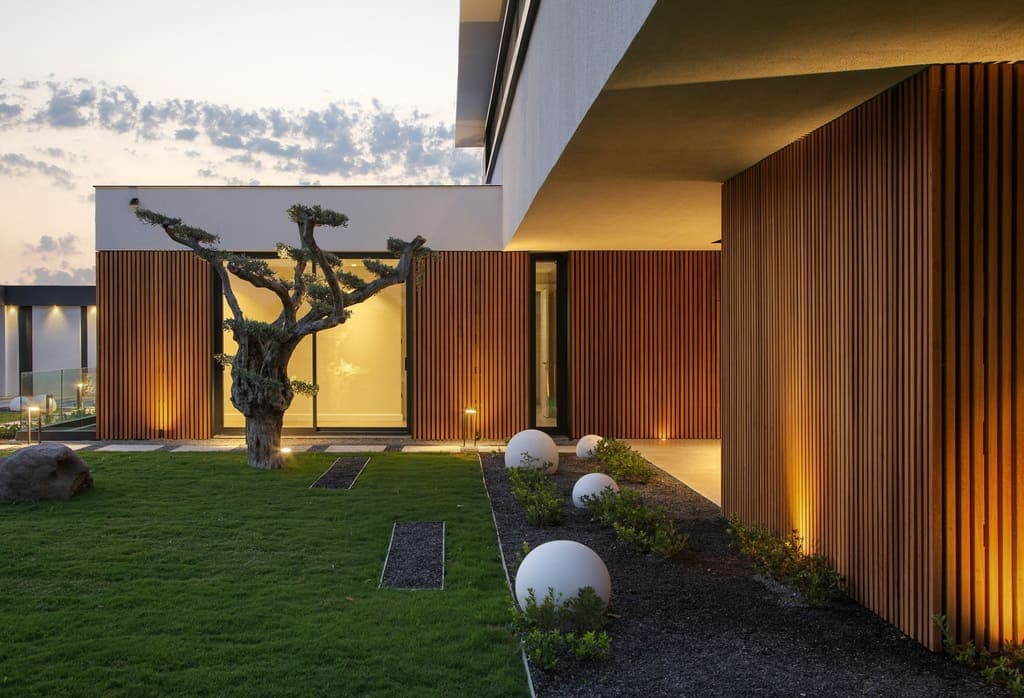
Why Thermally Modified Wood for Covered Patio Walls?
Covered patio walls, while shielded from the harshest elements, still experience environmental changes that can affect traditional wood. Fluctuations in temperature and humidity can lead to warping, checking, or fungal growth in untreated timber. Thermally modified wood addresses these concerns by undergoing a high-temperature process that changes its physical properties.
This modification significantly reduces the wood's hygroscopicity (its tendency to absorb moisture), making it more stable and less prone to movement. This stability is particularly beneficial for wall applications where a consistent, flat appearance is desired. Additionally, the process enhances the wood's natural resistance to decay and insects, contributing to a lower-maintenance material over time. The result is a durable, attractive material that retains the natural beauty of wood with improved performance characteristics.
Selecting the Right Profile and Species
Thermally modified wood is available in various profiles, each offering a distinct aesthetic and installation method. For covered patio walls, common choices include tongue-and-groove, shiplap, and square-edge profiles. Tongue-and-groove profiles offer a tight, interlocking fit, creating a smooth, continuous surface with concealed fasteners. Shiplap provides a clean, overlapping joint, often creating a subtle shadow line that adds depth to the wall.
Square-edge profiles can be installed with visible gaps for a more open, contemporary look, or butted tightly for a flush appearance. The choice of profile impacts both the visual texture of the wall and the installation complexity. Species commonly available as thermally modified include Ash and Pine, each offering different grain patterns and natural color tones. NORX is a brand offering thermally modified wood products suitable for wall applications.
Consider the overall design of your patio and home when selecting a profile. A sleek, modern patio might benefit from a narrow shiplap or a tight tongue-and-groove, while a more rustic or traditional space might accommodate wider boards or a profile with a more pronounced shadow line.
Finishing Options for Aesthetics and Protection
While thermally modified wood is inherently more stable and decay-resistant than untreated wood, finishing can further enhance its appearance and offer additional protection, especially in areas with moderate humidity like Salem, OR. The thermal modification process typically results in a rich, darker tone. If left unfinished, the wood will naturally weather to a silvery-gray patina over time, a process that occurs more slowly and evenly in a covered application compared to fully exposed siding.
For those who prefer to maintain the wood's initial color or introduce a specific hue, a penetrating oil finish is often recommended. These finishes absorb into the wood fibers, nourishing and protecting them while allowing the natural grain to show through. They can also provide UV protection, helping to slow the weathering process and maintain color consistency. Unlike film-forming finishes, oils typically do not crack or peel, making maintenance simpler.
When selecting a finish, consider the desired aesthetic and the level of maintenance you are prepared for. A clear oil will enhance the natural color, while tinted oils can deepen the tone or introduce subtle color variations. Always follow the manufacturer's recommendations for application and reapplication to ensure optimal performance and longevity.
Attachment and Substructure Considerations
Proper attachment is crucial for the long-term performance and appearance of thermally modified wood on covered patio walls. The substructure behind the cladding must be sound, level, and appropriately spaced to support the chosen profile. Typically, furring strips or a rainscreen system are installed over the structural sheathing. While covered patio walls are less exposed than exterior facades, a rainscreen gap can still provide ventilation, helping to equalize moisture content and prevent condensation buildup behind the cladding.
Fastener selection is also important. Stainless steel fasteners are generally recommended to prevent staining and ensure corrosion resistance, especially in areas where some moisture exposure is possible. Depending on the profile, fasteners may be face-nailed, blind-nailed, or clipped. Blind fastening methods, often used with tongue-and-groove or specific shiplap profiles, create a cleaner aesthetic by concealing the fasteners.
Ensure that the substructure is plumb and square before installation begins. Any irregularities in the substructure can transfer to the cladding, resulting in an uneven or wavy appearance. Plan for expansion and contraction by following manufacturer guidelines for spacing between boards and at corners or transitions, even though thermally modified wood exhibits less movement than untreated wood.
Hypothetical Project Example: Covered Patio Wall in Salem
Consider a covered patio in Salem, measuring 12 feet wide by 8 feet high. The homeowner desires a modern, clean look and selects thermally modified Ash in a 5.5-inch face-width shiplap profile. Each board is supplied in 10-foot lengths. The goal is to clad the 12-foot wide wall.
To calculate the number of boards needed, first determine the total linear feet required for the wall. The wall height is 8 feet. If using horizontal installation, the number of courses would be 8 feet / 5.5 inches (0.458 feet) = 17.47 courses. Since we can't have partial courses, 18 courses are needed. So, 18 courses * 12 linear feet/course = 216 linear feet of material.
Since boards come in 10-foot lengths, you would need 216 linear feet / 10 linear feet/board = 21.6 boards. To account for cuts, waste, and potential board defects, it is prudent to add an overage, typically 10-15%. For this example, we'll use 15%. So, 21.6 boards * 1.15 = 24.84 boards. Therefore, 25 boards of 10-foot length thermally modified Ash shiplap would be a reasonable purchase quantity. This calculation assumes minimal waste and efficient cutting, especially for any offcuts from the 10-foot boards to complete the 12-foot width.
Before you order
- Confirm the specific thermally modified wood species and profile are approved for vertical wall applications.
- Evaluate the level of sun exposure and moisture within the covered patio area to determine if a finish is needed.
- Select an appropriate finish (e.g., penetrating oil) if you wish to maintain the wood's color or add protection.
- Verify the existing substructure is sound, plumb, and adequately spaced for the chosen cladding profile.
- Choose corrosion-resistant fasteners (e.g., stainless steel) suitable for the installation method.
- Plan for proper ventilation behind the cladding, even in covered areas, by considering furring strips or a rainscreen gap.
- Calculate material quantities accurately, including waste factor, based on wall dimensions and board lengths.
- Review manufacturer's installation guidelines for specific spacing, fastening, and detailing requirements.
Confirm installation details, approved uses and warranty terms in the current instructions for the exact product and profile. Your installer should verify the substrate, structure and applicable project requirements.
This is a planning guide for projects in Salem, OR. Ask our team to confirm availability, delivery to your ZIP code and which branch can support your order.
Questions to help you decide
Does thermally modified wood require a finish for covered patio walls?
While thermally modified wood is inherently stable and decay-resistant, a finish can protect its color from gradual weathering and offer additional aesthetic benefits. If left unfinished, the wood will naturally develop a silvery-gray patina over time. A penetrating oil finish is often recommended to maintain the original color or introduce a specific hue, and it can also provide UV protection.
Can thermally modified wood be installed directly onto existing siding?
Generally, it is recommended to remove existing siding and install thermally modified wood onto a prepared substructure, such as furring strips over structural sheathing. This ensures a flat, stable surface for attachment and allows for proper ventilation behind the cladding, even in covered areas. Direct installation over uneven surfaces can lead to an inconsistent appearance and potential moisture issues.
How do I clean and maintain thermally modified wood on covered patio walls?
Maintenance for thermally modified wood on covered patio walls is relatively simple. Regular cleaning with a soft brush or cloth and mild soap and water can remove dust, dirt, and any mildew. Avoid harsh chemicals or abrasive cleaners. If a penetrating oil finish has been applied, periodic reapplication according to the manufacturer's instructions will help maintain its appearance and protective qualities.
Ready to Enhance Your Salem, OR Covered Patio?
Request a material quote for your project. Provide your project dimensions, desired profile, and ZIP code to confirm current availability and service options for thermally modified wood.
Request a material quote →