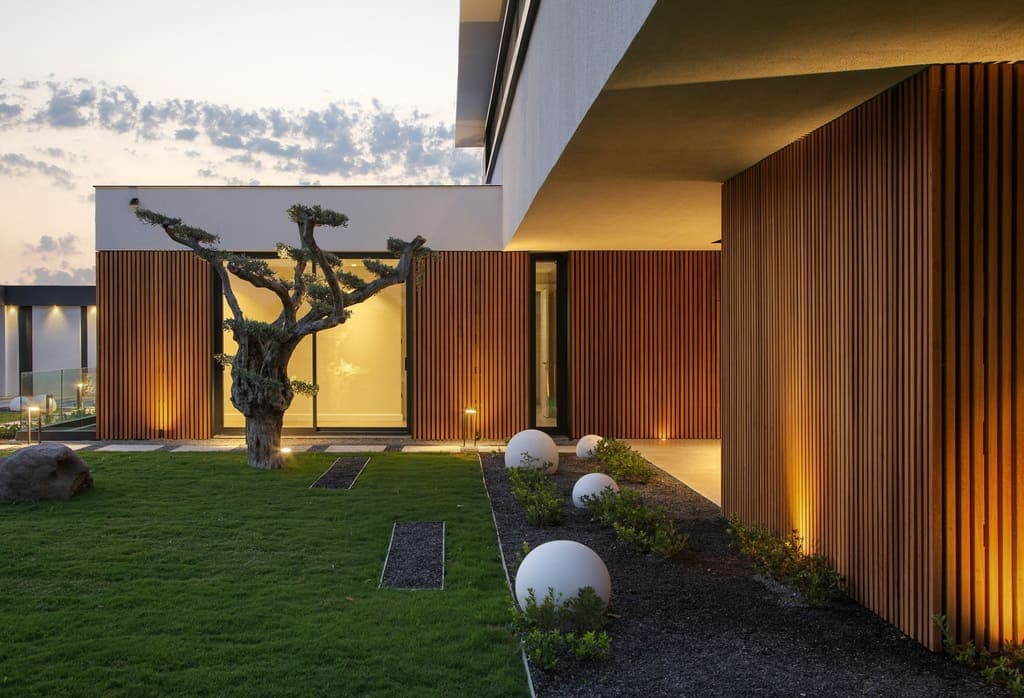
Understanding Thermally Modified Wood for Wall Applications
Thermally modified wood undergoes a high-heat treatment process that alters its cellular structure. This process aims to enhance the wood's stability and resistance to decay and insects, making it a suitable choice for various exterior applications.
For covered patio walls, these properties are particularly advantageous. While not exposed to the full force of rain and sun, covered areas still experience humidity fluctuations and indirect moisture. The enhanced dimensional stability of thermally modified wood can help reduce warping, twisting, and checking, which are common concerns with untreated wood in outdoor settings.
The thermal modification process also imparts a rich, darker tone to the wood, which can vary depending on the species and treatment intensity. This consistent color throughout the wood means that minor scratches or wear are less noticeable than with surface-stained materials. It also offers a natural, uniform aesthetic that can complement a range of architectural styles.
Selecting the Right Profile and Species
When choosing thermally modified wood for covered patio walls, the profile plays a significant role in both aesthetics and installation. Common profiles include tongue-and-groove, shiplap, and square-edge boards.
Tongue-and-groove profiles create a tight, interlocking fit, offering a clean, continuous appearance and simplifying alignment during installation. Shiplap provides a distinctive shadow line and allows for some wood movement, which can be beneficial in fluctuating humidity. Square-edge boards offer a minimalist look, often installed with a gap for a more open, contemporary feel.
The species of wood used for thermal modification also influences the final look and characteristics. While the thermal modification process enhances many wood species, different woods retain their unique grain patterns and subtle color variations. Consider how the natural grain and inherent color of the thermally modified species will integrate with your patio's design and other surrounding materials.
Finishing Options: Natural vs. Coated
Thermally modified wood can be left unfinished to weather naturally or protected with a coating. Leaving it unfinished allows the wood to gradually develop a silver-gray patina over time, a characteristic many find appealing. This weathering process is typically slower and more uniform under a covered patio compared to fully exposed applications.
If you prefer to maintain the original rich tone or introduce a specific color, applying a UV-protective finish is recommended. These finishes help to slow down the weathering process and protect the wood from discoloration. For covered patio walls, a penetrating oil finish can enhance the wood's natural beauty and offer some moisture resistance without forming a film that might peel or crack.
When selecting a finish, consider the level of maintenance you are prepared for. Unfinished wood requires minimal upkeep for appearance, while coated wood will need periodic reapplication of the finish to maintain its color and protection. Always follow the finish manufacturer's instructions for application and reapplication schedules.
Attachment Methods and Substructure
Proper attachment is crucial for the longevity and appearance of thermally modified wood walls. For covered patio walls, a robust substructure is essential. This typically consists of furring strips or battens installed vertically or horizontally, depending on the orientation of your wood panels.
Face fastening with screws or nails is a common method. When face fastening, pre-drilling pilot holes can help prevent splitting, especially near board ends. Using stainless steel fasteners is recommended to avoid staining the wood from corrosion, particularly in the humid climate of Olympia, WA.
Concealed fastening systems are also available, which hide the fasteners for a cleaner aesthetic. These systems often involve clips or specialized profiles that attach to the back or edge of the boards. Ensure that any concealed fastening system is appropriate for wall applications and the specific thermally modified wood profile you have chosen. Regardless of the method, ensure adequate spacing between boards if recommended by the manufacturer to allow for minor expansion and contraction.
Planning a Covered Patio Wall Project: An Example
Consider a hypothetical covered patio in Olympia, WA, with two walls to be clad in thermally modified wood. Wall A measures 10 feet wide by 8 feet high, and Wall B measures 12 feet wide by 8 feet high. We choose a thermally modified wood shiplap profile, 5.5 inches wide with a 0.5-inch overlap, sold in 8-foot lengths.
First, calculate the total area: Wall A is 10 ft * 8 ft = 80 sq ft. Wall B is 12 ft * 8 ft = 96 sq ft. Total area = 176 sq ft. Next, calculate the effective coverage of one board. With a 5.5-inch board and 0.5-inch overlap, the effective visible width is 5 inches (0.4167 feet). An 8-foot length covers 0.4167 ft * 8 ft = 3.33 sq ft per board.
To cover 176 sq ft, you would need 176 sq ft / 3.33 sq ft/board 52.85 boards. Always round up and add a waste factor (e.g., 10-15%) for cuts and potential errors. For this example, let's add 15%: 52.85 * 1.15 60.77 boards. So, you would need to purchase 61 boards. For a project with these dimensions, furring strips would be installed horizontally at regular intervals (e.g., 16 or 24 inches on center) to support the vertically installed shiplap boards. Stainless steel fasteners would be used for attachment.
Before you order
- Have I confirmed that thermally modified wood is suitable for my covered patio's specific exposure to indirect weather in Olympia, WA?
- Which profile (tongue-and-groove, shiplap, square-edge) best suits my desired aesthetic and installation method?
- Will I leave the wood unfinished to weather, or apply a protective coating? If coating, which type and what is the maintenance schedule?
- Is my substructure adequate for supporting the thermally modified wood, and what type of fasteners will I use (face vs. concealed, stainless steel)?
- Have I accurately measured the area and calculated the required quantity, including a waste factor?
- Do I have a plan for ensuring proper ventilation behind the wall cladding, if applicable?
- What are the local building considerations or recommendations for exterior wood cladding in Olympia, WA?
Confirm installation details, approved uses and warranty terms in the current instructions for the exact product and profile. Your installer should verify the substrate, structure and applicable project requirements.
This is a planning guide for projects in Olympia, WA. Ask our team to confirm availability, delivery to your ZIP code and which branch can support your order.
Questions to help you decide
Can thermally modified wood be painted?
While it can be painted, thermally modified wood is often chosen for its natural beauty and enhanced stability, which makes it less prone to issues like paint peeling or blistering. Many prefer to use clear or semi-transparent stains/oils to enhance its appearance rather than opaque paints. If painting, ensure the paint is specifically formulated for exterior wood and compatible with thermally modified surfaces.
How does Olympia, WA's climate affect thermally modified wood on a covered patio?
Olympia's climate, characterized by frequent rainfall and moderate temperatures, means high humidity levels can be a concern for any exterior wood. While covered patios offer protection from direct rain, indirect moisture and humidity are still present. Thermally modified wood's enhanced dimensional stability and resistance to decay make it a resilient choice in these conditions, reducing the likelihood of warping or fungal growth compared to untreated wood. Proper ventilation behind the wall is still recommended.
Is special care needed for thermally modified wood in winter?
For covered patio walls, thermally modified wood generally requires minimal special care for winter in Olympia, WA. Its improved stability helps it withstand temperature fluctuations. If you have applied a finish, periodically check its condition and reapply as needed to maintain protection. Ensure any gutters or drainage systems around the patio are clear to prevent water from pooling near the base of the walls.
Ready to Plan Your Thermally Modified Wood Patio Walls?
Request a material quote today. Provide your project dimensions, desired profile, and ZIP code to confirm current availability and service options for your Olympia, WA project.
Request a material quote →