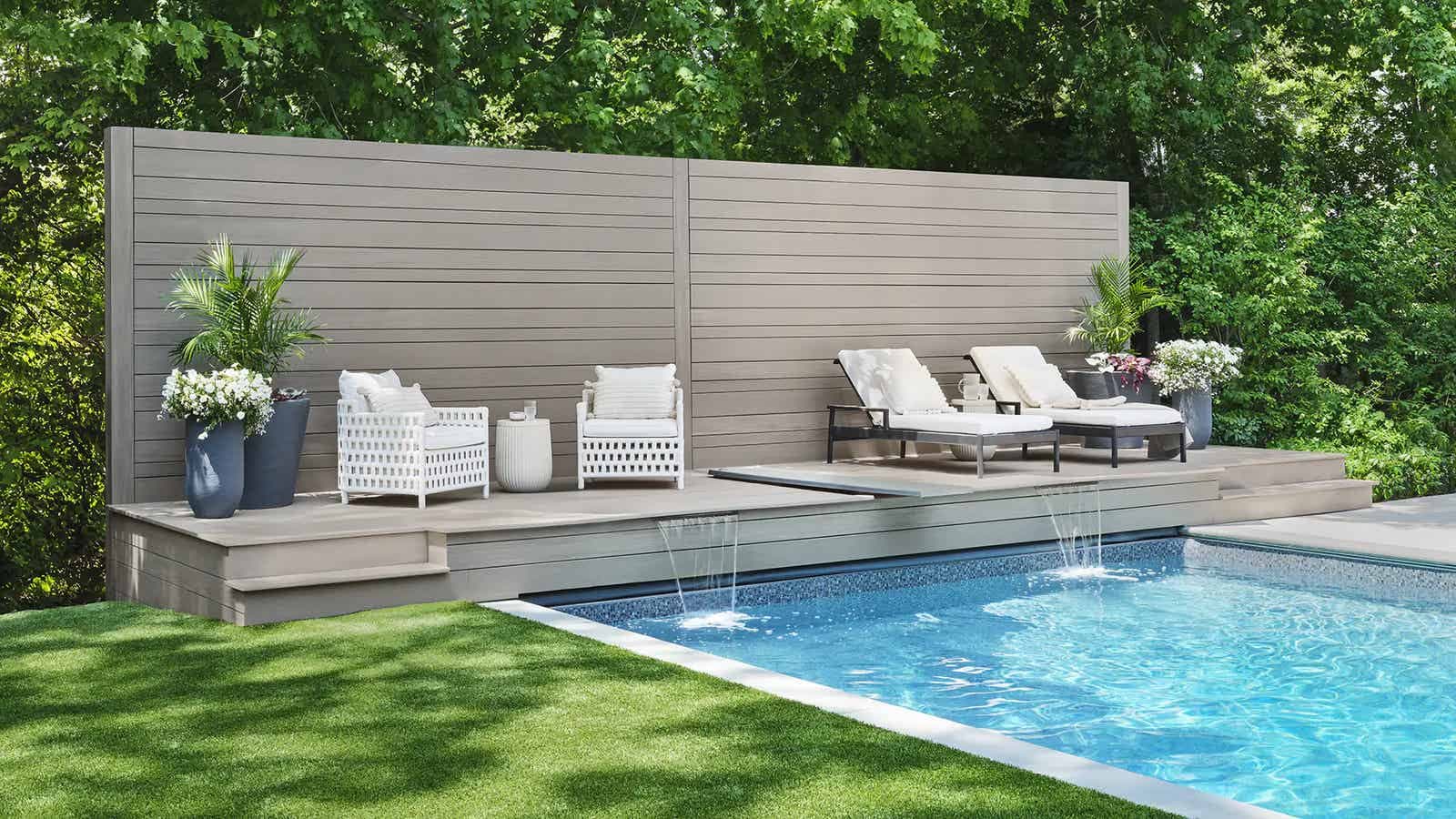
Why Consider PVC Decking for a Pool Terrace?
PVC decking is a 100% synthetic material, meaning it contains no wood fiber. This composition is a primary advantage for applications like pool terraces where boards are routinely wet. Unlike wood or even wood-composite materials, PVC boards are waterproof to the core, which means they are designed not to swell, stain, or rot when exposed to standing water, splash zones, or salt spray.
This inherent water resistance makes PVC decking a practical option for areas that will be constantly wet, such as around a swimming pool. The material is engineered to shed grease and wine, and it is designed to clean with soap and water, contributing to its low-maintenance profile.
Appearance and Design Options for PVC Pool Decks
Modern PVC decking offers a range of aesthetic choices, including collections designed to mimic the appearance of natural wood with varied grain patterns and color options. These advanced capped polymer boards feature deep wood looks, allowing for a refined finish around your pool.
When selecting PVC decking, consider the overall design of your outdoor space. Colors can range from light, heat-mitigating options to deeper tones. The availability of fascia and trim pieces allows for a coordinated and finished appearance, particularly important for visible edges around a pool. You can explore options like TimberTech Azek's Vintage, Landmark, and Harvest collections, which are designed to offer diverse aesthetic profiles.
Complementary products such as hardwood decking or composite decking can be used in other areas of your yard to create distinct zones, but for the immediate pool surround, PVC is often chosen for its specific performance characteristics.
Planning for St. Petersburg's Climate: Sun, Moisture, and Maintenance
St. Petersburg's climate presents specific challenges for outdoor materials, including intense sun exposure, high humidity, and frequent rain. PVC decking is designed to withstand these conditions due to its synthetic composition. The material's waterproof nature helps prevent issues like swelling or rot that can affect wood products in humid environments.
Maintenance is a key consideration for any pool area. PVC decking's capped polymer surface is designed to be easy to clean. Regular cleaning with soap and water can help maintain its appearance, which is particularly beneficial in a pool area where spills, sunscreen, and chlorine splashes are common. While PVC decking is known for its durability, understanding the specific cleaning recommendations for your chosen product is important for long-term care.
Some PVC decking lines offer heat-mitigating color options, which can be a valuable consideration in sunny Florida to help keep the surface cooler underfoot. It is always prudent to review product specifications for specific heat retention characteristics, as no decking material remains completely cool in direct sun.
Structural Considerations and Installation Basics
While PVC decking itself is waterproof, the underlying structure must still be planned for proper drainage and ventilation, especially in a humid climate. Ensure that your deck frame is built to local codes and allows for adequate airflow to prevent moisture buildup beneath the deck boards. This is crucial for the longevity of the entire assembly.
PVC decking boards are generally lighter than hardwood and some composite options, which can facilitate easier handling and installation. However, proper installation techniques, including correct board spacing and fastening methods, are essential to ensure the deck performs as intended. Always refer to the manufacturer's installation guidelines for specific details on fasteners and support requirements. Hidden fastener systems are often compatible with PVC boards, providing a clean, unblemished surface.
Worked Example: Calculating PVC Decking for a St. Petersburg Pool Terrace
Let's consider a hypothetical pool terrace project in St. Petersburg. Imagine you are planning a rectangular pool deck measuring 20 feet by 15 feet. This results in a total area of 300 square feet. For this example, we'll assume a standard PVC decking board size of 12 feet long and 5.5 inches wide.
First, convert the board width to feet: 5.5 inches / 12 inches/foot = 0.458 feet. The area of one board is 12 feet * 0.458 feet = 5.496 square feet. To cover 300 square feet, you would initially need approximately 300 / 5.496 = 54.59 boards. Since boards are purchased as full units, you would need to round up to 55 boards at a minimum.
However, this calculation only provides area coverage. You must also account for cuts, waste, and specific layout requirements. For a 20-foot length, you could use one 12-foot board and an 8-foot offcut (if available from another board cut, or a separate 8-foot board). For the 15-foot width, you'd lay boards side-by-side. If a board is 12 feet long, you'd need two cuts per board to get 10-foot lengths, leaving a 2-foot offcut. A more efficient plan might involve using the 12-foot boards for the full 12-foot dimension, and then cutting other boards to achieve the remaining 3-foot section, optimizing for minimal waste by aligning board lengths with deck dimensions. Always add a percentage for waste, typically 5-10%, depending on the complexity of the cuts and layout. For this project, a safer estimate would be 55 boards + 10% waste = 61 boards.
Remember to also factor in any picture-framing boards, fascia boards for the perimeter, and stair treads if your pool terrace includes steps. Each of these elements will require additional specific board lengths and profiles.
Before you order
- Confirm the exact dimensions of your pool terrace, including any irregular shapes or steps.
- Research local building codes for deck construction, especially around pools.
- Review specific manufacturer installation guides for your chosen PVC decking product.
- Consider the aesthetic impact of color and grain pattern on your overall outdoor design.
- Plan for proper drainage and ventilation beneath the deck surface.
- Account for fasteners, trim, and fascia boards in your material list.
- Factor in a waste percentage (typically 5-10%) for cuts and potential errors.
- Inquire about heat-mitigating color options suitable for St. Petersburg's sun exposure.
Confirm installation details, approved uses and warranty terms in the current instructions for the exact product and profile. Your installer should verify the substrate, structure and applicable project requirements.
This is a planning guide for projects in St. Petersburg, FL. Ask our team to confirm availability, delivery to your ZIP code and which branch can support your order.
Questions to help you decide
Is PVC decking slippery when wet, especially around a pool?
However, any wet surface can be slippery. It is always recommended to exercise caution around wet pool decks. Specific slip resistance ratings vary by product, so checking the manufacturer's specifications for your chosen PVC decking is advisable.
How does PVC decking hold up to chlorine and pool chemicals?
PVC decking is manufactured to be highly resistant to common household chemicals, including those typically found in pool water. Its synthetic nature means it is not prone to the staining or degradation that some wood products might experience from prolonged exposure to chlorinated water. However, it's always best to clean up spills promptly and avoid harsh, abrasive cleaners unless specifically approved by the decking manufacturer.
Can PVC decking be installed directly on a concrete slab around a pool?
Installing PVC decking directly on a concrete slab requires careful planning to ensure adequate drainage and ventilation. Typically, a sleeper system or a pedestal system is used to elevate the decking boards slightly above the concrete. This creates an air gap that allows water to drain away and prevents moisture from getting trapped, which is crucial for preventing issues like mold or mildew buildup in humid environments. Always follow the manufacturer's specific installation instructions for on-slab applications.
Ready to Plan Your St. Petersburg Pool Terrace with PVC Decking?
Request a material quote today. Provide your project dimensions, desired PVC decking profile, and your ZIP code to confirm current availability and service options for your project.
Request a material quote →